




2, 2- Dimethyloxirane can be cleaved by:
(A) Acid
(B) Water
(C) Bromine
(D) None of these
Answer
 Verified
292.2k+ views
Hint: The structure of 2, 2-dimethyloxirane contains a cyclopropane ring. 2, 2-Dimethyloxirane contains a heterocyclic ring in its structure. 2, 2-Dimethyloxirane also called as 1, 2-isobutylene oxide. The structure of 2, 2- Dimethyloxirane is as follows.
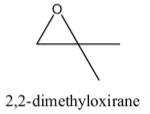
Complete step by step solution:-
-The ring strain is too high in cyclopropane rings when compared to cyclobutane, cyclopentane and cyclohexane.
-Because of ring strain in the structure of 2, 2-dimethyloxirane, it will undergo cleavage very easily.
-The cleavage of the 2, 2-dimethyloxirane is as follows.

-The mechanism of the cleavage of the 2, 2-dimethyloxirane is as follows.

-In the above mechanism we can see clearly that the ring cleavage is going to be initiated by an acid.
-In the first step the acid is going to form a bond with oxygen which is present in the ring and oxygen gets a positive charge because oxygen forms three bonds with the acid.
-Later the lone pair of electrons in the water molecule reacts with tertiary carbon atoms in the ring.
-Then the ring slowly destabilizes and the ring is going to cleave and forms an acyclic compound.
-Therefore the oxirane ring in 2, 2- dimethyloxirane is cleaved by the presence of an acid.
So, the correct option is A.
Note: Because of the presence of ring strain in the given molecule 2,2- dimethyloxirane, it undergoes ring cleavage easily with very small amounts of the acid. Cyclopropane has the highest strain in the ring of 114kJ/mol.
Complete step by step solution:-
-The ring strain is too high in cyclopropane rings when compared to cyclobutane, cyclopentane and cyclohexane.
-Because of ring strain in the structure of 2, 2-dimethyloxirane, it will undergo cleavage very easily.
-The cleavage of the 2, 2-dimethyloxirane is as follows.
-The mechanism of the cleavage of the 2, 2-dimethyloxirane is as follows.
-In the above mechanism we can see clearly that the ring cleavage is going to be initiated by an acid.
-In the first step the acid is going to form a bond with oxygen which is present in the ring and oxygen gets a positive charge because oxygen forms three bonds with the acid.
-Later the lone pair of electrons in the water molecule reacts with tertiary carbon atoms in the ring.
-Then the ring slowly destabilizes and the ring is going to cleave and forms an acyclic compound.
-Therefore the oxirane ring in 2, 2- dimethyloxirane is cleaved by the presence of an acid.
So, the correct option is A.
Note: Because of the presence of ring strain in the given molecule 2,2- dimethyloxirane, it undergoes ring cleavage easily with very small amounts of the acid. Cyclopropane has the highest strain in the ring of 114kJ/mol.
Recently Updated Pages
Atomic Structure JEE Main Mock Test 2026-27: Free Practice Online

JEE Main 2025-26 Mock Test: Classification of Elements & Periodicity
JEE Main Mock Test 2025-26: Free Practice, Analysis & Tips
JEE Main Mock Test 2026-27: Some Basic Concepts in Chemistry
Class 12 Chemistry Mock Test Series for JEE Main – Free Online Practice
Classification of Drugs in Chemistry: Types, Examples & Exam Guide
Trending doubts
JEE Main 2026: Exam Dates, Session 2 Updates, City Slip, Admit Card & Latest News
Understanding the Electric Field of a Uniformly Charged Ring
Understanding Atomic Structure for Beginners
Electron Gain Enthalpy and Electron Affinity Explained
Derivation of Equation of Trajectory Explained for Students
Understanding the Different Types of Solutions in Chemistry
Other Pages
NCERT Solutions For Class 12 Chemistry Chapter 2 Electrochemistry - 2026-27 Free PDF Download (Sign-in Required)
NCERT Solutions For Class 12 Chemistry Chapter 1 Solutions - 2026-27 Free PDF Download (Sign-in Required)
NCERT Solutions For Class 12 Chemistry Chapter 3 Chemical Kinetics - 2026-27 Free PDF Download (Login Required)
CBSE Notes Class 12 Chemistry Chapter 1 - Solutions - 2026-27 PDF Download (Login Required)
NCERT Solutions for Class 12 Chemistry Chapter 6 Haloalkanes and Haloarenes - 2026-27 Free PDF Download (Sign-In Required)
NCERT Solutions For Class 12 Chemistry Chapter 7 Alcohol Phenol And Ether - 2026-27 Free PDF Download (Login Required)
NCERT Solutions For Class 12 Chemistry Chapter 2 Electrochemistry - 2026-27 Free PDF Download (Sign-in Required)
NCERT Solutions For Class 12 Chemistry Chapter 1 Solutions - 2026-27 Free PDF Download (Sign-in Required)
NCERT Solutions For Class 12 Chemistry Chapter 3 Chemical Kinetics - 2026-27 Free PDF Download (Login Required)