






How the Y2K Bug Was Fixed and Why It Mattered Worldwide
The Y2K Bug, also known as the Year 2000 Problem, was a major computer issue that raised global concern as the world approached January 1, 2000. It was based on the fear that computers would fail or malfunction due to the way dates were stored in early computer systems. Governments, banks, airlines, hospitals, and businesses worldwide invested billions of dollars to prevent possible disruptions. Although the predicted global chaos did not occur, the Y2K Bug remains an important event in the history of technology and cybersecurity.
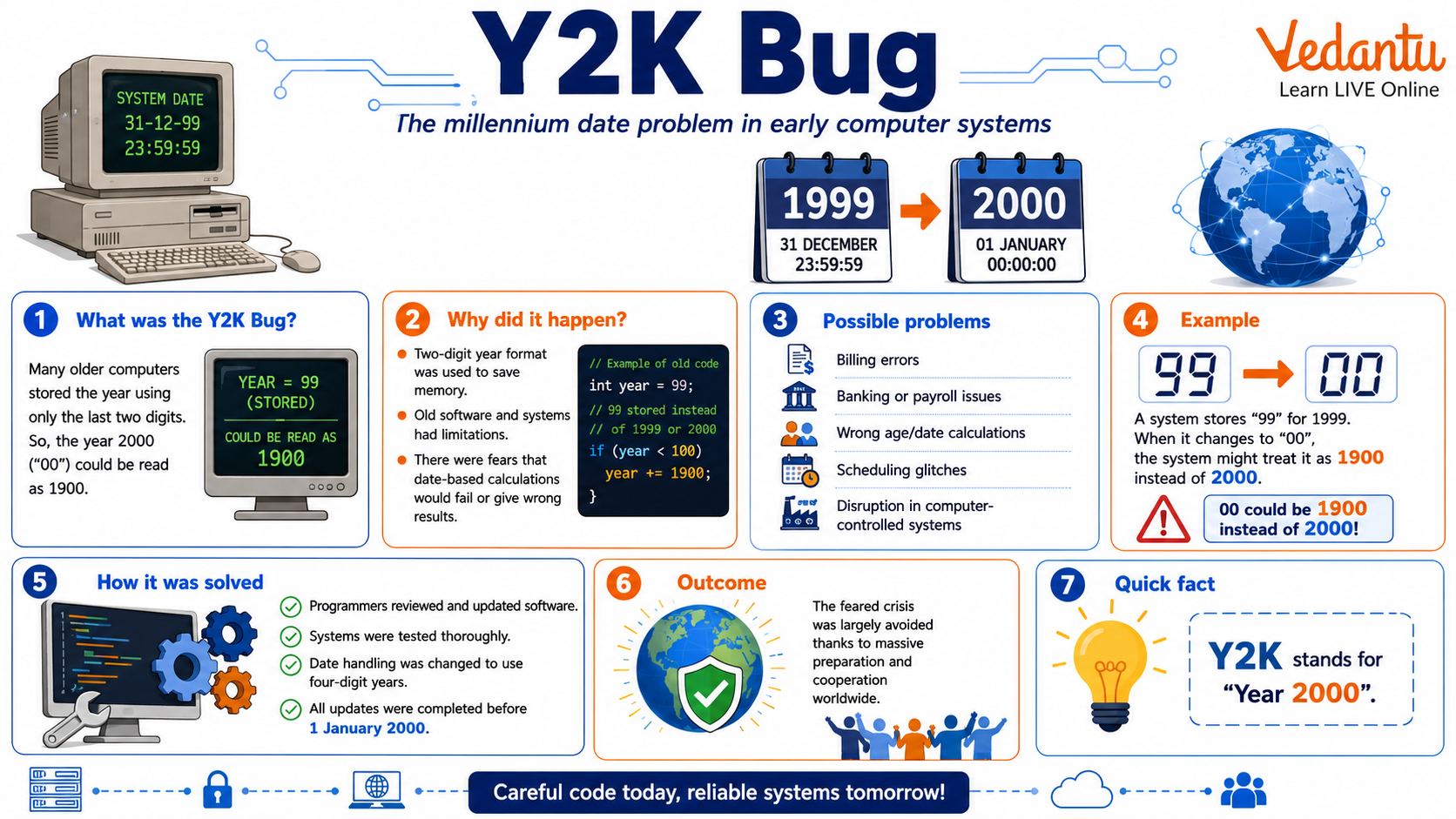
What Was the Y2K Bug?
The Y2K Bug was a computer programming issue related to date formatting. In early computer systems, years were often stored using only two digits instead of four. For example, 1998 was written as 98. This practice saved memory space when storage was expensive.
The problem was that when the year changed from 1999 to 2000, computers might interpret 00 as 1900 instead of 2000. This could cause errors in calculations, data processing, and system operations.
Why Two Digits Were Used
- Early computers had limited memory and storage capacity.
- Reducing the year from four digits to two saved valuable storage space.
- Programmers did not expect these systems to remain in use for decades.
Potential Risks of the Y2K Bug
Experts feared that if computers misinterpreted the year 2000 as 1900, it could lead to widespread technical failures. Many essential services depended heavily on computer systems.
- Banking systems could miscalculate interest and account balances.
- Airline reservation and navigation systems might malfunction.
- Power plants and utility systems could face operational disruptions.
- Healthcare equipment relying on date functions might produce errors.
- Government records and defense systems could be affected.
Global Preparations for Y2K
As awareness of the problem grew during the 1990s, governments and corporations began large-scale efforts to fix affected systems. This process involved reviewing millions of lines of code and updating software.
Steps Taken to Prevent Failure
- Identifying computer systems that used two-digit year formats.
- Rewriting and testing software code to support four-digit years.
- Upgrading outdated hardware and software.
- Conducting simulations to check for system reliability.
- Establishing emergency response plans for critical services.
Key Facts About the Y2K Bug
| Aspect | Details | Impact |
|---|---|---|
| Cause | Two-digit year storage | Risk of date misinterpretation |
| Time Period | Late 1990s concern | Global preparation efforts |
| Estimated Cost | Over 300 billion USD worldwide | System upgrades and fixes |
The large financial investment ensured that most critical systems were corrected before January 1, 2000. As a result, only minor issues were reported when the new millennium began.
What Actually Happened on January 1, 2000?
When the clock struck midnight on January 1, 2000, widespread system failures did not occur. Most systems functioned normally due to extensive preventive measures. A few minor glitches were reported, such as small billing errors and display issues, but there was no major global disruption.
The success in avoiding disaster demonstrated the importance of proactive planning, software testing, and international cooperation in managing technological risks.
Impact and Lessons Learned
The Y2K Bug became a landmark event in information technology history. It highlighted how deeply society depends on computer systems and digital infrastructure.
Major Lessons
- Long-term software planning is essential.
- Short-term cost-saving measures can create future risks.
- Regular system audits and updates are necessary.
- Global collaboration improves crisis management.
Y2K and Its Relevance Today
Although the Y2K Bug is now a historical event, it remains relevant in discussions about cybersecurity, software maintenance, and digital risk management. Similar concerns have appeared in later years, such as the Year 2038 problem, which affects certain computer systems using 32-bit time formats.
The Y2K experience serves as a reminder that technological systems must be designed with long-term sustainability and accuracy in mind. It also shows how global awareness and timely action can prevent potential disasters.
Conclusion
The Y2K Bug was a significant technological challenge that tested the preparedness of the global community at the turn of the millennium. Caused by the use of two-digit year formats in early computer systems, it posed serious potential risks to banking, aviation, healthcare, and government services. Due to extensive global efforts and preventive measures, the transition into the year 2000 occurred smoothly. The event remains an important case study in computer science, risk management, and global cooperation.
FAQs on Y2K Bug and the Millennium Computer Scare
1. What was the Y2K Bug?
The Y2K Bug was a computer programming issue that occurred because many systems stored years in two-digit formats, causing confusion at the year 2000 transition.
- Also known as the Year 2000 Problem or Millennium Bug
- Computers recorded years as “99” instead of “1999”
- When 2000 arrived, systems could interpret it as “1900”
- Created fears of system crashes in banking, aviation, and power sectors
- A major topic in computer history and IT crisis management
2. Why did the Y2K Bug happen?
The Y2K Bug happened due to early programming practices that saved memory by using two-digit year formats.
- Early computers had limited storage capacity
- Programmers used “YY” instead of “YYYY” to save space
- Example: 1998 stored as “98”
- In 2000, “00” could be misread as 1900
- Highlighted risks in legacy systems and outdated software
3. What problems were expected because of the Y2K Bug?
Experts feared that the Y2K Bug would disrupt critical global systems.
- Banking system errors and incorrect transactions
- Power grid and utility failures
- Air traffic control malfunctions
- Government and defense system breakdowns
- Concerns related to financial systems, embedded systems, and global infrastructure
4. How was the Y2K problem fixed?
The Y2K problem was fixed through massive global software updates and code corrections before January 1, 2000.
- Programmers updated date formats to four digits (YYYY)
- Governments formed special Y2K task forces
- Companies tested and replaced old systems
- Billions of dollars were spent worldwide
- A major example of IT modernization and risk prevention
5. Did the Y2K Bug cause major damage?
The Y2K Bug did not cause major global damage because preventive actions were taken in time.
- Minor glitches occurred in some systems
- No large-scale power failures or banking collapse
- Successful preparation reduced risks
- Considered a case study in crisis management and technology preparedness
6. Which countries were most affected by Y2K preparations?
Developed countries with advanced computer systems invested heavily in Y2K preparations.
- United States led major prevention efforts
- United Kingdom, Canada, and Japan upgraded systems
- India played a key role in global software services
- Highlighted global cooperation in information technology
7. What role did India play in solving the Y2K Bug?
India played a significant role by providing software professionals to fix Y2K-related code worldwide.
- Indian IT companies corrected legacy code
- Boosted growth of firms like TCS and Infosys
- Strengthened India’s position in the global IT industry
- Marked a turning point in software outsourcing
8. What lessons were learned from the Y2K Bug?
The Y2K Bug taught the importance of long-term planning and regular software updates.
- Avoid short-term coding shortcuts
- Maintain and upgrade legacy systems
- Conduct regular system testing
- Emphasized cybersecurity awareness and digital risk management
9. What is meant by legacy systems in relation to Y2K?
Legacy systems are outdated computer systems that were still in use during the Y2K period.
- Built using old programming languages like COBOL
- Stored dates in two-digit formats
- Difficult and costly to update
- Central to discussions about software maintenance and technology upgrades
10. Why is the Y2K Bug important in computer history?
The Y2K Bug is important because it was one of the largest global technology challenges ever managed successfully.
- Demonstrated global IT coordination
- Prevented potential economic disruption
- Encouraged modernization of computer systems
- Remains a key topic in computer science, millennium technology crisis, and digital transformation history
