






Gupta Dynasty Emperors: From Chandragupta I to Skandagupta Explained
The Gupta Dynasty Important Rulers form a significant chapter in Ancient Indian History. The Gupta Empire, which flourished between the 4th and 6th centuries CE, is often referred to as the Golden Age of India due to remarkable progress in administration, literature, science, art, and architecture. The rulers of this dynasty played a crucial role in political unification, cultural development, and economic prosperity. Understanding the important rulers of the Gupta Dynasty is essential for students and competitive exam aspirants as it forms a key part of General Knowledge and history syllabus.
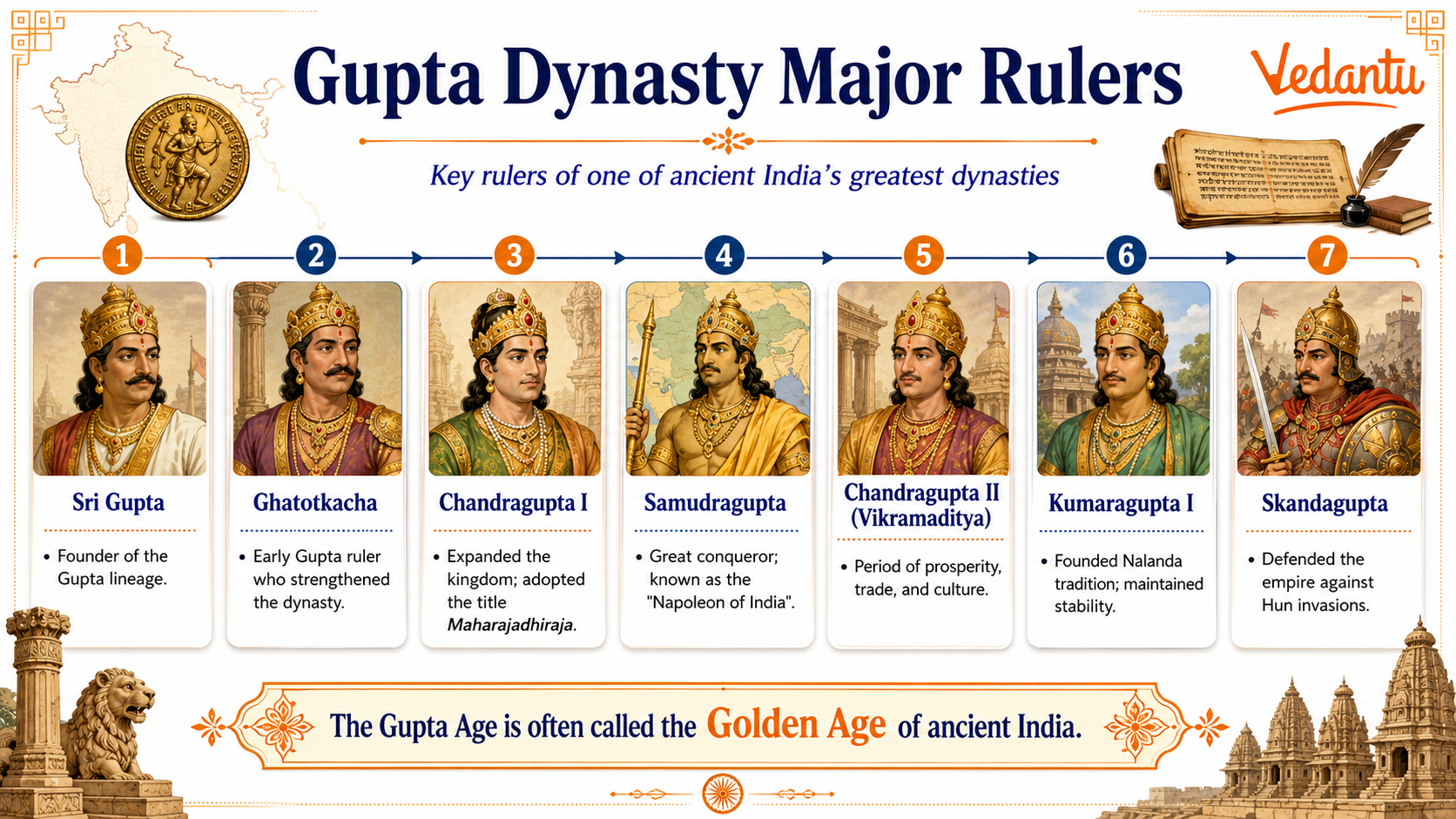
Overview of the Gupta Dynasty
The Gupta Dynasty was founded in the early 4th century CE in northern India. It gradually expanded its territory through military conquests and strategic alliances. The empire covered large parts of northern and central India at its peak. The dynasty is known for strong central administration, promotion of Hindu culture, and religious tolerance.
- Time Period - Approximately 320 CE to 550 CE
- Founder - Sri Gupta
- Capital - Pataliputra
- Known As - Golden Age of India
Important Rulers of the Gupta Dynasty
1. Sri Gupta
Sri Gupta was the founder of the Gupta Dynasty. Although not much detailed information is available about his reign, he laid the foundation of the empire in Magadha. He is believed to have ruled around 240 to 280 CE. His rule marked the beginning of Gupta authority in northern India.
2. Ghatotkacha
Ghatotkacha succeeded Sri Gupta and continued consolidating the small kingdom. He used the title Maharaja. His reign helped strengthen the base for future expansion under his successors.
3. Chandragupta I
Chandragupta I is considered the real founder of the Gupta Empire. He assumed the title Maharajadhiraja and expanded the kingdom significantly. His marriage alliance with Kumaradevi of the Lichchhavi clan strengthened his political position and increased his territory.
- Reign - Around 319 to 335 CE
- Started the Gupta Era in 319 CE
- Expanded control over Magadha and surrounding regions
4. Samudragupta
Samudragupta was one of the greatest rulers of the Gupta Dynasty. He is often called the Napoleon of India due to his extensive military campaigns. His achievements are recorded in the Allahabad Pillar Inscription composed by Harisena.
- Reign - Around 335 to 375 CE
- Expanded the empire through northern and southern expeditions
- Promoted art, literature, and music
- Issued gold coins with various designs
5. Chandragupta II
Chandragupta II, also known as Vikramaditya, further expanded and strengthened the Gupta Empire. His reign is considered the peak of the Gupta Golden Age. He defeated the Shakas and extended the empire to western India.
- Reign - Around 375 to 415 CE
- Defeated the Western Kshatrapas
- Period of cultural excellence with scholars like Kalidasa
- Chinese traveler Faxian visited during his reign
6. Kumaragupta I
Kumaragupta I maintained the vast empire built by his predecessors. He founded Nalanda University, which later became a famous center of learning. His reign saw internal stability but faced threats toward its end.
7. Skandagupta
Skandagupta was the last powerful ruler of the Gupta Dynasty. He successfully repelled the invasions of the Hunas, which posed a serious threat to the empire. However, after his reign, the empire gradually declined.
- Defeated the Hunas
- Faced economic challenges due to continuous wars
- Marked the beginning of decline after his rule
Gupta Dynasty Important Rulers Summary Table
| Ruler | Reign Period | Major Contribution |
|---|---|---|
| Sri Gupta | c. 240 to 280 CE | Founder of the dynasty |
| Chandragupta I | c. 319 to 335 CE | Expanded kingdom and began Gupta Era |
| Samudragupta | c. 335 to 375 CE | Major military conquests |
| Chandragupta II | c. 375 to 415 CE | Golden Age peak and defeat of Shakas |
| Skandagupta | c. 455 to 467 CE | Defeated Hunas |
The above table provides a quick revision of the Gupta Dynasty Important Rulers, their time period, and their key contributions. This summary is particularly helpful for competitive exams and quick general knowledge revision.
Why Gupta Dynasty Important Rulers Matter in GK
The Gupta rulers are frequently asked in competitive exams such as SSC, UPSC, State PSC, Banking, Railways, and other government exams. Questions are usually based on chronology, achievements, inscriptions, cultural developments, and foreign travelers.
- Identify the ruler associated with the Allahabad Pillar Inscription
- Match rulers with their achievements
- Arrange rulers in chronological order
- Recognize titles like Vikramaditya
Quick Revision Points
- Samudragupta - Known as Napoleon of India
- Chandragupta II - Golden Age peak
- Skandagupta - Defeated Hunas
- Faxian visited during Chandragupta II reign
- Gupta Era began in 319 CE
In conclusion, the Gupta Dynasty Important Rulers played a defining role in shaping ancient Indian civilization. Their administrative skills, military strength, and support for culture and learning made the Gupta period one of the most celebrated eras in Indian history. A clear understanding of these rulers helps build a strong foundation in General Knowledge and Ancient Indian History.
FAQs on Gupta Dynasty Major Rulers and Their Contributions
1. Who was the founder of the Gupta Dynasty?
The founder of the Gupta Dynasty was Sri Gupta, who established the dynasty around 240–280 CE in northern India.
• He laid the foundation of what later became the Golden Age of India.
• His rule marked the beginning of political stability after the Kushan Empire.
• The dynasty initially controlled parts of Magadha and Bengal.
This question is commonly asked in GK, UPSC, SSC, and other competitive exams under Ancient Indian History.
2. Why is Chandragupta I considered an important Gupta ruler?
Chandragupta I is considered important because he expanded the Gupta kingdom and assumed the title of Maharajadhiraja (King of Kings).
• Ruled from around 319–335 CE.
• Married a Lichchhavi princess, strengthening political alliances.
• Laid the foundation for Gupta imperial expansion.
His reign marked the real beginning of the Gupta Empire’s rise to power in northern India.
3. Who was Samudragupta and why is he called the Napoleon of India?
Samudragupta was one of the greatest rulers of the Gupta Dynasty, known for his extensive military conquests.
• Ruled from 335–375 CE.
• Expanded the empire across northern and central India.
• His achievements are recorded in the Allahabad Pillar Inscription.
• Called the “Napoleon of India” due to his military genius and victorious campaigns.
He also promoted art, culture, and religious tolerance during his reign.
4. What were the achievements of Chandragupta II (Vikramaditya)?
Chandragupta II, also known as Vikramaditya, led the Gupta Empire to its cultural peak.
• Ruled from 375–415 CE.
• Defeated the Shakas (Western Kshatrapas).
• Promoted literature, science, and art.
• His court included the famous Navaratnas (Nine Gems), including Kalidasa.
His reign is often associated with the Golden Age of Indian Civilization.
5. Who were the Navaratnas in the court of Chandragupta II?
The Navaratnas were nine eminent scholars in the court of Chandragupta II Vikramaditya.
• Included Kalidasa (poet and dramatist).
• Varahamihira (astronomer).
• Amarasimha (lexicographer).
• Dhanvantari (physician).
These scholars contributed to advancements in Sanskrit literature, astronomy, medicine, and mathematics during the Gupta period.
6. Why is the Gupta period called the Golden Age of India?
The Gupta Period is called the Golden Age of India because of remarkable achievements in art, science, literature, and administration.
• Development of decimal system and zero.
• Works of scholars like Kalidasa and Aryabhata.
• Growth of temple architecture and sculpture.
• Political stability and economic prosperity.
This era marked significant progress in Indian culture and civilization.
7. Who was Kumaragupta I and what were his contributions?
Kumaragupta I was a powerful Gupta ruler who maintained the empire’s stability.
• Ruled from 415–455 CE.
• Founded the famous Nalanda University (according to historical tradition).
• Successfully defended the empire from early invasions.
His reign is known for administrative efficiency and continued cultural development.
8. Who was Skandagupta and why is he significant?
Skandagupta was the last strong ruler of the Gupta Dynasty who protected India from foreign invasions.
• Ruled around 455–467 CE.
• Successfully repelled the Hun (Huna) invasions.
• Faced economic challenges due to continuous wars.
His efforts delayed the decline of the Gupta Empire in ancient Indian history.
9. What led to the decline of the Gupta Dynasty?
The decline of the Gupta Dynasty was caused by internal weakness and external invasions.
• Repeated attacks by the Huns (Hun invasions in India).
• Weak successors after Skandagupta.
• Economic instability and administrative breakdown.
• Rise of regional powers.
By the late 6th century CE, the once-powerful empire had fragmented.
10. What is the importance of the Allahabad Pillar Inscription in Gupta history?
The Allahabad Pillar Inscription is a key historical source for understanding Samudragupta’s reign.
• Composed by court poet Harishena.
• Describes military campaigns and conquests.
• Highlights administrative policies and diplomatic relations.
It is one of the most important epigraphic records of the Gupta Empire in Ancient Indian History.
