






Why World Day for International Justice Is Celebrated on 17 July
World Day for International Justice is observed every year on 17 July to promote international criminal justice and support the work of the International Criminal Court - ICC. The day highlights the importance of holding individuals accountable for serious crimes such as genocide, war crimes, crimes against humanity, and the crime of aggression. It encourages nations and citizens to strengthen global justice systems and uphold the rule of law at the international level.
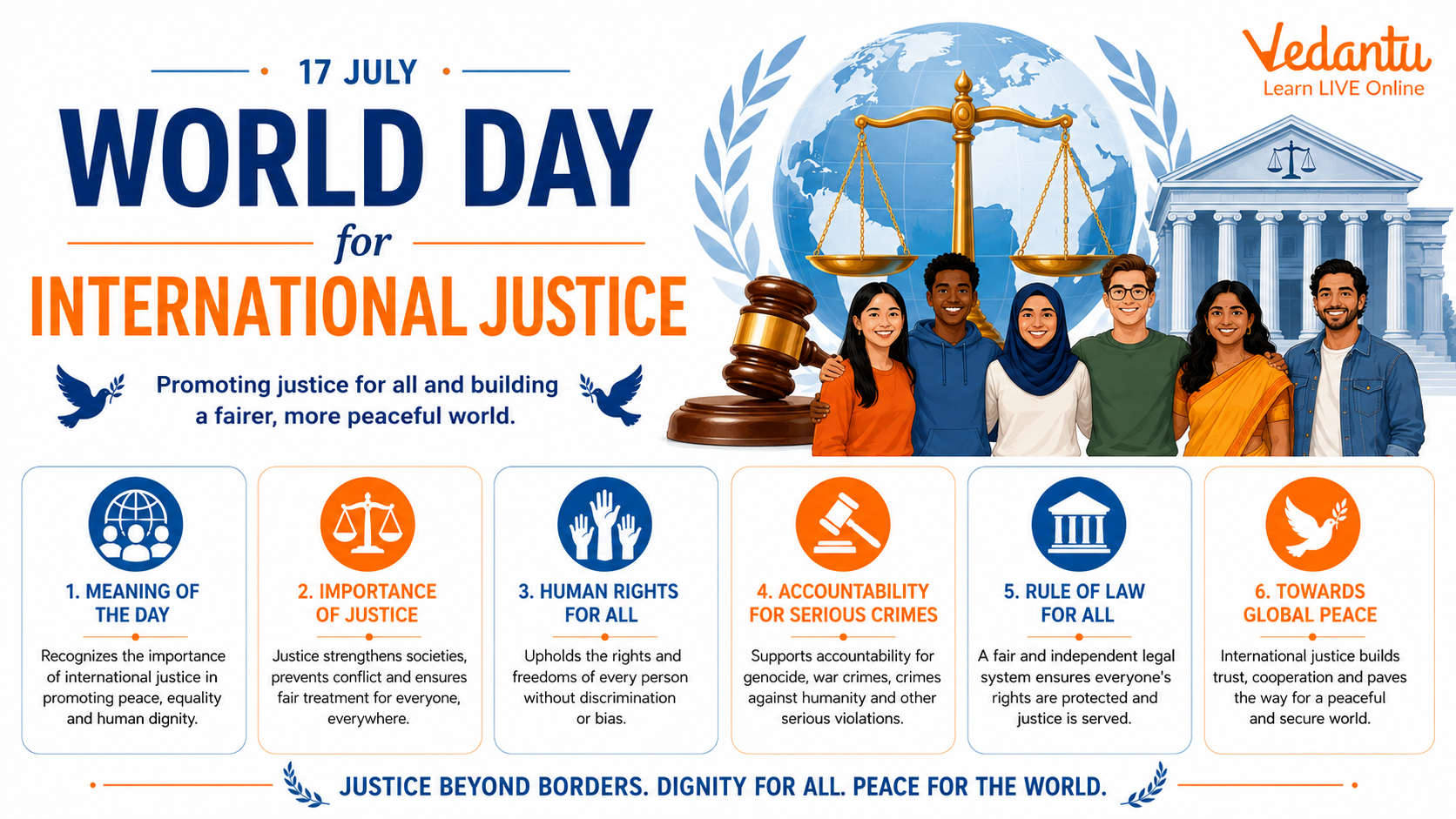
Why is World Day for International Justice Observed?
The day marks the adoption of the Rome Statute on 17 July 1998, which established the International Criminal Court. The Rome Statute is a treaty that gives the ICC the authority to prosecute individuals responsible for the most serious international crimes. The observance promotes justice for victims and reinforces the global commitment to accountability and human rights.
- To raise awareness about international criminal justice.
- To support victims of genocide, war crimes, and crimes against humanity.
- To promote peace, security, and the rule of law globally.
- To encourage countries to cooperate with the International Criminal Court.
History of World Day for International Justice
On 17 July 1998, representatives from 120 countries adopted the Rome Statute in Rome, Italy. This historic agreement led to the creation of the International Criminal Court. The ICC officially began functioning on 1 July 2002 after the required number of countries ratified the treaty. Since then, 17 July has been commemorated as World Day for International Justice to celebrate this milestone in global law.
About the International Criminal Court - ICC
The International Criminal Court is a permanent international court headquartered in The Hague, Netherlands. It prosecutes individuals, not states, who are accused of committing serious international crimes. The ICC acts only when national courts are unwilling or unable to prosecute offenders.
- Established: 2002
- Headquarters: The Hague, Netherlands
- Legal Basis: Rome Statute of the International Criminal Court
- Jurisdiction: Genocide, war crimes, crimes against humanity, and crime of aggression
Key Facts about World Day for International Justice
| Event Name | Date | Purpose |
|---|---|---|
| World Day for International Justice | 17 July | Promote global criminal justice |
| Adoption of Rome Statute | 17 July 1998 | Establishment of ICC |
The table above highlights the significance of 17 July as both the anniversary of the Rome Statute and the observance of World Day for International Justice. The day emphasizes accountability and global cooperation in delivering justice.
Crimes Covered under International Criminal Law
The International Criminal Court focuses on four main categories of crimes that threaten global peace and security. These crimes are defined under the Rome Statute.
- Genocide - Acts committed with intent to destroy a national, ethnic, racial, or religious group.
- Crimes against humanity - Widespread or systematic attacks against civilians.
- War crimes - Serious violations of the laws and customs of war.
- Crime of aggression - Planning or executing acts of aggression by a state against another state.
Importance for Students and Competitive Exams
World Day for International Justice is an important topic in General Knowledge, Current Affairs, Political Science, and International Relations. Questions related to the ICC, Rome Statute, headquarters, and jurisdiction often appear in competitive examinations.
- Remember the date - 17 July.
- Know the headquarters of ICC - The Hague.
- Understand the four major crimes under ICC jurisdiction.
- Be aware of the significance of the Rome Statute.
How is the Day Observed?
World Day for International Justice is observed through conferences, awareness campaigns, educational programs, and discussions organized by governments, international organizations, and civil society groups. These activities focus on strengthening international justice systems and ensuring accountability for serious crimes.
Conclusion
World Day for International Justice serves as a reminder that justice is essential for peace and stability in the world. By commemorating the adoption of the Rome Statute and supporting the International Criminal Court, the global community reaffirms its commitment to accountability, human rights, and the rule of law. For students and exam aspirants, understanding this day helps build awareness about international institutions and global governance.
FAQs on World Day for International Justice 2026 – History, Purpose and Significance
1. What is World Day for International Justice?
World Day for International Justice is an annual observance promoting global justice and accountability for serious crimes.
• Celebrated on 17 July every year
• Marks the adoption of the Rome Statute (1998)
• Supports the work of the International Criminal Court (ICC)
• Raises awareness about human rights, war crimes, genocide, and crimes against humanity
This day is also known as International Justice Day and highlights the importance of global peace and rule of law.
2. Why is World Day for International Justice celebrated on 17 July?
World Day for International Justice is observed on 17 July to commemorate the adoption of the Rome Statute in 1998.
• On 17 July 1998, 120 countries adopted the Rome Statute of the ICC
• The treaty established the International Criminal Court
• It created a permanent court to try individuals for serious international crimes
This date is significant in global legal history and is frequently asked in GK and competitive exams.
3. What is the Rome Statute?
The Rome Statute is the founding treaty that established the International Criminal Court (ICC).
• Adopted in Rome, Italy, in 1998
• Came into force on 1 July 2002
• Defines crimes like genocide, war crimes, crimes against humanity, and crime of aggression
• Signed and ratified by over 120 countries
The Rome Statute forms the legal basis of modern international criminal law.
4. What is the International Criminal Court (ICC)?
The International Criminal Court (ICC) is a permanent global court that prosecutes individuals for serious international crimes.
• Established in 2002 under the Rome Statute
• Headquarters located in The Hague, Netherlands
• Tries cases related to genocide, war crimes, and crimes against humanity
• Works independently from the United Nations (UN)
The ICC ensures accountability and promotes international justice and human rights protection.
5. What are the main objectives of World Day for International Justice?
The main objective of World Day for International Justice is to strengthen global efforts against impunity and injustice.
• Promote awareness of international law
• Support victims of human rights violations
• Encourage cooperation with the International Criminal Court
• Advocate for accountability in cases of war crimes and genocide
This day emphasizes global peace, fairness, and the rule of law.
6. Which crimes are prosecuted by the International Criminal Court?
The International Criminal Court prosecutes four major types of international crimes.
• Genocide – Acts intended to destroy a national, ethnic, racial, or religious group
• Crimes against humanity – Widespread attacks against civilians
• War crimes – Serious violations of the laws of war
• Crime of aggression – Use of armed force against another state
These crimes are central topics in international justice and global law.
7. How is World Day for International Justice observed worldwide?
World Day for International Justice is observed through awareness campaigns and educational programs globally.
• Seminars and workshops on human rights and international law
• Public discussions about the ICC and global justice
• Social media campaigns promoting justice and accountability
• Academic activities in schools and universities
These activities help spread knowledge about global peace and legal responsibility.
8. What is the importance of World Day for International Justice for students?
World Day for International Justice is important for students as it enhances understanding of global law and human rights.
• Frequently asked in General Knowledge (GK) and competitive exams
• Builds awareness about international organizations
• Encourages values of justice, equality, and peace
• Helps in subjects like Civics, Political Science, and History
It promotes responsible global citizenship among young learners.
9. Is the International Criminal Court part of the United Nations?
No, the International Criminal Court is independent but cooperates with the United Nations.
• Established by the Rome Statute, not by the UN
• Functions as an independent judicial institution
• Works with the UN Security Council in certain cases
• Maintains a cooperation agreement with the United Nations
This distinction is important in understanding global governance and international institutions.
10. What is the theme of World Day for International Justice?
World Day for International Justice does not have a fixed annual theme but focuses on strengthening global accountability.
• Emphasizes ending impunity for serious crimes
• Promotes justice for victims
• Supports the mission of the International Criminal Court (ICC)
• Encourages international cooperation in upholding human rights and rule of law
The observance consistently highlights the need for a fair and just international legal system.
