






Women Freedom Fighters of India in the Indian Independence Movement: Major Contributions and Stories
Women Freedom Fighters of India played a crucial role in the struggle against British colonial rule. Their courage, leadership, and sacrifices significantly contributed to India’s independence movement. From leading armed revolts to organizing protests, spreading awareness, and participating in civil disobedience movements, Indian women stood shoulder to shoulder with men in the fight for freedom. Their stories continue to inspire generations and form an important part of General Knowledge for students and competitive exam aspirants.
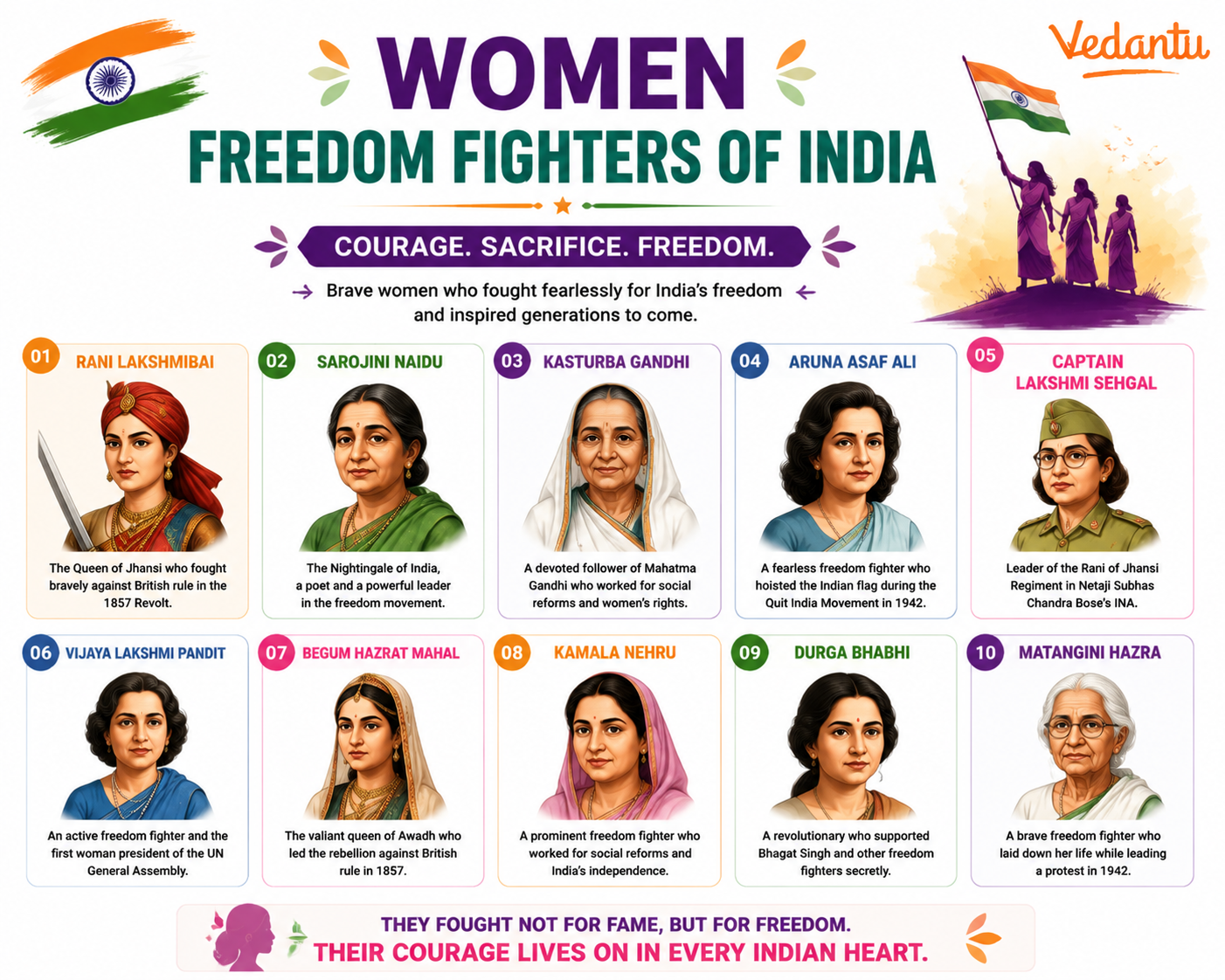
Introduction to Women Freedom Fighters of India
The participation of women in the Indian freedom struggle marked a significant turning point in Indian history. Despite social restrictions and traditional barriers, women actively joined movements such as the Revolt of 1857, Non-Cooperation Movement, Civil Disobedience Movement, and Quit India Movement. Their involvement not only strengthened the national movement but also paved the way for women empowerment in modern India.
Major Women Freedom Fighters of India
Prominent Women Freedom Fighters
| Name | Key Contribution | Movement or Period |
|---|---|---|
| Rani Lakshmibai | Led armed resistance against British in Jhansi | Revolt of 1857 |
| Sarojini Naidu | Led Civil Disobedience Movement and Salt Satyagraha | 1920s to 1940s |
| Begum Hazrat Mahal | Rebelled against British rule in Awadh | Revolt of 1857 |
| Aruna Asaf Ali | Hoisted Indian National Congress flag during Quit India Movement | 1942 |
| Kasturba Gandhi | Supported Gandhian movements and organized women | Non-Cooperation and Civil Disobedience |
| Usha Mehta | Ran underground radio during Quit India Movement | 1942 |
These women leaders played both direct and supportive roles in the freedom struggle. Some led armies into battle, while others organized protests, spread nationalist ideas, and endured imprisonment for the cause of independence.
Detailed Contributions of Key Leaders
Rani Lakshmibai of Jhansi
Rani Lakshmibai was one of the leading figures of the Revolt of 1857. She refused to surrender Jhansi to the British under the Doctrine of Lapse. Her bravery in battle and leadership qualities made her a symbol of resistance against British rule.
Sarojini Naidu
Known as the Nightingale of India, Sarojini Naidu was a prominent leader of the Indian National Congress. She participated in the Salt March and was later appointed as the first woman Governor of independent India. Her speeches motivated thousands to join the freedom movement.
Aruna Asaf Ali
Aruna Asaf Ali played a vital role during the Quit India Movement in 1942. She hoisted the Congress flag at the Gowalia Tank Maidan in Mumbai, which became a historic act of defiance against British authority.
Kasturba Gandhi
Kasturba Gandhi actively supported Mahatma Gandhi in various movements. She mobilized women to participate in protests and endured several imprisonments for the cause of freedom.
Roles Played by Women in the Freedom Struggle
Women contributed in multiple ways to the Indian independence movement. Their participation went beyond symbolic support and included active leadership and sacrifice.
- Leading armed revolts and participating in revolutionary activities.
- Organizing protests, marches, and public meetings.
- Spreading nationalist ideas through speeches and writings.
- Participating in Non-Cooperation and Civil Disobedience movements.
- Providing shelter and support to revolutionaries.
Importance in General Knowledge and Competitive Exams
Women Freedom Fighters of India form an important part of History and General Knowledge sections in competitive exams such as UPSC, SSC, Banking, State PSC, and other government exams. Questions are often asked about their contributions, associated movements, and historical significance.
Preparation Tips
- Learn key names along with their major contributions.
- Remember the movements associated with each leader.
- Focus on important years such as 1857 and 1942.
- Revise through tables and short notes for quick recall.
Legacy and Impact
The sacrifices of women freedom fighters not only helped India gain independence but also challenged social norms and expanded the role of women in public life. Their contributions laid the foundation for gender equality and inspired future generations to participate in nation building. Today, their stories are celebrated in textbooks, memorials, and national commemorations across India.
Conclusion
Women Freedom Fighters of India were pillars of the independence movement. Their bravery, leadership, and resilience strengthened the national struggle against British rule. Understanding their contributions is essential for students and exam aspirants, as it highlights the inclusive and collective nature of India’s fight for freedom. Their legacy continues to inspire courage, patriotism, and determination in modern India.
FAQs on Women Freedom Fighters of India and Their Role in Independence
1. Who were the most famous women freedom fighters of India?
The most famous Women Freedom Fighters of India played a crucial role in the Indian Independence Movement against British rule.
• Rani Lakshmibai – Leader of the Revolt of 1857
• Sarojini Naidu – Known as the Nightingale of India
• Kasturba Gandhi – Active participant in Non-Cooperation Movement
• Aruna Asaf Ali – Heroine of the Quit India Movement
• Usha Mehta – Organized secret Congress Radio
These women leaders are frequently asked in GK questions, competitive exams, and People Also Ask queries related to India’s freedom struggle.
2. What was the role of Rani Lakshmibai in the Revolt of 1857?
Rani Lakshmibai was a fearless queen who led armed resistance during the Revolt of 1857, also known as the First War of Indian Independence.
• Queen of Jhansi
• Fought against the British Doctrine of Lapse
• Died in battle in 1858
She became a symbol of bravery, women empowerment, and patriotism in Indian history.
3. Why is Sarojini Naidu important in Indian history?
Sarojini Naidu was a prominent freedom fighter and poet who contributed significantly to India’s independence movement.
• Known as the Nightingale of India
• First Indian woman President of the Indian National Congress (1925)
• First woman Governor of an Indian state (Uttar Pradesh)
She actively participated in the Civil Disobedience Movement and women’s rights advocacy.
4. What was the contribution of Kasturba Gandhi in the freedom struggle?
Kasturba Gandhi was an active supporter of Mahatma Gandhi and participated in major national movements.
• Took part in the Non-Cooperation Movement
• Participated in the Quit India Movement (1942)
• Promoted women’s education and social reforms
She is remembered as a key woman leader in India’s independence and social reform movements.
5. Who was Aruna Asaf Ali and why is she remembered?
Aruna Asaf Ali is remembered as the heroine of the Quit India Movement of 1942.
• Hoisted the Indian National Congress flag at Gowalia Tank Maidan
• Played a leading underground role during British suppression
• Awarded the Bharat Ratna (posthumously)
She symbolizes courage and resistance in modern Indian history.
6. What was the role of women in the Indian Independence Movement?
Women played a vital and multi-dimensional role in the Indian National Movement.
• Participated in protests, marches, and satyagraha
• Led revolutionary activities and underground movements
• Promoted swadeshi and boycott of British goods
• Spread awareness about freedom and social reforms
Their participation marked a major step toward women empowerment in India.
7. Who was Usha Mehta and what was Congress Radio?
Usha Mehta was a young freedom fighter who secretly operated Congress Radio during the Quit India Movement.
• Broadcast anti-British messages in 1942
• Spread news of nationalist activities
• Arrested and imprisoned by British authorities
Her contribution is often highlighted in GK and competitive exam questions on underground movements.
8. Which women freedom fighters were involved in revolutionary activities?
Several women participated in revolutionary and militant activities against British rule.
• Madam Bhikaji Cama – Hoisted Indian flag in Germany (1907)
• Kalpana Dutt – Member of Chittagong Armoury Raid
• Pritilata Waddedar – Revolutionary activist in Bengal
These women are often searched under revolutionary women leaders of India.
9. Why are women freedom fighters important for students and competitive exams?
Women freedom fighters are important because they are frequently asked in General Knowledge (GK), UPSC, SSC, and school exams.
• Questions on key leaders and movements
• Important dates like 1857, 1925, 1942
• Roles in Non-Cooperation and Civil Disobedience Movements
Understanding their contributions strengthens knowledge of Indian history and nationalism.
10. How did women freedom fighters promote women empowerment in India?
Women freedom fighters promoted women empowerment by breaking social barriers and leading national movements.
• Encouraged female participation in politics
• Advocated education and social reforms
• Challenged gender discrimination during British rule
Their legacy continues to inspire discussions on gender equality, leadership, and nation-building in modern India.
