






Blood Group A in Hindi – Traits, Compatibility, and Health Insights
Blood group type A is one of the major blood groups in the ABO blood grouping system. In Hindi, blood group type A is called "ए ब्लड ग्रुप" or "रक्त समूह A". This blood group is identified by the presence of A antigen on the surface of red blood cells and anti-B antibodies in the plasma. Understanding what blood group A means in Hindi is important for students, medical aspirants, and general readers, especially for topics related to biology, health, and competitive exams like NEET.
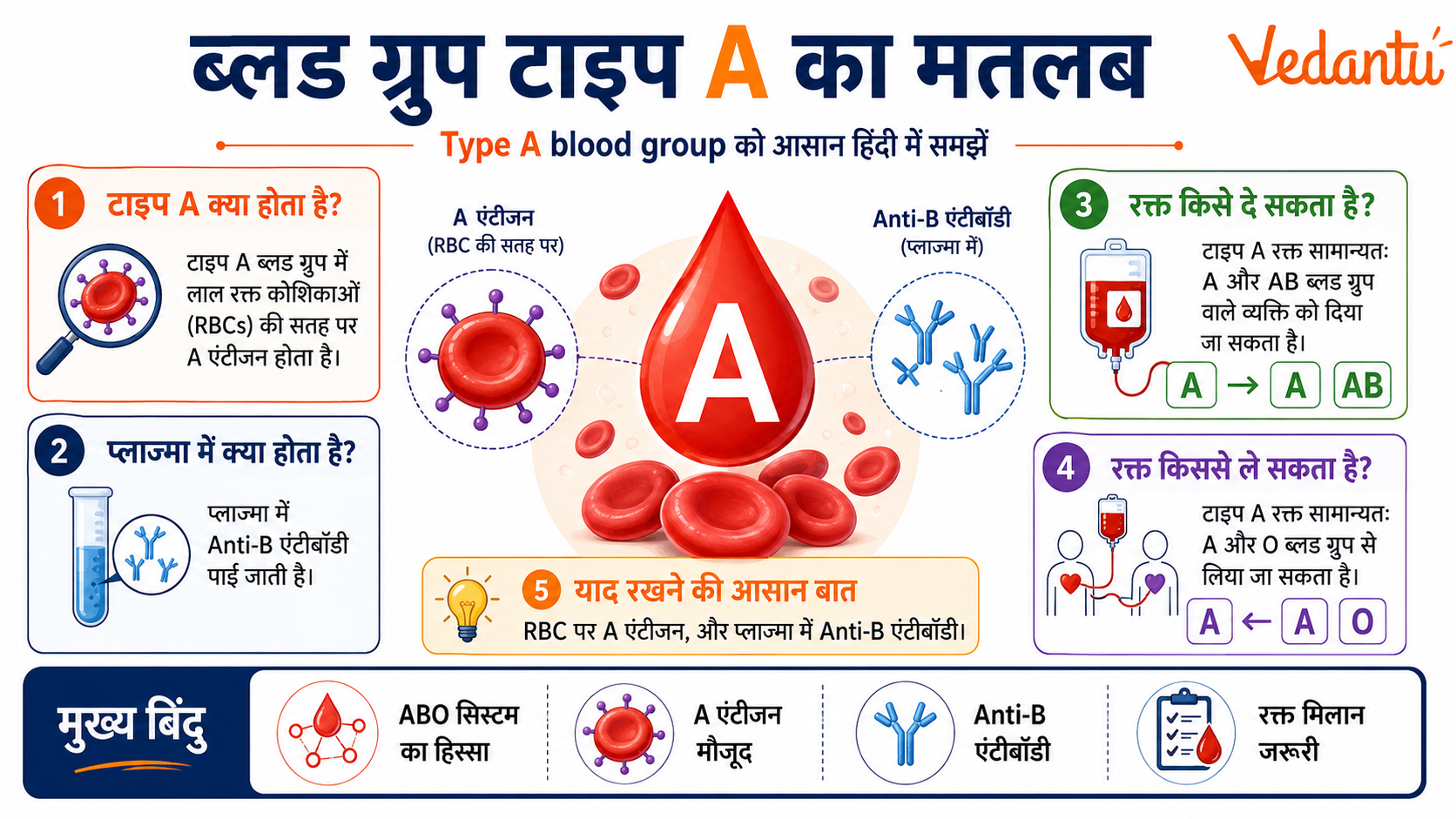
ए ब्लड ग्रुप (Blood Group A) का अर्थ
ए ब्लड ग्रुप वह रक्त समूह है जिसमें लाल रक्त कोशिकाओं की सतह पर A एंटीजन मौजूद होता है और प्लाज्मा में anti-B एंटीबॉडी पाई जाती है। ABO रक्त समूह प्रणाली के अनुसार, रक्त को मुख्य रूप से चार समूहों में बांटा जाता है - A, B, AB और O।
- A एंटीजन - लाल रक्त कोशिकाओं की सतह पर उपस्थित
- Anti-B एंटीबॉडी - प्लाज्मा में उपस्थित
- रक्त आधान के समय B या AB रक्त नहीं ले सकता
ABO रक्त समूह प्रणाली
ABO प्रणाली की खोज कार्ल लैंडस्टीनर ने 1901 में की थी। इस प्रणाली में रक्त समूह का निर्धारण लाल रक्त कोशिकाओं की सतह पर मौजूद एंटीजन के आधार पर किया जाता है। ए ब्लड ग्रुप इसी प्रणाली का एक महत्वपूर्ण भाग है।
ABO रक्त समूह का तुलनात्मक विवरण
| रक्त समूह | एंटीजन | एंटीबॉडी |
|---|---|---|
| A | A एंटीजन | Anti-B |
| B | B एंटीजन | Anti-A |
ऊपर दी गई तालिका से स्पष्ट है कि ए ब्लड ग्रुप में A एंटीजन और Anti-B एंटीबॉडी होती है। इसी आधार पर रक्त चढ़ाने की प्रक्रिया सुरक्षित रूप से की जाती है।
रक्त आधान में ए ब्लड ग्रुप की भूमिका
रक्त आधान यानी ब्लड ट्रांसफ्यूजन के समय सही रक्त समूह का मिलान करना बहुत आवश्यक होता है। यदि गलत रक्त समूह चढ़ा दिया जाए तो गंभीर प्रतिक्रिया हो सकती है।
ए ब्लड ग्रुप किससे रक्त ले सकता है?
- A समूह से
- O समूह से
ए ब्लड ग्रुप किसे रक्त दे सकता है?
- A समूह को
- AB समूह को
Rh फैक्टर और ए ब्लड ग्रुप
ए ब्लड ग्रुप को Rh फैक्टर के आधार पर दो भागों में बांटा जाता है - A सकारात्मक (A+) और A नकारात्मक (A-). यदि Rh फैक्टर उपस्थित है तो रक्त समूह A+ कहलाता है और यदि अनुपस्थित है तो A- कहा जाता है।
- A+ - A एंटीजन और Rh एंटीजन दोनों उपस्थित
- A- - केवल A एंटीजन उपस्थित
ए ब्लड ग्रुप का महत्व
ए ब्लड ग्रुप का महत्व चिकित्सा, आपातकालीन स्थितियों और सर्जरी में बहुत अधिक है। रक्तदान शिविरों में रक्त समूह की जांच अनिवार्य रूप से की जाती है। इसके अलावा, प्रतियोगी परीक्षाओं में ABO रक्त समूह से संबंधित प्रश्न अक्सर पूछे जाते हैं।
- रक्त आधान की सुरक्षा सुनिश्चित करता है
- आनुवंशिक अध्ययन में उपयोगी
- NEET और अन्य मेडिकल परीक्षाओं के लिए महत्वपूर्ण विषय
संक्षिप्त सार
ए ब्लड ग्रुप का अर्थ है ऐसा रक्त समूह जिसमें A एंटीजन मौजूद होता है और प्लाज्मा में Anti-B एंटीबॉडी पाई जाती है। इसे हिंदी में ए रक्त समूह कहा जाता है। यह ABO रक्त समूह प्रणाली का एक मुख्य भाग है और रक्त आधान में इसकी सही पहचान जीवन रक्षक सिद्ध होती है। छात्रों और प्रतियोगी परीक्षा अभ्यर्थियों के लिए यह विषय अत्यंत महत्वपूर्ण है।
FAQs on What Blood Group Type A Means in Hindi: Full Explanation for Students
1. What does Blood Group Type A mean in Hindi?
The meaning of Blood Group Type A in Hindi is "रक्त समूह A", which refers to a specific type of blood based on the presence of A antigens.
• In Hindi, it is called ब्लड ग्रुप ए or रक्त समूह ए.
• It contains A antigen on red blood cells.
• It has anti-B antibodies in the plasma.
• It is part of the ABO blood group system discovered by Karl Landsteiner.
• People also ask: What is A positive meaning in Hindi? What is A negative blood group?
2. What are the characteristics of Blood Group A?
Blood Group A is defined by the presence of specific antigens and antibodies in the blood.
• Contains A antigen on red blood cells (RBCs).
• Has anti-B antibodies in plasma.
• Can be A positive (A+) or A negative (A−) depending on Rh factor.
• Important in blood transfusion compatibility.
• Also searched as: features of blood group A, properties of A blood type.
3. What is the difference between A positive and A negative blood group?
The difference between A positive (A+) and A negative (A−) blood group lies in the presence of the Rh factor.
• A+ has the Rh factor (D antigen).
• A− does not have the Rh factor.
• A+ can receive blood from A+, A−, O+, and O−.
• A− can receive blood only from A− and O−.
• Common query: What is Rh factor in Hindi?
4. Who can donate blood to Blood Group A?
Blood Group A can receive blood from specific compatible groups based on the ABO system.
• A+ can receive from A+, A−, O+, O−.
• A− can receive from A− and O− only.
• Compatibility depends on ABO and Rh factor.
• Incorrect transfusion may cause immune reaction.
• People also search: blood compatibility chart, who can donate to A blood group.
5. Is Blood Group A rare or common?
Blood Group A is considered one of the most common blood types worldwide.
• It is the second most common after O group in many countries.
• Distribution varies by region and ethnicity.
• A+ is more common than A−.
• Blood group frequency is important for blood banks and transfusion services.
• Also asked: Which blood group is rarest?
6. What is the importance of Blood Group A in medical science?
Blood Group A plays a crucial role in safe blood transfusion and medical treatments.
• Helps determine donor-recipient compatibility.
• Important in organ transplantation.
• Used in pregnancy care for Rh compatibility.
• Essential in emergency medicine and surgery.
• Semantic keywords: ABO system, blood typing, medical importance of blood group.
7. How is Blood Group A identified?
Blood Group A is identified through a laboratory test called blood typing.
• A sample of blood is mixed with anti-A serum.
• If clumping (agglutination) occurs, it confirms A antigen presence.
• Tested along with anti-B and Rh serum.
• Usually done before blood donation or surgery.
• People also ask: How to check blood group at home?
8. What foods are recommended for Blood Group A?
According to the popular Blood Type Diet theory, certain foods are suggested for Blood Group A individuals.
• Emphasis on vegetarian diet.
• Includes fruits, vegetables, whole grains.
• Limited intake of red meat.
• Note: This diet theory is not scientifically proven.
• Also searched as: blood group A diet plan, A type food chart.
9. What problems can occur if Blood Group A receives wrong blood?
Receiving incompatible blood can cause a serious transfusion reaction.
• Anti-B antibodies attack B antigens.
• Causes fever, chills, kidney failure.
• May lead to life-threatening complications.
• Proper cross-matching prevents such risks.
• Common query: What happens in wrong blood transfusion?
10. Who discovered the ABO blood group system?
The ABO blood group system, including Blood Group A, was discovered by Karl Landsteiner in 1901.
• He identified A, B, and O blood groups.
• Later, AB group was discovered.
• He received the Nobel Prize in 1930.
• His discovery made safe blood transfusion possible.
• Also asked: When was blood group discovered?
