






Types of Balls Used in Cricket for Test, ODI, and T20 Matches
Cricket is one of the most popular sports in the world, and the type of ball used plays a crucial role in how the game is played. Different formats and conditions require different types of cricket balls. The ball's material, color, weight, and construction can affect swing, spin, bounce, and visibility. Understanding the types of balls used in cricket is important for students, sports enthusiasts, and competitive exam aspirants as it is a common General Knowledge topic. In this article, we will explore the main types of cricket balls, their features, and their uses in various formats of the game.
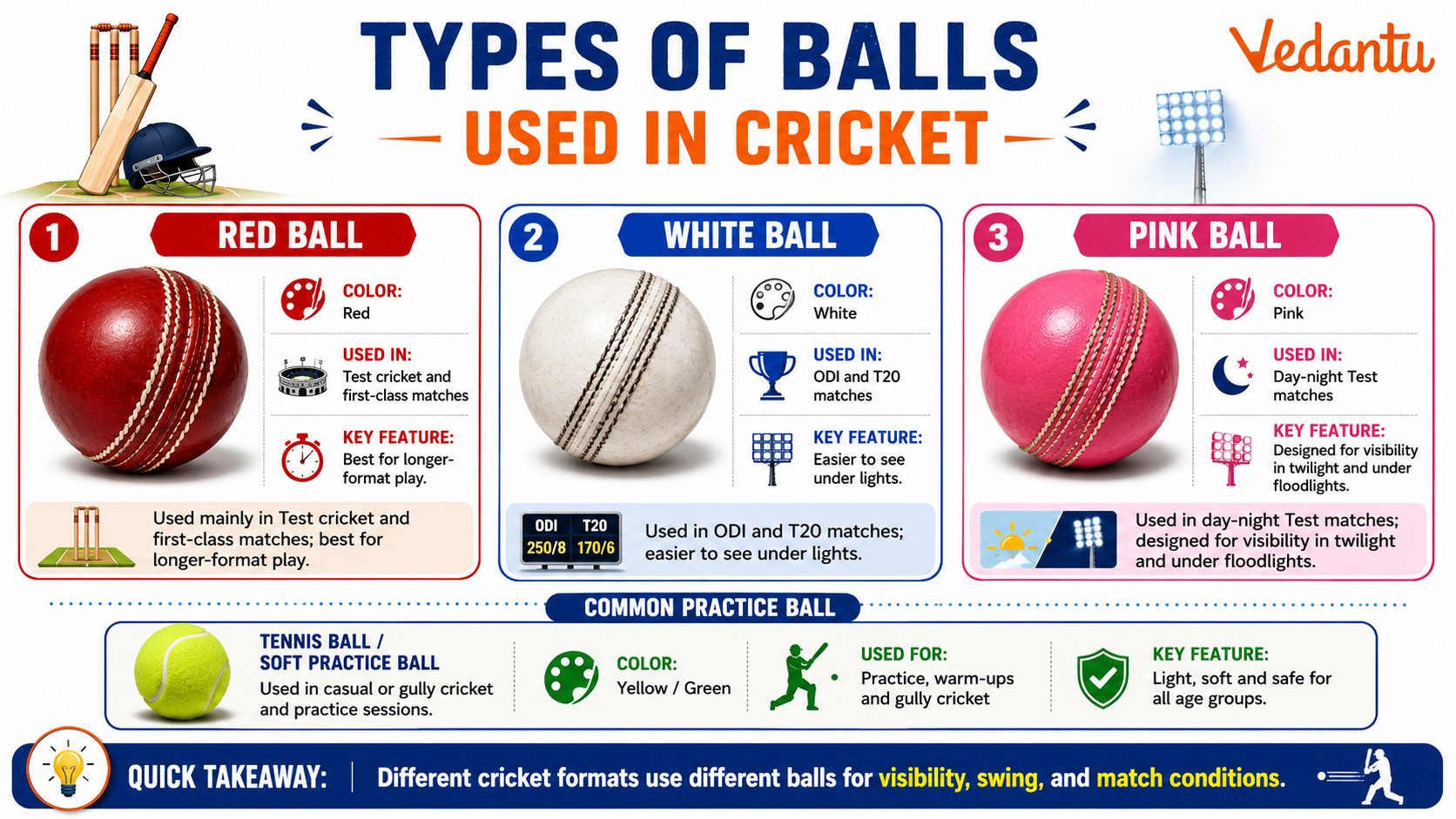
Main Types Of Balls Used In Cricket
Red Cricket Ball
The red cricket ball is the traditional ball used in cricket. It is mainly used in Test matches and first-class cricket. The red color provides better visibility in daylight conditions and is ideal for longer formats of the game.
- Used in Test matches and first-class matches
- Made of cork core wrapped in string and covered with leather
- Provides more swing and seam movement
- Remains hard for a longer duration
White Cricket Ball
The white cricket ball is mainly used in limited-overs formats such as One Day Internationals and T20 matches. The white color improves visibility under floodlights during day-night matches.
- Used in ODIs and T20 matches
- Easier to see under artificial lights
- Tends to swing more in the early overs
- Gets dirty and soft quicker than the red ball
Pink Cricket Ball
The pink cricket ball is used in day-night Test matches. It was introduced to improve visibility during evening sessions while maintaining the traditional format of Test cricket.
- Used in day-night Test matches
- Designed for better visibility under lights
- Has an extra layer of lacquer for shine retention
- Behaves slightly differently compared to red and white balls
Other Types Of Cricket Balls
Tennis Ball
A tennis ball is often used in street cricket and informal matches. It is lighter and softer than a professional leather cricket ball, making it safer for casual play.
Rubber Ball
Rubber balls are commonly used by beginners and children. They are affordable and durable but not suitable for professional cricket matches.
Practice Ball
Practice balls are specially designed for training sessions. These may include machine balls used in bowling machines or slightly cheaper leather balls for net practice.
Comparison Of Types Of Balls Used In Cricket
| Type Of Ball | Used In | Main Feature |
|---|---|---|
| Red Ball | Test Matches | Better for long duration and daylight play |
| White Ball | ODI and T20 | Visible under floodlights |
| Pink Ball | Day-Night Test | Visible in evening sessions |
Each type of cricket ball is designed to suit a specific format and playing condition. The color and coating of the ball affect its durability, swing, and visibility. Professional matches use leather balls with a cork core, while informal games may use tennis or rubber balls for safety and convenience.
Standard Specifications Of A Cricket Ball
According to international cricket rules, the weight and size of the ball are standardized to maintain fairness in the game. These specifications are important for competitive exams and sports awareness.
- Weight - 155.9 grams to 163 grams for men's cricket
- Circumference - 22.4 cm to 22.9 cm
- Made of cork core covered with stitched leather
- Prominent seam for swing and spin bowling
Why Different Balls Are Used In Cricket
Different formats of cricket have different playing conditions. Test matches last up to five days, while T20 matches are completed in a few hours. Lighting conditions, pitch behavior, and match duration all influence the choice of ball. Using the appropriate ball ensures fair competition, better visibility for players, and an improved viewing experience for spectators.
In conclusion, the types of balls used in cricket include the red ball, white ball, pink ball, and other informal variants like tennis and rubber balls. Each type has specific characteristics suited to particular formats and conditions. Understanding these differences enhances general knowledge and helps in competitive exam preparation as well as sports awareness.
FAQs on Types of Balls Used in Cricket: A Simple Student Guide
1. What are the different types of balls used in cricket?
The main types of cricket balls are used based on match format and playing conditions.
- Red Ball – Used in Test matches and first-class cricket.
- White Ball – Used in ODI and T20 matches (limited-overs cricket).
- Pink Ball – Used in Day-Night Test matches.
- Tennis Ball – Used in street or casual cricket.
- Leather Ball – Standard professional cricket ball made of cork core and leather cover. These types of balls in cricket differ in visibility, durability, and swing characteristics.
2. Why is the red ball used in Test cricket?
The red cricket ball is used in Test cricket because it lasts longer and performs well in daylight conditions.
- Offers better swing and seam movement over extended overs.
- Durable for up to 80 overs before replacement.
- Clearly visible in natural daylight.
- Preferred in traditional five-day matches. The red ball helps bowlers maintain consistent performance in longer formats.
3. Why is the white ball used in ODI and T20 matches?
The white cricket ball is used in limited-overs cricket for better visibility under floodlights.
- Easily visible during day-night matches.
- Used in ODI (One Day International) and T20 formats.
- Swings more in early overs but deteriorates faster.
- Two new balls are used in ODIs (one from each end). The white ball supports fast-paced formats and high-scoring games.
4. What is a pink ball in cricket?
The pink ball is specially designed for Day-Night Test matches to improve visibility under lights.
- Brighter color for better sight during evening sessions.
- Has extra lacquer coating for durability.
- Behaves similarly to the red ball but may offer more swing.
- Introduced to make Test cricket more spectator-friendly. The pink cricket ball balances visibility and traditional gameplay.
5. What material is a professional cricket ball made of?
A professional leather cricket ball is made using a cork core wrapped with string and covered in leather.
- Inner core: Cork for hardness.
- Middle layer: Tightly wound string for shape retention.
- Outer layer: Leather cover stitched with a prominent seam.
- Weighs between 155.9–163 grams (men’s cricket). The construction affects bounce, swing, and seam movement.
6. What is the difference between red, white, and pink cricket balls?
The difference between red, white, and pink cricket balls lies in color, durability, and match format usage.
- Red Ball – Used in Test matches, durable, better for daylight.
- White Ball – Used in ODIs/T20s, ideal under floodlights.
- Pink Ball – Used in Day-Night Tests, visible in both daylight and night.
- White ball deteriorates faster compared to red and pink balls. Each ball type suits specific playing conditions and formats.
7. How much does a cricket ball weigh?
A standard men’s cricket ball weighs between 155.9 grams and 163 grams as per ICC rules.
- Circumference: 22.4–22.9 cm.
- Women’s cricket ball: 140–151 grams.
- Junior cricket balls are lighter in weight.
- Weight consistency ensures fair play and standard performance. These measurements are defined by the International Cricket Council (ICC).
8. Which brands manufacture official cricket balls?
Several well-known brands manufacture official cricket balls used in international matches.
- Dukes – Used in England and West Indies.
- Kookaburra – Used in Australia, India, and many other countries.
- SG (Sanspareils Greenlands) – Used in India for Test matches.
- Each brand differs slightly in seam shape and swing behavior. These brands are approved for professional cricket formats.
9. What is a tennis ball in cricket?
A tennis ball in cricket is a lightweight rubber ball used for casual or street cricket.
- Made of rubber and felt material.
- Softer and safer than a leather ball.
- Common in gully cricket and school games.
- Does not provide professional swing or seam movement. It is popular for informal and recreational cricket matches.
10. How often is the cricket ball replaced in a match?
The cricket ball is replaced according to match format rules and condition.
- In Test cricket, a new ball is available after 80 overs.
- In ODIs, two new balls are used from the start (one from each end).
- In T20 matches, one new ball is used per innings.
- The umpire may replace a damaged ball. Ball replacement rules are governed by the ICC playing conditions.
