






Complete BSE Trading Holidays and Market Closure Dates
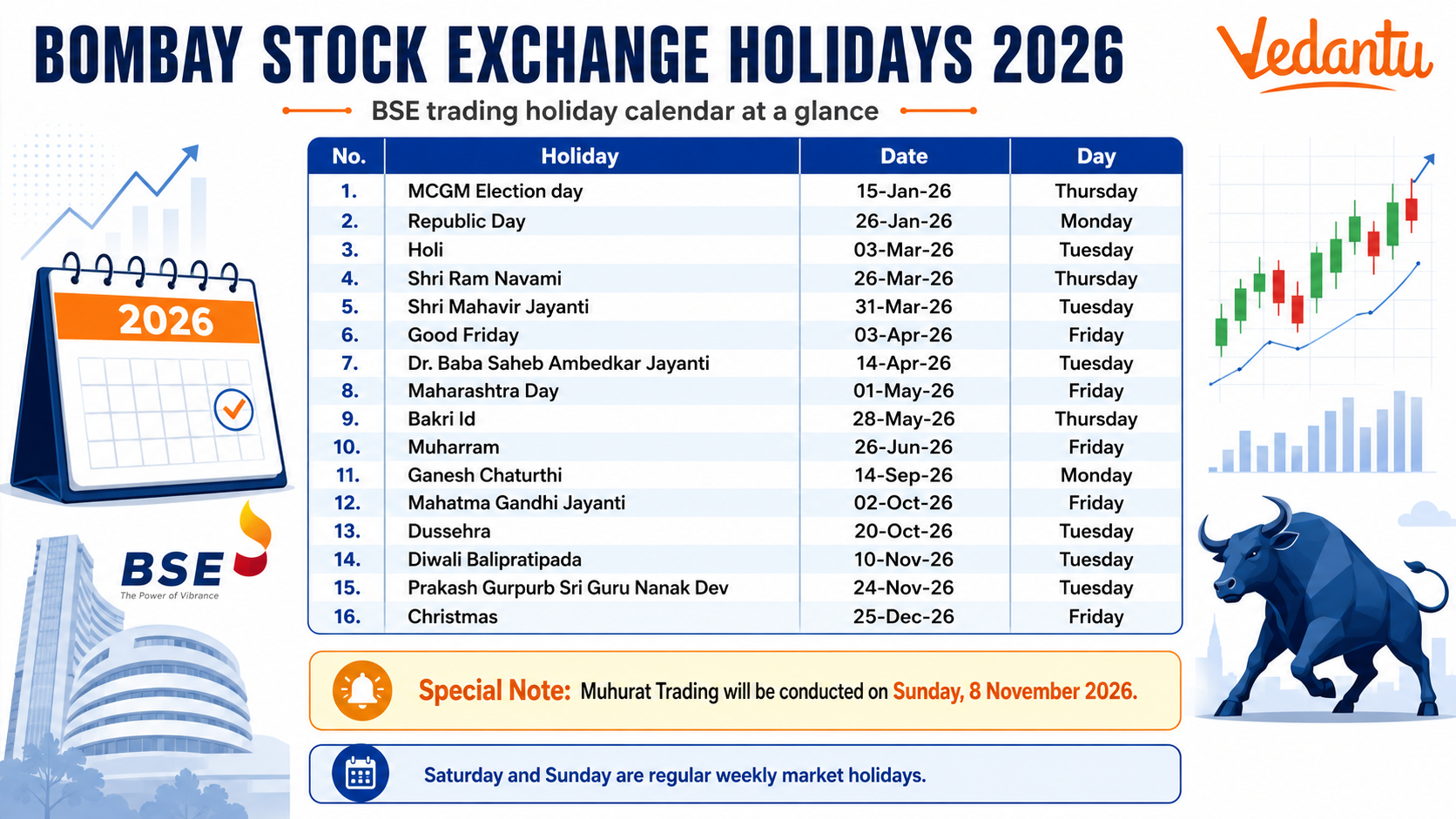
The Bombay Stock Exchange Holidays refer to the official trading holidays observed by the Bombay Stock Exchange - BSE, one of the oldest and most prominent stock exchanges in Asia. On these days, equity, equity derivatives, currency derivatives, and other trading segments remain closed for regular trading. Understanding BSE holidays is important for investors, traders, students preparing for competitive exams, and anyone interested in India’s financial markets. These holidays are declared in advance each year and generally align with national holidays and major Indian festivals.
About Bombay Stock Exchange - BSE
The Bombay Stock Exchange was established in 1875 and is headquartered in Mumbai, Maharashtra. It plays a crucial role in India’s capital market by providing a platform for trading equities, derivatives, debt instruments, mutual funds, and more. Trading on BSE takes place on weekdays from Monday to Friday, except on declared holidays.
- Established - 1875
- Headquarters - Mumbai, India
- Regulator - Securities and Exchange Board of India - SEBI
- Major Index - SENSEX
What Are Bombay Stock Exchange Holidays?
Bombay Stock Exchange Holidays are non-trading days when the exchange remains closed for regular sessions. On these days, investors cannot buy or sell securities through the exchange. Holidays are typically declared for:
- National holidays such as Republic Day and Independence Day
- Religious festivals like Diwali, Eid, and Christmas
- Public holidays declared by the Government of India
If a holiday falls on a weekend, there is generally no additional holiday observed on a weekday, unless specifically notified.
Indicative List of Common BSE Holidays
| Holiday | Occasion Type | Typical Month |
|---|---|---|
| Republic Day | National Holiday | January |
| Holi | Festival | March |
| Independence Day | National Holiday | August |
| Diwali - Laxmi Pujan | Festival | October or November |
| Christmas | Religious Holiday | December |
The exact list of holidays varies every year and is officially published by the Bombay Stock Exchange at the beginning of the calendar year. Investors should always refer to the latest official notification for accurate dates.
Special Case - Muhurat Trading
Although Diwali is a declared holiday, the BSE conducts a special trading session known as Muhurat Trading. This is a symbolic one-hour session held in the evening to mark the beginning of the Hindu financial year. Many investors consider trading during this session auspicious.
- Duration - Usually 1 hour
- Conducted on Diwali evening
- Applies to equity and equity derivatives segments
Trading Sessions on Regular Working Days
On non-holiday weekdays, BSE follows a structured trading schedule. Understanding this helps in differentiating between working days and holidays.
- Pre-opening session - 9:00 AM to 9:15 AM
- Regular trading session - 9:15 AM to 3:30 PM
- Post-closing session - 3:40 PM to 4:00 PM
If any of these sessions do not occur on a weekday, it is usually due to a declared exchange holiday.
Importance of Knowing BSE Holidays
For Investors and Traders
- Helps in planning trades and investment strategies
- Prevents confusion regarding order execution
- Assists in managing settlement cycles
For Students and Competitive Exams
Questions related to stock exchanges, financial markets, and regulatory bodies are commonly asked in banking, SSC, UPSC, and other competitive exams. Knowing about BSE holidays helps in understanding:
- Structure of Indian financial markets
- Role of SEBI and stock exchanges
- Differences between trading days and settlement days
Difference Between Weekend and BSE Holiday
The BSE remains closed every Saturday and Sunday. These are regular weekly offs and are not considered special exchange holidays. In contrast, BSE holidays are specific weekdays declared as non-trading days due to national or religious significance.
- Weekend - Fixed weekly closure on Saturday and Sunday
- Exchange Holiday - Declared closure on a weekday due to a specific occasion
How Are BSE Holidays Decided?
Bombay Stock Exchange holidays are decided in coordination with regulatory authorities and other financial market institutions. The exchange publishes an official holiday calendar at the beginning of each year. This ensures uniformity across different trading segments and synchronization with other exchanges like NSE.
Any changes or additional holidays are communicated through official circulars. Therefore, traders and financial institutions closely monitor exchange notifications.
Conclusion
Bombay Stock Exchange Holidays are officially declared non-trading days observed by the BSE in accordance with national holidays, major festivals, and government notifications. They play a vital role in the functioning of India’s capital markets by providing a structured trading calendar. For investors, understanding these holidays ensures better financial planning, while for students and exam aspirants, it strengthens knowledge of India’s financial system. Staying updated with the annual BSE holiday list is essential for effective participation in the stock market.
FAQs on Bombay Stock Exchange Holiday Schedule for Students
1. What are Bombay Stock Exchange holidays?
The Bombay Stock Exchange (BSE) holidays are official non-trading days when stock market activities remain closed in India.
- Declared annually by the BSE and NSE
- Include national holidays, religious festivals, and special trading holidays
- No trading in equity, derivatives, currency, and commodity segments
- Important for investors, traders, and competitive exam aspirants
2. Who decides the Bombay Stock Exchange holiday list?
The Bombay Stock Exchange (BSE) holiday list is decided by the exchange in coordination with regulatory authorities.
- Issued by BSE Limited
- Aligned with National Stock Exchange (NSE)
- Regulated under guidelines of SEBI (Securities and Exchange Board of India)
- Published at the beginning of each financial year
3. How many holidays does the Bombay Stock Exchange have in a year?
The BSE holiday list usually includes around 14–16 trading holidays each year.
- Includes major festivals like Diwali, Holi, Eid, Christmas
- National events such as Republic Day and Independence Day
- May vary slightly each year depending on calendar dates
4. Is the Bombay Stock Exchange closed on Saturdays and Sundays?
Yes, the Bombay Stock Exchange remains closed on all Saturdays and Sundays.
- Regular trading happens only from Monday to Friday
- Trading hours are typically 9:15 AM to 3:30 PM
- Weekends are considered non-trading days
5. What is Muhurat Trading on the Bombay Stock Exchange?
Muhurat Trading is a special one-hour trading session held on Diwali by the Bombay Stock Exchange.
- Symbolizes prosperity and new beginnings
- Conducted in the evening for a limited duration
- Considered auspicious by traders and investors
6. Are banks closed on Bombay Stock Exchange holidays?
Banks may or may not be closed on BSE holidays, depending on the type of holiday.
- National holidays usually affect both banks and stock markets
- Some regional holidays may apply only to exchanges
- Online banking services generally remain functional
7. Where can I check the official Bombay Stock Exchange holiday list?
The official Bombay Stock Exchange holiday list is available through authorized exchange announcements.
- Released annually by BSE India
- Published along with NSE trading holidays
- Updated before the start of the financial year
8. Does the Bombay Stock Exchange close for national emergencies?
Yes, the BSE can suspend trading during national emergencies or extraordinary situations.
- Decisions taken by BSE management in consultation with SEBI
- Examples include major disruptions or unforeseen events
- Public notice is issued before closure
9. Why are Bombay Stock Exchange holidays important for investors?
BSE holidays are important because they help investors plan their trading and investment strategies.
- Affects settlement cycles and transaction timelines
- Impacts intraday trading and derivatives expiry
- Helps in planning around market volatility
10. Are Bombay Stock Exchange holidays the same as NSE holidays?
Yes, the Bombay Stock Exchange (BSE) and National Stock Exchange (NSE) generally follow the same holiday schedule.
- Uniform holiday list for major trading segments
- Ensures consistency across Indian capital markets
- Applies to equity, derivatives, and currency segments
