






Which Are the Most Important Buddhist Monasteries Across India?
Buddhist monasteries in India are among the most significant spiritual and historical landmarks in the world. These monasteries served as centers of learning, meditation, art, and culture from ancient times. Many of them were established during the reign of great rulers like Emperor Ashoka and the Gupta kings. They played a vital role in spreading Buddhism across Asia. Today, these monasteries are important pilgrimage sites, tourist attractions, and symbols of India’s rich cultural heritage.
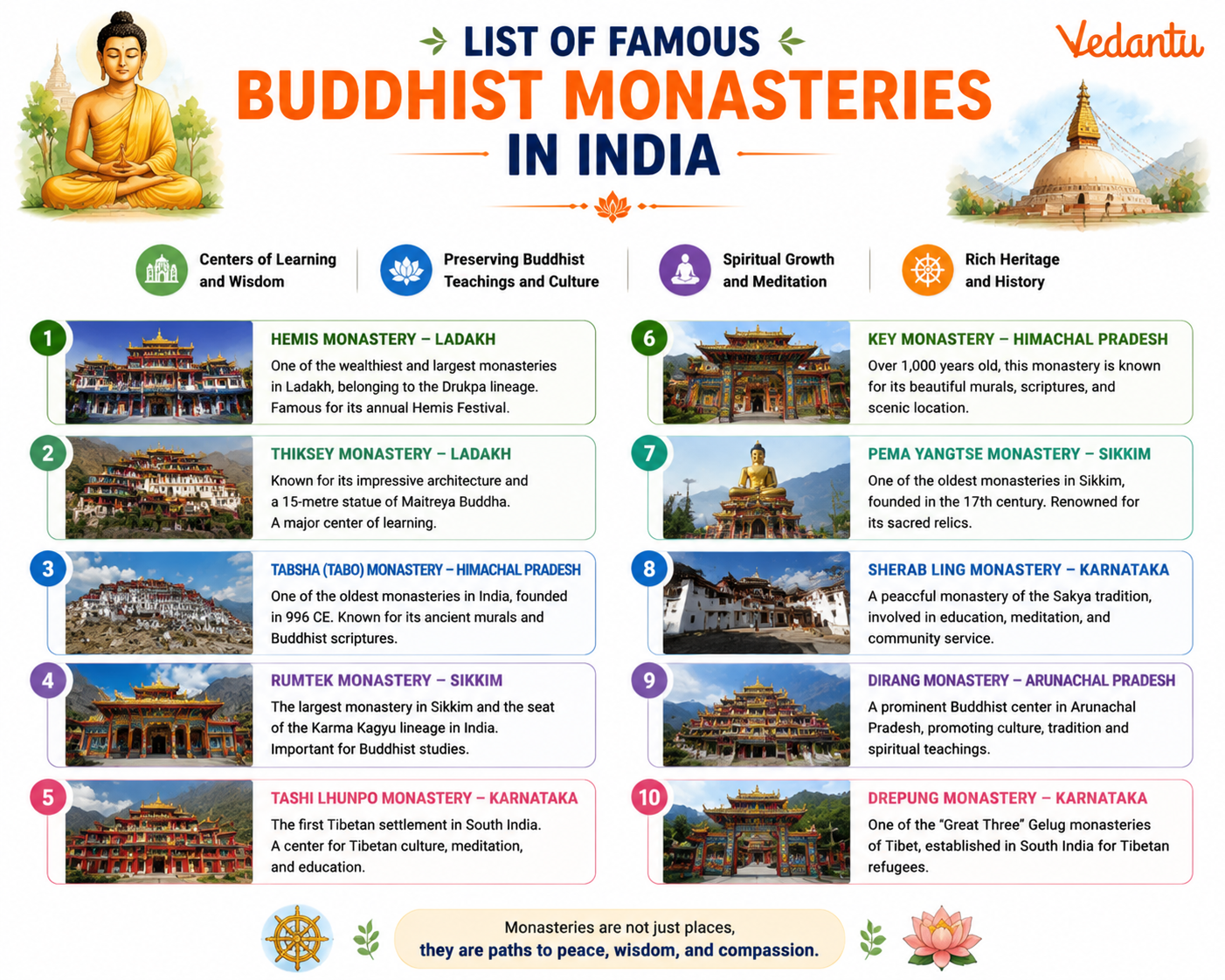
List Of Famous Buddhist Monasteries In India
Major Buddhist Monasteries In India
| Monastery | Location | Founded By / Period |
|---|---|---|
| Nalanda Mahavihara | Bihar | Gupta Period - 5th Century CE |
| Vikramashila Monastery | Bihar | Pala Dynasty - 8th Century CE |
| Tawang Monastery | Arunachal Pradesh | 1680-1681 CE |
| Hemis Monastery | Ladakh | 1672 CE |
| Rumtek Monastery | Sikkim | 16th Century - Rebuilt 1960s |
| Sanchi Monastery | Madhya Pradesh | 3rd Century BCE - Mauryan Period |
These monasteries represent different phases of Buddhist development in India, from ancient universities to Himalayan monasteries that continue to function as active centers of worship and learning.
Ancient Buddhist Monasteries
Nalanda Mahavihara
Nalanda was one of the world's first residential universities. Located in Bihar, it attracted students from China, Korea, Japan, Tibet, and Central Asia. Subjects such as philosophy, medicine, logic, and astronomy were taught here. The Chinese traveler Xuanzang studied and taught at Nalanda. It was destroyed in the 12th century but remains a UNESCO World Heritage Site.
Vikramashila Monastery
Founded by King Dharmapala of the Pala Dynasty, Vikramashila was another great center of Buddhist learning in Bihar. It specialized in Tantric Buddhism and had a large central stupa. The monastery contributed significantly to the spread of Buddhism in Tibet.
Sanchi Monastery
Sanchi, established during Emperor Ashoka's reign, is famous for its Great Stupa. Although primarily known for stupas, it also housed monastic complexes where monks lived and meditated. It reflects early Buddhist architecture and art.
Famous Himalayan Buddhist Monasteries
Tawang Monastery
Tawang Monastery in Arunachal Pradesh is the largest monastery in India and one of the largest in Asia. It belongs to the Gelugpa sect of Mahayana Buddhism. It houses a massive statue of Lord Buddha and serves as an important spiritual center for Tibetan Buddhists.
Hemis Monastery
Located in Ladakh, Hemis Monastery is famous for the annual Hemis Festival. It belongs to the Drukpa lineage of Tibetan Buddhism. The monastery is known for its rich collection of ancient relics, thangkas, and murals.
Rumtek Monastery
Rumtek Monastery in Sikkim is the main center of the Karma Kagyu sect in India. Originally built in the 16th century, it was reconstructed in the 1960s. It is a major pilgrimage site and a hub of Buddhist teachings.
Importance Of Buddhist Monasteries
- Centers of Education - Monasteries like Nalanda and Vikramashila functioned as universities.
- Spiritual Practice - Monks practiced meditation, prayer, and religious rituals.
- Cultural Exchange - Scholars from different countries visited these monasteries.
- Architectural Heritage - They showcase ancient Indian art, sculptures, and murals.
- Tourism and Pilgrimage - These monasteries attract thousands of visitors every year.
Key Facts For Competitive Exams
- Nalanda University is a UNESCO World Heritage Site.
- Tawang Monastery is the largest monastery in India.
- Vikramashila was established by King Dharmapala of the Pala Dynasty.
- Sanchi Stupa was commissioned by Emperor Ashoka in the 3rd century BCE.
- Hemis Monastery hosts the famous Hemis Festival in Ladakh.
Conclusion
The famous Buddhist monasteries in India reflect the country’s deep spiritual traditions and historical significance in the development of Buddhism. From ancient centers of higher learning like Nalanda and Vikramashila to majestic Himalayan monasteries such as Tawang and Hemis, these institutions played a crucial role in education, culture, and religion. Understanding these monasteries is important for students preparing for competitive exams and for anyone interested in Indian history and heritage.
FAQs on Famous Buddhist Monasteries in India – Complete Guide for Students
1. What are the most famous Buddhist monasteries in India?
The most famous Buddhist monasteries in India are historically and spiritually significant centers of learning and meditation.
• Tawang Monastery (Arunachal Pradesh) – Largest monastery in India
• Hemis Monastery (Ladakh) – Famous for Hemis Festival
• Rumtek Monastery (Sikkim) – Major Karma Kagyu center
• Thiksey Monastery (Ladakh) – Known for Maitreya Buddha statue
• Namdroling Monastery (Karnataka) – Golden Temple of Coorg
• Sanchi Monastery (Madhya Pradesh) – UNESCO World Heritage Site
• Mahabodhi Monastery (Bodh Gaya, Bihar) – Site of Buddha’s enlightenment.
2. Which is the largest Buddhist monastery in India?
The Tawang Monastery in Arunachal Pradesh is the largest Buddhist monastery in India and the second largest in the world.
• Founded in 1680–1681
• Belongs to the Gelugpa sect of Tibetan Buddhism
• Houses over 400 monks
• Major center of Mahayana Buddhism in Northeast India.
3. Why is Mahabodhi Monastery in Bodh Gaya important?
The Mahabodhi Monastery is important because it marks the place where Gautama Buddha attained enlightenment.
• Located in Bodh Gaya, Bihar
• Built near the sacred Bodhi Tree
• Recognized as a UNESCO World Heritage Site
• Major pilgrimage site for Buddhists worldwide.
4. Which Buddhist monasteries are located in Ladakh?
Ladakh is home to several famous Tibetan Buddhist monasteries known for their scenic and spiritual importance.
• Hemis Monastery – Largest monastery in Ladakh
• Thiksey Monastery – Resembles Potala Palace
• Diskit Monastery – Oldest in Nubra Valley
• Alchi Monastery – Known for ancient murals
• Lamayuru Monastery – One of the oldest in Ladakh.
5. What is the historical significance of Sanchi Monastery?
The Sanchi Monastery is historically significant as one of the oldest Buddhist sites in India.
• Commissioned by Emperor Ashoka in the 3rd century BCE
• Famous for the Great Stupa
• Features ancient Buddhist art and carvings
• Declared a UNESCO World Heritage Site.
6. Which Buddhist monastery is known as the Golden Temple in India?
The Namdroling Monastery in Karnataka is popularly known as the Golden Temple.
• Located in Bylakuppe, Coorg
• One of the largest Nyingma lineage centers
• Famous for golden statues of Buddha, Padmasambhava, and Amitayus
• Major Tibetan Buddhist settlement in South India.
7. Which is the oldest Buddhist monastery in India?
The Alchi Monastery in Ladakh is considered one of the oldest surviving Buddhist monasteries in India.
• Built in the 10th–11th century
• Known for Indo-Tibetan art style
• Houses ancient wall paintings and scriptures
• Important center of early Himalayan Buddhism.
8. What are the main sects associated with Buddhist monasteries in India?
Buddhist monasteries in India are associated with different schools of Buddhism.
• Mahayana Buddhism – Followed in Ladakh and Northeast India
• Theravada Buddhism – Practiced in some eastern regions
• Vajrayana Buddhism – Prominent in Himalayan monasteries
• Gelug, Nyingma, Kagyu sects – Tibetan traditions.
9. Why are Buddhist monasteries important for students and competitive exams?
Famous Buddhist monasteries in India are important for GK and competitive exams due to their cultural and historical relevance.
• Frequently asked in UPSC, SSC, State PSC exams
• Linked with Emperor Ashoka and ancient history
• Connected to UNESCO World Heritage Sites
• Important for questions on Indian religion and art.
10. Which Buddhist monastery is associated with the Hemis Festival?
The Hemis Monastery in Ladakh is famous for hosting the annual Hemis Festival.
• Celebrates the birth anniversary of Guru Padmasambhava
• Features colorful masked dances (Cham dance)
• Major attraction for tourists and pilgrims
• Important center of the Drukpa Kagyu sect.
