






Why the Bru-Reang refugee resettlement pact was signed and its key provisions
The Bru Reang Refugee Agreement is a significant humanitarian and political settlement between the Governments of India, Tripura, and Mizoram aimed at permanently resolving the long-standing displacement of the Bru or Reang tribal community. The issue began in 1997 when ethnic tensions in Mizoram forced thousands of Bru families to flee to neighboring Tripura. After more than two decades of living in relief camps, a historic agreement was signed in January 2020 to provide permanent settlement, financial assistance, and rehabilitation to the displaced families. The agreement is considered an important milestone in conflict resolution and tribal welfare in Northeast India.
Background of the Bru Reang Community
The Brus, also known as Reangs, are a tribal community primarily residing in the northeastern states of India such as Mizoram, Tripura, and parts of Assam. In Mizoram, they are recognized as a Scheduled Tribe. Tensions arose in 1997 following ethnic clashes between the Mizos and the Brus, leading to large-scale displacement.
- In 1997, ethnic violence broke out in Mizoram.
- Around 30,000 to 37,000 Bru people fled to North Tripura.
- They were housed in temporary relief camps for over two decades.
- Multiple repatriation attempts between 2009 and 2019 had limited success.
Need for the Agreement
The prolonged stay of Bru refugees in relief camps created humanitarian, economic, and administrative challenges. Lack of permanent settlement affected their access to education, healthcare, and employment. The situation required a comprehensive solution acceptable to all stakeholders.
Major Concerns
- Poor living conditions in relief camps.
- Limited livelihood opportunities.
- Citizenship and identity issues.
- Interstate administrative challenges between Mizoram and Tripura.
Bru Reang Refugee Agreement 2020
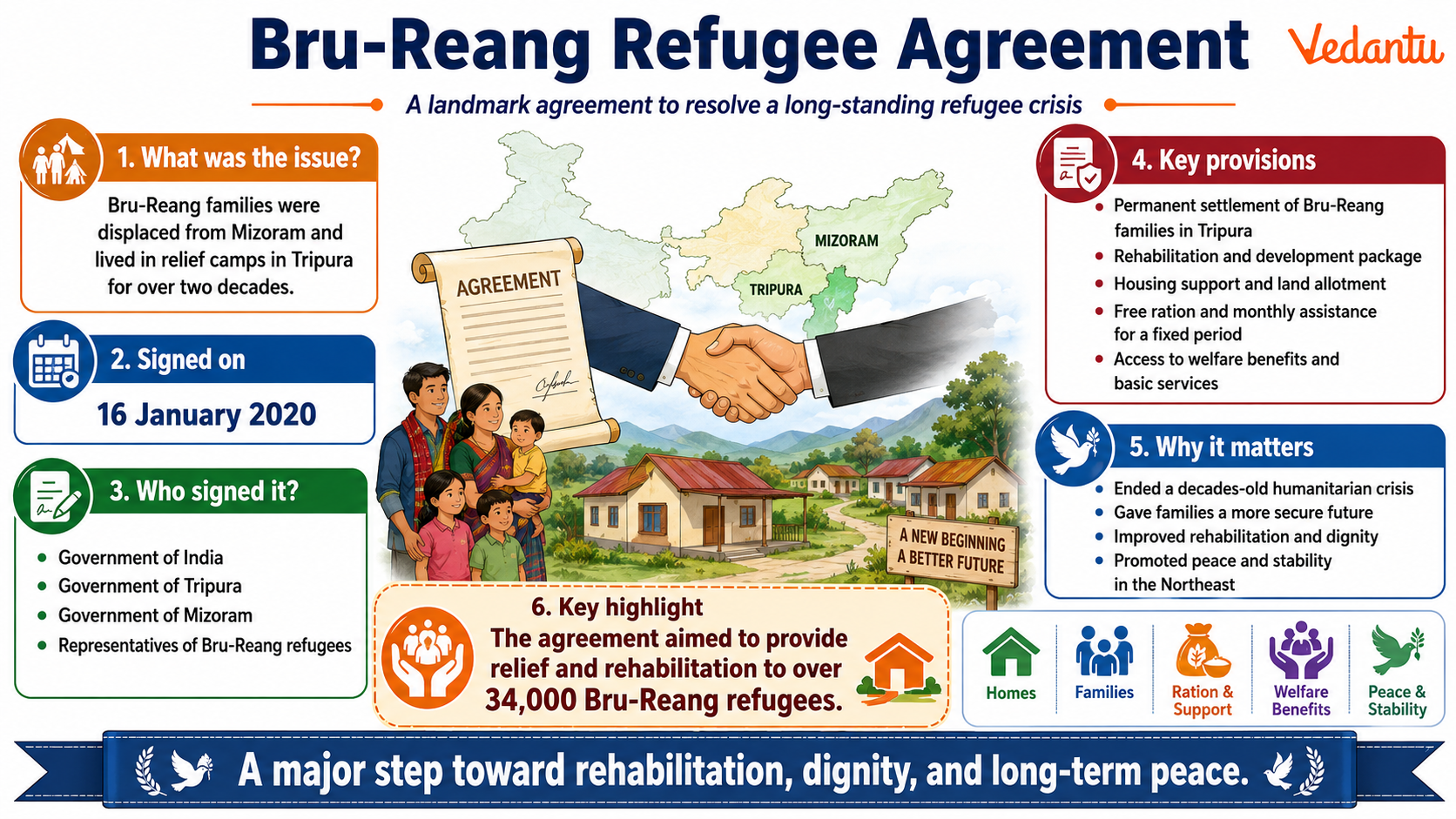
On 16 January 2020, a quadripartite agreement was signed between the Government of India, Government of Tripura, Government of Mizoram, and Bru representatives. The agreement aimed to permanently settle Bru refugees in Tripura instead of repatriating them to Mizoram.
Key Provisions of the Agreement
- Permanent settlement of Bru families in Tripura.
- Financial assistance of Rs 4 lakh as a fixed deposit for each family.
- Monthly cash assistance of Rs 5,000 for two years.
- Free ration for two years.
- Allotment of residential plots.
- Assistance for house construction.
Key Facts About the Bru Reang Refugee Agreement
| Aspect | Details | Year |
|---|---|---|
| Initial Displacement | Ethnic violence in Mizoram | 1997 |
| Final Agreement Signed | Quadripartite settlement | 2020 |
| Beneficiary Families | Approximately 34,000 people | 2020 |
The 2020 agreement is considered one of the largest rehabilitation packages for internally displaced people in Northeast India. It marked a shift from temporary relief measures to a permanent rehabilitation approach.
Significance of the Agreement
The Bru Reang Refugee Agreement has social, political, and administrative importance. It demonstrates cooperative federalism and commitment to tribal welfare and peace-building in conflict-prone regions.
- Resolved a 23-year-old humanitarian crisis.
- Strengthened inter-state cooperation.
- Improved living standards of displaced families.
- Promoted stability in Northeast India.
Challenges in Implementation
Despite the agreement, certain challenges remain in the implementation phase. These include land allocation, integration with local communities, and ensuring sustainable livelihoods for the beneficiaries.
- Identification and allocation of suitable land.
- Ensuring employment opportunities.
- Maintaining social harmony between communities.
Importance for Competitive Exams
The Bru Reang Refugee Agreement is an important topic for General Knowledge and current affairs sections of competitive examinations. Questions may focus on the year of agreement, parties involved, financial provisions, and its significance in federal governance.
Preparation Tips
- Remember the year 2020 as the landmark settlement year.
- Understand the reason for displacement in 1997.
- Focus on the financial and rehabilitation provisions.
- Note the role of cooperative federalism in the agreement.
Conclusion
The Bru Reang Refugee Agreement of 2020 stands as a landmark humanitarian settlement in India’s Northeast region. By providing permanent settlement, financial security, and rehabilitation support, the agreement ended decades of uncertainty for thousands of displaced families. It highlights the importance of dialogue, cooperation, and inclusive development in resolving ethnic conflicts and ensuring long-term peace and stability.
FAQs on Bru-Reang Refugee Agreement: Background, Terms and Significance
1. What is the Bru-Reang Refugee Agreement?
The Bru-Reang Refugee Agreement is a 2020 tripartite settlement that permanently rehabilitated displaced Bru (Reang) families in Tripura.
• Signed on 16 January 2020
• Parties involved: Government of India, Tripura Government, Mizoram Government, and Bru representatives
• Aimed to resolve the long-pending Bru refugee crisis that began in 1997
• Provided financial assistance, land, and citizenship rights
This agreement ended over two decades of displacement and is considered a landmark in India’s internal refugee rehabilitation efforts.
2. Who are the Bru or Reang people?
The Bru (Reang) are an indigenous tribal community primarily living in Tripura, Mizoram, and Assam.
• Recognized as a Particularly Vulnerable Tribal Group (PVTG) in Tripura
• Speak the Bru language (Tibeto-Burman family)
• Follow a distinct cultural and social identity
• Faced ethnic tensions in Mizoram in the 1990s
They are often discussed in topics related to ethnic conflict, internal displacement, and tribal rights in Northeast India.
3. Why did the Bru-Reang refugee crisis begin?
The Bru-Reang refugee crisis began in 1997 due to ethnic violence and political tensions in Mizoram.
• Conflict between Bru tribals and Mizo groups
• Demand for Autonomous District Council by Bru organizations
• Violence following the killing of a forest official
• Over 30,000 Bru people fled to relief camps in Tripura
This event led to one of the longest-running internal displacement issues in India.
4. What are the key features of the 2020 Bru-Reang Agreement?
The 2020 agreement provided a comprehensive rehabilitation package for Bru refugees.
• ₹4 lakh fixed deposit per family
• Free ration for 2 years
• Monthly cash assistance of ₹5,000
• Residential plots in Tripura
• Permanent settlement instead of repatriation to Mizoram
The package aimed at ensuring social security, economic stability, and permanent resettlement.
5. How many Bru refugees were affected by the agreement?
Nearly 34,000 Bru refugees from around 6,000 families benefited from the agreement.
• Lived in relief camps in North Tripura for over 20 years
• Registered under official refugee records
• Given option of permanent settlement in Tripura
This large-scale rehabilitation is frequently cited in discussions on refugee resettlement policies in India.
6. Why is the Bru-Reang Agreement important for India?
The agreement is important because it resolved a 23-year-old humanitarian and ethnic conflict issue.
• Promoted peace and stability in Northeast India
• Strengthened cooperative federalism
• Demonstrated a model for conflict resolution and tribal rehabilitation
• Reduced ethnic tensions between Mizoram and Tripura
It is often mentioned in competitive exams under internal security, governance, and social justice.
7. What challenges were faced during the implementation of the agreement?
The implementation faced administrative, social, and political challenges.
• Land identification and allocation delays
• Local opposition in some areas of Tripura
• Infrastructure development for settlements
• Ensuring livelihood opportunities for refugees
These challenges highlight complexities in refugee rehabilitation and ethnic integration policies.
8. How does the Bru-Reang issue relate to internal displacement in India?
The Bru crisis is one of India’s longest cases of internal displacement due to ethnic conflict.
• Involved citizens displaced within national borders
• Required humanitarian aid and state intervention
• Showed gaps in early conflict resolution mechanisms
• Raised debates on citizenship rights and tribal autonomy
It is often compared with other cases of IDPs (Internally Displaced Persons) in India.
9. What role did the central government play in the Bru-Reang Agreement?
The Central Government played a mediating and financial role in finalizing the settlement.
• Negotiated between Tripura and Mizoram governments
• Provided financial assistance package
• Ensured security and monitoring of implementation
• Facilitated dialogue with Bru leaders
This reflects the Centre’s responsibility in maintaining national integration and internal security.
10. What is the current status of the Bru-Reang rehabilitation process?
The Bru-Reang rehabilitation process is ongoing with settlement development in Tripura.
• Construction of permanent housing colonies
• Distribution of financial packages completed in phases
• Inclusion in voter lists and welfare schemes
• Focus on education, healthcare, and livelihood programs
The agreement continues to be monitored as a case study in peacebuilding, tribal welfare, and refugee resettlement in India.
