






Which Are the Wealthiest Nations in Asia by GDP Per Capita?
Asia is the largest and most economically diverse continent in the world. It is home to some of the fastest-growing economies as well as some of the wealthiest nations globally. The ranking of the richest countries in Asia is usually based on Gross Domestic Product - GDP per capita, which measures the average income per person in a country. Countries with high GDP per capita generally have strong financial systems, advanced infrastructure, high living standards, and diversified economies. Below is a detailed and updated overview of the Top 10 Richest Countries in Asia based on GDP per capita.
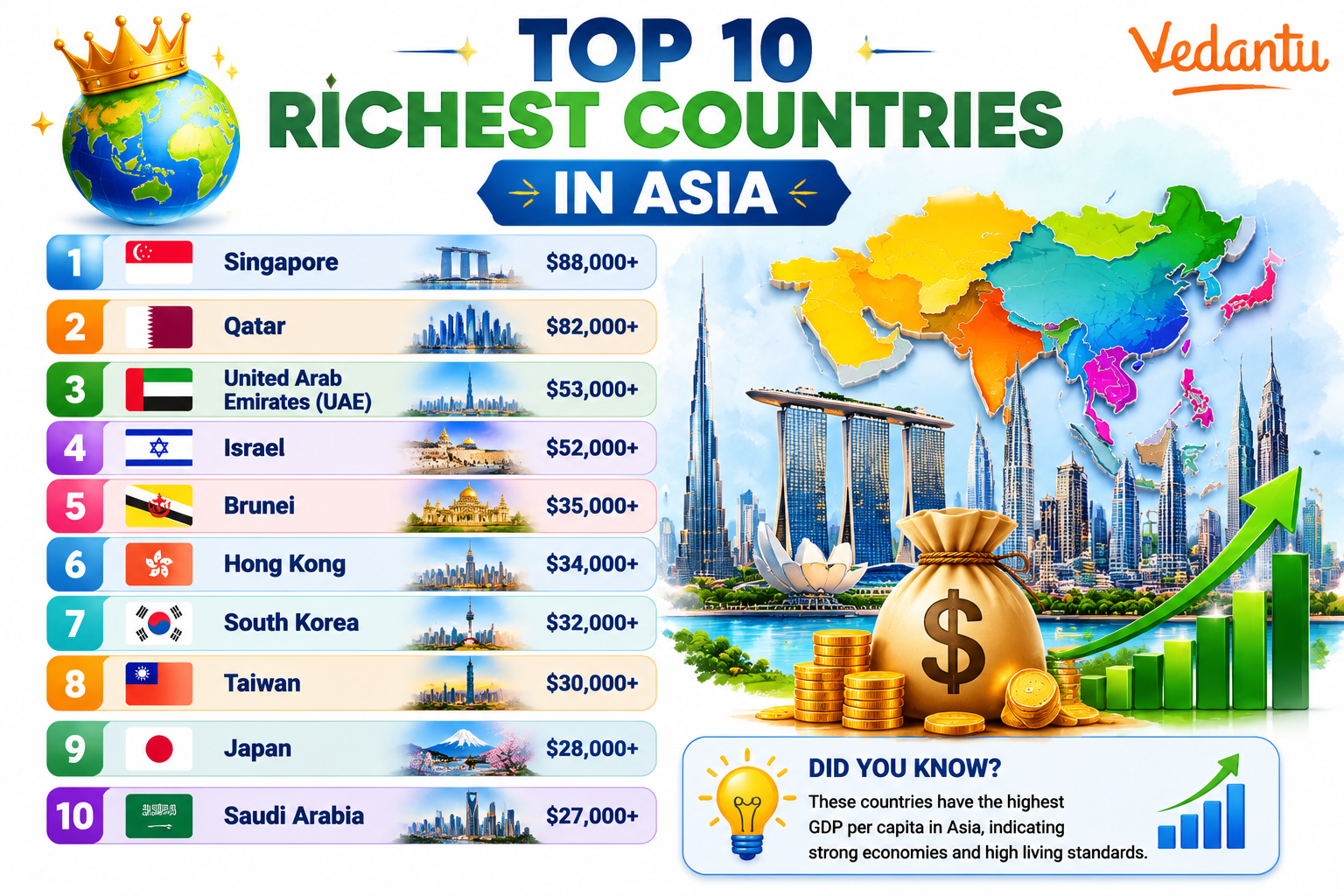
Top 10 Richest Countries In Asia - GDP Per Capita Ranking
| Rank | Country | GDP Per Capita - Approx USD |
|---|---|---|
| 1 | Singapore | 80,000+ |
| 2 | Qatar | 70,000+ |
| 3 | United Arab Emirates | 50,000+ |
| 4 | Kuwait | 45,000+ |
| 5 | Israel | 50,000+ |
| 6 | Brunei | 35,000+ |
| 7 | Japan | 34,000+ |
| 8 | South Korea | 33,000+ |
| 9 | Saudi Arabia | 30,000+ |
| 10 | Bahrain | 28,000+ |
Note: The figures are approximate and may vary slightly depending on the source such as the IMF or World Bank. Rankings are generally based on nominal GDP per capita.
1. Singapore
Singapore is the richest country in Asia in terms of GDP per capita. It is a global financial hub with strong banking, trade, shipping, and technology sectors. Despite its small size and lack of natural resources, Singapore has achieved remarkable economic success through strategic planning, global trade partnerships, and innovation.
2. Qatar
Qatar is one of the wealthiest countries in Asia due to its vast reserves of natural gas and oil. The energy sector contributes significantly to national income. The country also invests heavily in infrastructure, aviation, and global investments.
3. United Arab Emirates
The UAE has transformed from an oil-dependent economy into a diversified economy. Dubai and Abu Dhabi are global centers for tourism, aviation, trade, and finance. Oil revenues and strong infrastructure contribute to its high income levels.
4. Kuwait
Kuwait’s wealth primarily comes from oil exports. It has one of the largest oil reserves in the world. The country maintains a high standard of living and provides strong welfare benefits to its citizens.
5. Israel
Israel is known for its advanced technology sector and is often called the Startup Nation. Its economy is driven by innovation, cybersecurity, defense technology, agriculture technology, and pharmaceuticals.
6. Brunei
Brunei is a small Southeast Asian nation rich in oil and natural gas. Its population is relatively small, which increases its GDP per capita significantly. The government provides free education and healthcare services.
7. Japan
Japan is one of the largest economies in the world. It is highly developed in technology, automobile manufacturing, robotics, and electronics. Although its population is large, its strong industrial base maintains a high per capita income.
8. South Korea
South Korea has experienced rapid economic growth over the past few decades. It is a global leader in electronics, automobiles, shipbuilding, and information technology. Major companies like Samsung and Hyundai contribute significantly to its economy.
9. Saudi Arabia
Saudi Arabia has one of the largest oil reserves in the world. Oil exports are the backbone of its economy. Under Vision 2030, the country is focusing on diversification into tourism, entertainment, and technology sectors.
10. Bahrain
Bahrain has a diversified economy compared to some other Gulf nations. Apart from oil, it has strong banking, finance, and tourism sectors. It is considered a financial hub in the Middle East.
Factors That Make These Countries Rich
- Abundant natural resources such as oil and natural gas
- Strong financial and banking systems
- Advanced technology and innovation sectors
- Strategic geographic location for trade
- Political stability and good governance
GDP Per Capita vs Total GDP
It is important to understand the difference between GDP per capita and total GDP. GDP per capita measures the average income per person, while total GDP measures the overall economic size of a country. For example, China and India have very large total GDP, but their GDP per capita is lower compared to smaller wealthy nations like Singapore or Qatar.
Importance For Competitive Exams
Questions about the richest countries in Asia are commonly asked in competitive exams, general knowledge tests, and interviews. Students should remember the top countries, the basis of ranking - GDP per capita - and the major source of income for each country.
Quick Revision Points
- Richest country in Asia - Singapore
- Oil rich nations - Qatar, Kuwait, Saudi Arabia, UAE, Brunei
- Technology driven economy - Israel, Japan, South Korea
- Ranking is based on GDP per capita
Conclusion
The richest countries in Asia have achieved economic success through a combination of natural resources, innovation, trade, and strategic planning. While some nations rely heavily on oil and gas exports, others have built strong economies through technology, finance, and manufacturing. Understanding these rankings helps students improve their general knowledge and gain insight into global economic trends.
FAQs on Top 10 Richest Countries in Asia: Latest Rankings and Key Facts
1. Which are the top 10 richest countries in Asia?
The top 10 richest countries in Asia are ranked mainly by GDP per capita, which measures average income per person.
Leading countries include:
• Singapore
• Qatar
• United Arab Emirates (UAE)
• Israel
• Japan
• South Korea
• Kuwait
• Saudi Arabia
• Brunei
• Hong Kong
These nations have strong economies based on oil exports, finance, technology, global trade, and innovation.
2. What is the richest country in Asia in 2026?
The richest country in Asia in 2026 is generally considered to be Singapore based on GDP per capita.
Key reasons include:
• Strong financial services sector
• Major global trade hub
• Advanced technology and infrastructure
• Stable political and economic policies
Singapore consistently ranks high in wealth, living standards, and economic development in Asia.
3. How is a country’s wealth measured in Asia?
A country’s wealth is mainly measured using GDP per capita, which shows the average income per person.
Other important indicators include:
• Gross Domestic Product (GDP)
• Purchasing Power Parity (PPP)
• Human Development Index (HDI)
• Foreign exchange reserves
For rankings like the richest Asian countries list, GDP per capita is the most commonly used metric.
4. Why are Middle Eastern countries among the richest in Asia?
Many Middle Eastern countries are wealthy due to large oil and natural gas reserves.
Main reasons include:
• High revenue from petroleum exports
• Strong energy sector investments
• Sovereign wealth funds
• Tax-free income policies (in some nations)
Countries like Qatar, UAE, Kuwait, and Saudi Arabia benefit greatly from energy-based economies.
5. Is Japan the richest country in Asia?
No, Japan is not the richest by GDP per capita, but it has one of the largest economies in Asia.
Important facts:
• Among the top in total GDP
• Leader in technology and automobile industries
• Strong global exports
While Japan is economically powerful, smaller nations like Singapore and Qatar rank higher in per capita income.
6. Which South Asian country is the richest?
In South Asia, the richest country by GDP per capita is usually the Maldives.
Reasons include:
• Strong tourism industry
• High foreign exchange earnings
• Service-based economy
Other South Asian nations like India, Bangladesh, and Pakistan have growing economies but lower per capita income.
7. What is the difference between GDP and GDP per capita?
The key difference is that GDP measures total economic output, while GDP per capita measures income per person.
• GDP = Total value of goods and services produced
• GDP per capita = GDP divided by population
For example, China has a very high GDP, but smaller countries like Singapore rank higher in GDP per capita, making them richer per person.
8. Which Southeast Asian country is the richest?
The richest country in Southeast Asia is Singapore.
It stands out due to:
• Strong banking and finance sector
• Major international port and trade hub
• High foreign direct investment (FDI)
Other developing economies in the region include Malaysia, Thailand, and Indonesia.
9. Are natural resources the main reason for wealth in Asia?
Natural resources contribute significantly, but they are not the only reason for wealth in Asia.
Wealth comes from:
• Oil and gas reserves (Qatar, Saudi Arabia)
• Technology and innovation (South Korea, Japan)
• Finance and trade (Singapore, Hong Kong)
• Tourism (Maldives, UAE)
Thus, both resource-based and diversified economies drive prosperity in Asia.
10. Why do smaller countries often rank higher in GDP per capita?
Smaller countries often rank higher because their total income is divided among a smaller population.
Key factors include:
• Small population size
• High-value industries like finance, oil, or technology
• Efficient governance and infrastructure
For example, Singapore and Qatar have small populations but very high national income, boosting their GDP per capita ranking.
