






How Punjab at a Glance Highlights Its Role as India’s Top Wheat and Rice Producer
Punjab, often called "The Granary of India", is one of the most agriculturally prosperous states in the country. Located in the northwestern part of India, Punjab plays a crucial role in ensuring national food security. The state is known for its fertile alluvial soil, extensive irrigation facilities, and high agricultural productivity, especially in wheat and rice production. Due to its significant contribution to the central food grain reserves, Punjab holds a vital place in India’s agricultural economy and General Knowledge studies.
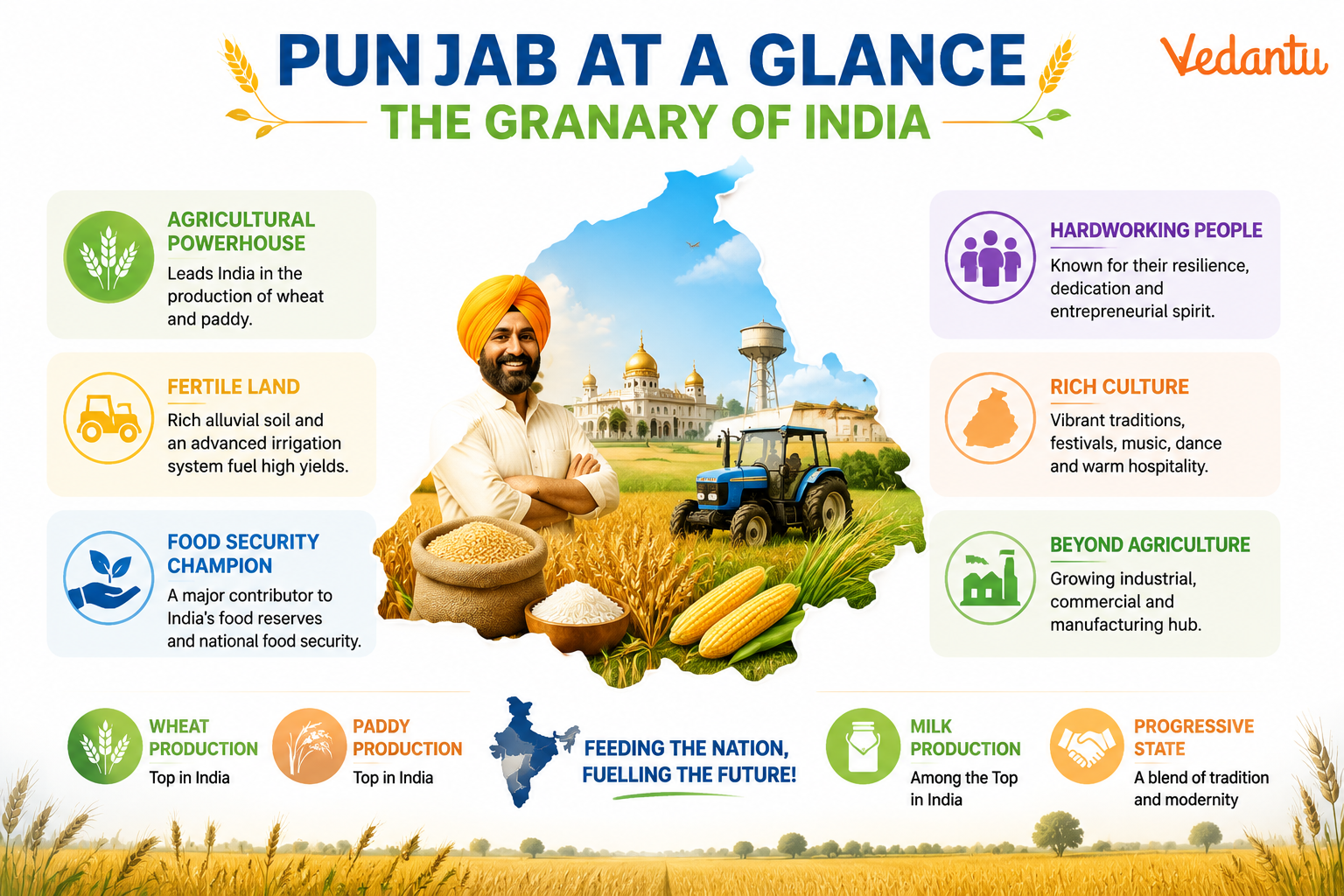
Why Punjab is Called The Granary of India
Punjab earned the title "Granary of India" because of its massive production of food grains. The state contributes a large share of wheat and rice to the central pool managed by the Food Corporation of India.
- Fertile alluvial soil deposited by rivers like Sutlej, Beas, and Ravi.
- Extensive irrigation system including canals and tube wells.
- Adoption of modern farming techniques during the Green Revolution.
- High yield varieties of wheat and rice.
- Strong government procurement system.
Geographical Features of Punjab
Punjab is located in northwestern India and shares its border with Pakistan. The state has a flat and fertile landscape, which is ideal for agriculture.
Major Rivers
- Sutlej
- Beas
- Ravi
The name Punjab itself means "Land of Five Rivers" where Pan means five and Aab means water.
Climate
Punjab experiences an extreme climate with hot summers and cold winters. The moderate rainfall and irrigation support two major cropping seasons - Rabi and Kharif.
Major Crops of Punjab
Major Crops and Seasons in Punjab
| Crop | Season | Importance |
|---|---|---|
| Wheat | Rabi | Main contributor to central food stock |
| Rice | Kharif | Major export and food grain crop |
| Maize | Kharif | Used for food and fodder |
Wheat and rice are the backbone of Punjab’s agricultural economy. The state is among the top producers of these crops in India.
Role of the Green Revolution
The Green Revolution in the 1960s transformed Punjab into a leading agricultural state. Introduction of high yielding variety seeds, chemical fertilizers, pesticides, and improved irrigation significantly increased production.
- Increased food grain production.
- Improved farmer income.
- Strengthened India’s food security.
- Made Punjab a model of agricultural development.
Economic Importance of Punjab
Agriculture is the backbone of Punjab’s economy. A large portion of the population is engaged in farming and allied activities.
- Major contributor to India’s food grain procurement.
- Strong agro based industries.
- High rural employment.
- Significant role in dairy and poultry farming.
Important Facts About Punjab
- Capital - Chandigarh
- Official Language - Punjabi
- State Formation - 1 November 1966
- Famous Festival - Baisakhi
- Major City - Amritsar, Ludhiana, Jalandhar
Challenges Faced by Punjab Agriculture
Despite its success, Punjab faces several agricultural challenges that require attention.
- Declining groundwater levels.
- Overdependence on wheat and rice crops.
- Soil degradation due to excessive fertilizer use.
- Need for crop diversification.
Conclusion
Punjab truly deserves the title "The Granary of India" due to its outstanding contribution to food grain production. With fertile soil, strong irrigation systems, and the impact of the Green Revolution, the state has played a key role in achieving food security for the nation. Understanding Punjab’s agricultural importance is essential for students preparing for competitive exams, as it remains a significant topic in Indian Geography and General Knowledge.
FAQs on Punjab at a Glance – Understanding Why Punjab Is Called the Granary of India
1. Why is Punjab called the Granary of India?
Punjab is called the Granary of India because it is one of the highest producers of food grains in the country.
- Major producer of wheat and rice
- Key contributor to India’s Public Distribution System (PDS)
- Benefited greatly from the Green Revolution (1960s)
- Fertile alluvial soil and advanced irrigation facilities
2. What are the main crops grown in Punjab?
The main crops grown in Punjab are wheat and rice, making it an agricultural powerhouse.
- Wheat – Major Rabi crop
- Rice – Major Kharif crop
- Maize
- Sugarcane
- Cotton
3. How did the Green Revolution impact Punjab?
The Green Revolution transformed Punjab into India’s leading agricultural state.
- Introduction of HYV seeds (High-Yielding Varieties)
- Expansion of irrigation systems
- Use of fertilizers and modern machinery
- Increased production of wheat and rice
4. What are the main rivers of Punjab?
Punjab is named after the “Land of Five Rivers,” which are vital for its agriculture.
- Sutlej
- Beas
- Ravi
- Chenab
- Jhelum
5. What is the capital of Punjab?
The capital of Punjab is Chandigarh, which it shares with Haryana.
- Designed by Le Corbusier
- A well-planned modern city
- Serves as the administrative headquarters of Punjab
6. What is the importance of agriculture in Punjab’s economy?
Agriculture is the backbone of Punjab’s economy and primary source of livelihood.
- Employs a large percentage of the population
- Major supplier to Food Corporation of India (FCI)
- Supports agro-based industries
- Contributes significantly to India’s food grain reserves
7. What type of soil is found in Punjab?
Punjab mainly has fertile alluvial soil, ideal for farming.
- Rich in nutrients
- Suitable for wheat and rice cultivation
- Formed by river deposits
- Supports intensive agriculture
8. What are the major irrigation sources in Punjab?
Punjab has a well-developed irrigation system that supports its farming sector.
- Canals from rivers like Sutlej and Beas
- Tube wells
- Bhakra-Nangal Dam Project
- Extensive groundwater usage
9. What is the geographical location of Punjab?
Punjab is located in the northwestern part of India and shares an international border with Pakistan.
- Bordered by Jammu & Kashmir, Himachal Pradesh, Haryana, and Rajasthan
- Part of the Indo-Gangetic Plain
- Strategic location for agriculture and trade
10. Why is Punjab important for competitive exams and GK studies?
Punjab is important in General Knowledge (GK) because of its agricultural, historical, and economic significance.
- Known as the Granary/Food Bowl of India
- Center of the Green Revolution
- Land of Five Rivers
- Major contributor to India’s food security
