






Key Differences Between Gandhara and Mathura Art Styles in Sculpture and Iconography
The Difference Between Gandhara School and Mathura School of Art is an important topic in Indian Art and Culture. Both schools flourished during the Kushana period and played a significant role in the development of Buddhist art in India. While Gandhara art shows strong foreign influence, especially Greek and Roman styles, Mathura art developed as a purely indigenous Indian style. Understanding their differences helps students grasp the evolution of sculpture, religious representation, and cultural exchange in ancient India. This topic is frequently asked in competitive exams and forms a key part of General Knowledge and history studies.
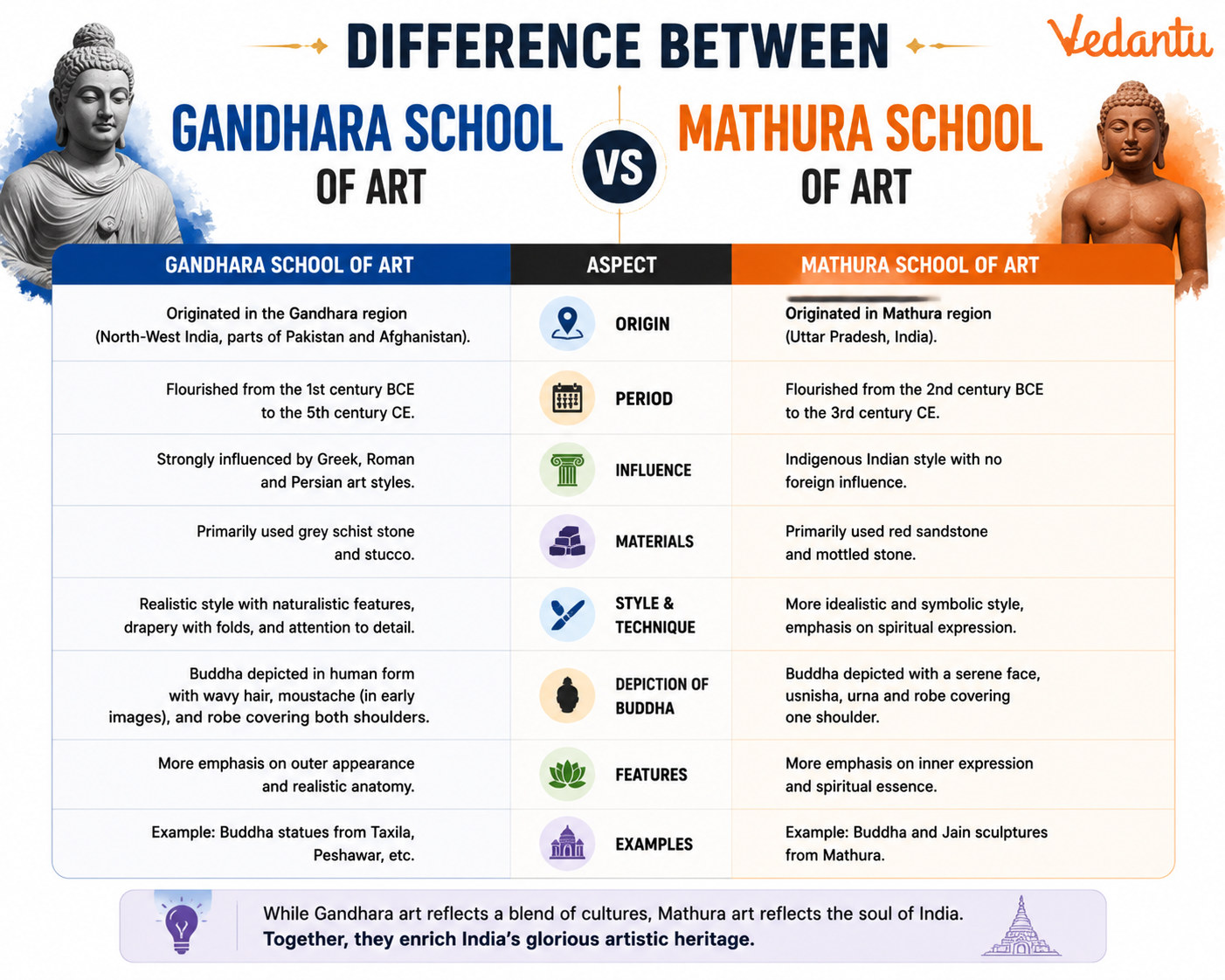
Overview of Gandhara School of Art
The Gandhara School of Art developed in the north western region of the Indian subcontinent, mainly in present day Pakistan and Afghanistan. It flourished between the 1st century BCE and 5th century CE under the patronage of the Kushana rulers, especially King Kanishka. This school is famous for introducing the first human images of Lord Buddha.
Main Features of Gandhara Art
- Strong influence of Greek and Roman art styles
- Use of grey schist stone and stucco for sculptures
- Buddha depicted with wavy hair and sharp facial features
- Realistic body structure and detailed drapery resembling Roman togas
- Themes mainly based on Buddhist religion
Overview of Mathura School of Art
The Mathura School of Art developed in the city of Mathura in present day Uttar Pradesh. It also flourished during the Kushana period. Unlike Gandhara art, Mathura art was purely Indian in style and tradition. It produced images not only of Buddha but also of Hindu and Jain deities.
Main Features of Mathura Art
- Indigenous Indian style with minimal foreign influence
- Use of red sandstone as the main material
- Buddha depicted with a smiling face and spiritual expression
- Clothing shown as thin and transparent, closely fitting the body
- Production of Buddhist, Jain, and Brahmanical images
Difference Between Gandhara School and Mathura School of Art
| Basis of Comparison | Gandhara School | Mathura School |
|---|---|---|
| Region | North western India, Pakistan, Afghanistan | Mathura region of Uttar Pradesh |
| Influence | Greek and Roman influence | Purely Indian influence |
| Material Used | Grey schist stone and stucco | Red sandstone |
| Depiction of Buddha | Wavy hair, sharp features, heavy drapery | Smiling face, spiritual look, thin drapery |
| Nature of Art | Realistic and naturalistic | Symbolic and spiritual |
The table above clearly shows that while both schools flourished during the same period and focused on religious themes, their artistic styles and influences were very different. Gandhara art reflects cultural interaction between India and the West, whereas Mathura art represents the growth of indigenous Indian artistic traditions.
Similarities Between Gandhara and Mathura Schools
Despite their differences, both schools share some important similarities as they developed during the same historical phase.
- Both flourished during the Kushana period
- Both produced images of Lord Buddha in human form
- Both contributed significantly to the spread of Buddhism
- Both influenced later Indian sculpture and temple art
Importance in Indian Art History
The Gandhara and Mathura schools mark a turning point in Indian art history because they introduced anthropomorphic images of Buddha. Before this period, Buddha was represented through symbols like the Bodhi tree, footprints, or the wheel. These two schools shaped the future development of Buddhist and Hindu iconography in India. Their styles influenced later art forms during the Gupta period, which is considered the golden age of Indian sculpture.
Exam Preparation Tips
For competitive exams and General Knowledge preparation, students should focus on key comparison points and unique features of each school.
- Remember the material used - grey schist for Gandhara and red sandstone for Mathura
- Associate Gandhara with Greek influence and realistic style
- Associate Mathura with indigenous style and spiritual expression
- Revise table based comparisons for quick recall in exams
Conclusion
The Difference Between Gandhara School and Mathura School of Art highlights the diversity and richness of ancient Indian sculpture. Gandhara art reflects cross cultural interaction and realism, while Mathura art represents indigenous creativity and spiritual depth. Together, they laid the foundation for classical Indian art and remain essential topics in General Knowledge and art history studies. A clear understanding of their features, differences, and significance helps students answer both objective and descriptive questions effectively.
FAQs on Difference Between Gandhara and Mathura School of Art Explained for Students
1. What is the main difference between Gandhara School and Mathura School of Art?
The main difference between the Gandhara School of Art and the Mathura School of Art lies in their style, material, and foreign influence.
• Gandhara School: Influenced by Greek-Roman (Hellenistic) art, used grey sandstone, and depicted Buddha with realistic features.
• Mathura School: Purely indigenous Indian style, used red sandstone, and showed spiritual and symbolic expressions.
These differences are important in understanding ancient Indian art and sculpture during the Kushan period.
2. Where were the Gandhara and Mathura Schools of Art located?
The Gandhara School developed in the northwestern region of India, while the Mathura School flourished in northern India.
• Gandhara: Present-day Afghanistan and Pakistan (Taxila, Peshawar).
• Mathura: Located in present-day Uttar Pradesh, India.
Both centers became major hubs of Buddhist art and sculpture during the Kushan Empire.
3. What materials were used in Gandhara and Mathura sculptures?
The two schools differed significantly in the materials used for sculpture.
• Gandhara School: Mainly used grey sandstone and sometimes stucco.
• Mathura School: Used red sandstone sourced from Sikri.
The choice of material influenced the texture, finish, and overall appearance of Buddhist statues and other religious icons.
4. How was Buddha depicted differently in Gandhara and Mathura art?
The depiction of Lord Buddha is a key difference between the two schools.
• Gandhara Art: Buddha shown with wavy hair, sharp facial features, heavy robes, and a Greco-Roman appearance.
• Mathura Art: Buddha shown with a shaved head or topknot, simple robe, spiritual smile, and Indian physical features.
This contrast highlights the blend of foreign influence vs indigenous tradition in ancient Indian sculpture.
5. Which rulers patronized the Gandhara and Mathura Schools of Art?
Both schools flourished under the patronage of the Kushan rulers, especially Kanishka.
• Gandhara School: Strongly supported by Kushan kings due to trade links with Central Asia and Rome.
• Mathura School: Also developed under Kushan rule and continued under the Gupta period.
Royal support helped promote Buddhist iconography and religious art.
6. What are the major features of the Gandhara School of Art?
The Gandhara School of Art is known for its realistic and classical style.
• Strong Greek-Roman influence
• Use of grey sandstone
• Realistic human anatomy and detailed drapery
• Curly hair and sharp facial features
• Focus on Buddhist themes
It is often called the Greco-Buddhist Art style in ancient Indian history.
7. What are the major features of the Mathura School of Art?
The Mathura School of Art is famous for its indigenous Indian characteristics.
• Use of red sandstone
• Spiritual and symbolic expressions
• Thin, transparent clothing
• Indigenous facial features
• Depiction of Buddha, Jain Tirthankaras, and Hindu deities
This school laid the foundation for later Gupta art and classical Indian sculpture.
8. Which school of art shows more foreign influence?
The Gandhara School of Art shows more foreign influence compared to Mathura.
• Influenced by Hellenistic (Greek), Roman, and Central Asian styles
• Realistic body structure and robe patterns
• Classical artistic techniques
In contrast, the Mathura School remained largely Indian in origin and expression.
9. During which period did Gandhara and Mathura Schools flourish?
Both schools flourished mainly during the Kushan period (1st–3rd century CE).
• Gandhara Art: Reached its peak under Kanishka.
• Mathura Art: Continued to develop further during the Gupta period.
This era is considered crucial in the development of Buddhist art in India.
10. Why is the study of Gandhara and Mathura Schools important for competitive exams?
The comparison between Gandhara and Mathura Schools of Art is important for GK, UPSC, SSC, and other competitive exams.
• Frequently asked in ancient Indian history sections
• Helps understand Buddhist sculpture and cultural exchange
• Important for topics like Kushan Empire, Indian art and culture
Understanding their differences improves clarity on Indian art history and cultural development.
