






How Commercial, RBI and Cooperative Banks Shape India's Banking System
The Structure of Banking Sector in India refers to the organized framework of financial institutions that accept deposits, provide loans, and facilitate financial transactions across the country. The Indian banking system plays a crucial role in economic development by mobilizing savings, promoting investments, supporting industries, and ensuring financial inclusion. It is regulated and supervised by the Reserve Bank of India - RBI, which acts as the central authority for monetary stability and banking operations. Understanding the structure of the Indian banking sector is important for students, competitive exam aspirants, and anyone interested in the functioning of the Indian economy.
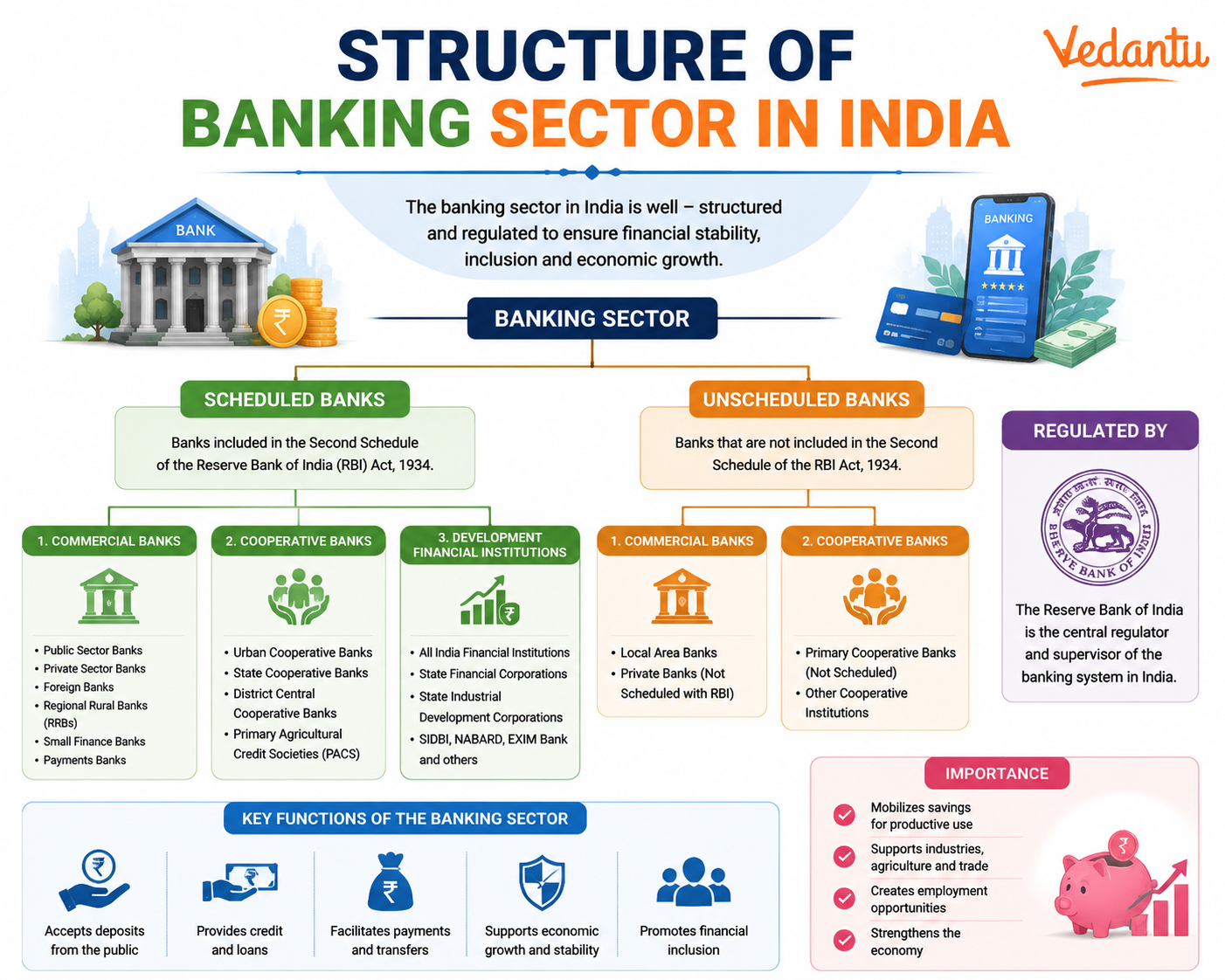
Overview of the Indian Banking System
The banking system in India is broadly classified into Scheduled Banks and Non-Scheduled Banks. Scheduled Banks are those listed in the Second Schedule of the Reserve Bank of India Act, 1934. These banks must satisfy certain conditions related to capital and reserves. Most banks operating in India fall under the category of Scheduled Banks.
The structure of the Indian banking sector can be divided into two major parts:
- Reserve Bank of India - Central Bank
- Commercial and Co-operative Banks
Reserve Bank of India - RBI
The Reserve Bank of India is the apex banking authority in India. It was established on 1 April 1935 under the RBI Act, 1934. RBI regulates and supervises the entire banking system in the country.
Main Functions of RBI
- Issue of currency notes except one rupee note
- Controller of credit and monetary policy
- Banker to the Government of India
- Banker’s bank and lender of last resort
- Custodian of foreign exchange reserves
Classification of Banks in India
Types of Banks in India
| Category | Sub-Category | Examples |
|---|---|---|
| Commercial Banks | Public, Private, Foreign, Regional Rural Banks | SBI, HDFC Bank, Citibank, RRBs |
| Co-operative Banks | Urban and Rural Co-operative Banks | State Co-operative Bank, District Central Co-operative Bank |
The above classification shows the broad structure of banks operating in India. Commercial banks dominate the Indian banking sector in terms of assets and branch network, while co-operative banks mainly serve rural and semi-urban areas.
Commercial Banks
Commercial banks are financial institutions that accept deposits from the public and provide loans for profit. They form the largest segment of the Indian banking sector.
1. Public Sector Banks
Public Sector Banks are those in which the Government of India holds more than 50 percent of the shares. These banks play a major role in implementing government policies and financial inclusion schemes.
- State Bank of India - SBI
- Punjab National Bank - PNB
- Bank of Baroda
2. Private Sector Banks
Private Sector Banks are owned by private individuals or corporations. They are known for efficient customer service and technological innovation.
- HDFC Bank
- ICICI Bank
- Axis Bank
3. Foreign Banks
Foreign Banks are banks headquartered outside India but operating branches in India. They facilitate international trade and foreign exchange operations.
4. Regional Rural Banks - RRBs
Regional Rural Banks were established in 1975 to provide banking facilities in rural areas. They are jointly owned by the Government of India, the concerned State Government, and a sponsoring public sector bank.
Co-operative Banks
Co-operative banks operate on the principle of co-operation and mutual help. They are registered under the Co-operative Societies Act and primarily serve farmers, small businesses, and local communities.
Types of Co-operative Banks
- State Co-operative Banks
- District Central Co-operative Banks
- Primary Agricultural Credit Societies
- Urban Co-operative Banks
Specialized Banks in India
Apart from commercial and co-operative banks, India also has specialized banks that cater to specific sectors of the economy.
- Small Finance Banks - Focus on financial inclusion
- Payments Banks - Provide limited banking services without lending
- Development Banks - Such as NABARD and EXIM Bank
Importance of the Banking Structure in India
The structured classification of banks ensures smooth functioning of financial activities across urban and rural areas. Each category of bank serves a specific purpose, which helps in balanced economic growth.
- Promotes savings and investment
- Supports agricultural and industrial development
- Encourages financial inclusion in rural areas
- Ensures stability of the financial system through RBI supervision
Key Points for Competitive Exams
- RBI was established in 1935 and nationalized in 1949
- Scheduled Banks are listed under the Second Schedule of RBI Act, 1934
- Public Sector Banks have majority government ownership
- RRBs were established in 1975 for rural development
- Small Finance Banks and Payments Banks are new generation banks introduced to improve financial access
Conclusion
The Structure of Banking Sector in India is well organized and diversified to meet the needs of a growing economy. From the Reserve Bank of India at the top to commercial, co-operative, and specialized banks at various levels, each institution plays a distinct role in financial development. A clear understanding of this structure helps students grasp how money flows within the economy and how financial institutions contribute to national growth. This topic is highly relevant for competitive exams and general awareness, making it an essential part of General Knowledge.
FAQs on Structure of India's Banking Sector: Types and Roles
1. What is the structure of the banking sector in India?
The structure of the banking sector in India is a multi-tier system regulated by the Reserve Bank of India (RBI) and divided into scheduled and non-scheduled banks.
• Central Bank – Reserve Bank of India (RBI)
• Scheduled Commercial Banks – Public Sector Banks, Private Sector Banks, Foreign Banks, Regional Rural Banks (RRBs)
• Cooperative Banks – Urban and Rural Cooperative Banks
• Development Banks & Specialized Institutions – NABARD, SIDBI, EXIM Bank
This hierarchical banking system ensures financial stability, credit flow, and economic development in India.
2. What are Scheduled and Non-Scheduled Banks in India?
The difference between Scheduled and Non-Scheduled Banks lies in their inclusion in the Second Schedule of the RBI Act, 1934.
• Scheduled Banks – Listed in RBI Act, must maintain CRR, eligible for RBI loans
• Non-Scheduled Banks – Not listed, smaller operations, limited RBI facilities
• Scheduled banks include Public, Private, Foreign, and Regional Rural Banks
This classification is important for competitive exams and understanding India’s banking regulation framework.
3. What are Public Sector Banks in India?
Public Sector Banks (PSBs) are banks where the majority stake is owned by the Government of India.
• Examples: State Bank of India (SBI), Punjab National Bank, Bank of Baroda
• Focus on financial inclusion and government schemes
• Account for a major share of banking assets in India
PSBs play a key role in implementing economic policies and supporting rural and priority sector lending.
4. What is the role of the Reserve Bank of India (RBI) in the banking sector?
The Reserve Bank of India (RBI) is the central bank that regulates and supervises the entire Indian banking system.
• Issues currency notes
• Controls monetary policy (Repo Rate, CRR, SLR)
• Acts as banker to the government and banks
• Supervises financial institutions
RBI ensures financial stability, inflation control, and smooth functioning of banks in India.
5. What are Regional Rural Banks (RRBs)?
Regional Rural Banks (RRBs) are government-backed banks established to serve rural and semi-urban areas.
• Established under the RRB Act, 1976
• Jointly owned by Central Government, State Government, and a Sponsor Bank
• Focus on agriculture, MSMEs, and rural credit
RRBs strengthen financial inclusion and rural banking infrastructure in India.
6. What are Cooperative Banks in India?
Cooperative Banks are financial institutions owned and operated by members under cooperative principles.
• Urban Cooperative Banks (UCBs)
• Rural Cooperative Banks – State, District, Primary Agricultural Credit Societies (PACS)
• Regulated by RBI and State Governments
They promote local savings, agricultural finance, and community-based banking services.
7. What are Private Sector Banks in India?
Private Sector Banks are banks where majority ownership lies with private individuals or corporations.
• Examples: HDFC Bank, ICICI Bank, Axis Bank
• Known for digital banking and customer service
• Operate under RBI guidelines
These banks enhance competition, innovation, and efficiency in the Indian banking industry.
8. What are Development Banks in India?
Development Banks are specialized financial institutions that provide long-term finance for economic development.
• NABARD – Agriculture and rural development
• SIDBI – MSME sector
• EXIM Bank – Export-import finance
They support infrastructure growth, industrialization, and sector-specific funding in India.
9. How many types of commercial banks are there in India?
There are four main types of Commercial Banks in India under Scheduled Commercial Banks.
• Public Sector Banks
• Private Sector Banks
• Foreign Banks
• Regional Rural Banks (RRBs)
These banks accept deposits, provide loans, and offer financial services to individuals and businesses.
10. Why is the banking sector important for the Indian economy?
The banking sector is vital because it supports economic growth, financial inclusion, and capital formation.
• Mobilizes savings and provides credit
• Supports trade, industry, and agriculture
• Implements government schemes like Jan Dhan Yojana
• Maintains monetary stability under RBI supervision
A strong Indian banking system ensures sustainable development and financial security.
