






Key Objectives and Member Countries of the SCO Alliance
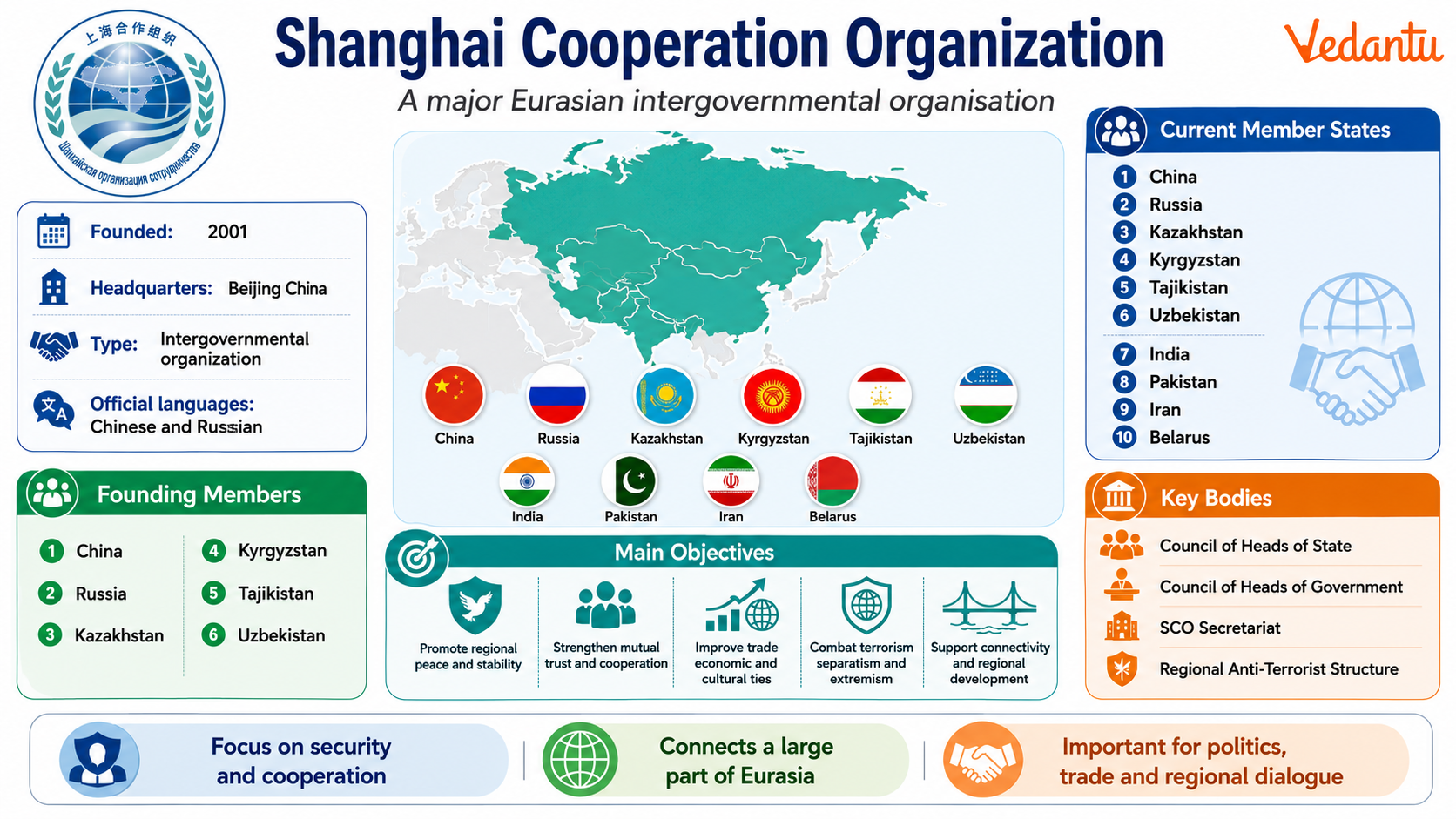
The Shanghai Cooperation Organization (SCO) is a major Eurasian political, economic, and security alliance formed to promote regional stability, cooperation, and development among its member countries. Established in 2001, the SCO plays a significant role in global geopolitics, particularly in Asia. It focuses on combating terrorism, separatism, and extremism while also strengthening economic ties and cultural cooperation among member states. The organization represents a large portion of the world's population and territory, making it an influential international grouping.
Formation and Background
The Shanghai Cooperation Organization evolved from the "Shanghai Five" mechanism formed in 1996. The original members were China, Russia, Kazakhstan, Kyrgyzstan, and Tajikistan. The primary aim was to resolve border disputes and build trust along shared borders.
In 2001, Uzbekistan joined the group, and the organization was officially named the Shanghai Cooperation Organization. Since then, it has expanded both in membership and scope of activities.
Objectives of the Shanghai Cooperation Organization
The SCO focuses on strengthening mutual trust and cooperation among member states. Its objectives include political, economic, and security-related goals.
- Strengthening mutual trust and neighborly relations among member states.
- Promoting cooperation in politics, trade, economy, research, technology, and culture.
- Ensuring regional peace, security, and stability.
- Combating terrorism, separatism, and extremism.
- Moving towards a democratic and fair international political and economic order.
Member Countries of SCO
Shanghai Cooperation Organization Members
| Category | Countries | Year of Entry |
|---|---|---|
| Founding Members | China, Russia, Kazakhstan, Kyrgyzstan, Tajikistan, Uzbekistan | 2001 |
| Later Members | India, Pakistan (2017), Iran (2023) | 2017 and 2023 |
The SCO continues to expand its influence. Several countries participate as observer states and dialogue partners, reflecting the growing importance of the organization in global affairs.
Observer States
- Afghanistan
- Belarus
- Mongolia
Organizational Structure
The SCO has a structured institutional framework to ensure effective functioning and decision-making.
- Council of Heads of State - The highest decision-making body.
- Council of Heads of Government - Discusses strategy and budget.
- Secretariat - Permanent administrative body located in Beijing, China.
- Regional Anti-Terrorist Structure (RATS) - Located in Tashkent, Uzbekistan, focuses on security cooperation.
Key Areas of Cooperation
1. Security Cooperation
Security remains the core focus of the SCO. Member states conduct joint military exercises and intelligence sharing to combat terrorism and cross-border threats.
2. Economic Cooperation
The SCO promotes trade, energy cooperation, infrastructure development, and connectivity among member states. Discussions often include regional connectivity projects and investment initiatives.
3. Cultural and People-to-People Exchanges
The organization encourages educational, cultural, and tourism exchanges to strengthen ties among citizens of member countries.
Importance of SCO for India
India became a full member of the SCO in 2017. Membership provides strategic and economic advantages.
- Platform to engage with Central Asian countries.
- Opportunity to combat terrorism through regional cooperation.
- Access to energy-rich Central Asian markets.
- Strengthening diplomatic engagement with Russia and China.
Challenges Faced by SCO
Despite its growing influence, the SCO faces several challenges that impact its effectiveness.
- Geopolitical tensions between member states.
- Differences in political systems and foreign policy priorities.
- Limited economic integration compared to other regional organizations.
- Security instability in neighboring regions.
Shanghai Cooperation Organization at a Glance
Quick Facts about SCO
| Parameter | Details | Location |
|---|---|---|
| Established | 2001 | Shanghai, China |
| Headquarters | SCO Secretariat | Beijing, China |
The Shanghai Cooperation Organization is one of the largest regional organizations in the world in terms of geographical coverage and population. With its focus on security, economic cooperation, and regional connectivity, it continues to shape the political and economic landscape of Eurasia. Understanding the SCO is important for competitive examinations and general awareness, as it plays a crucial role in India's foreign policy and global geopolitics.
FAQs on Shanghai Cooperation Organization (SCO): Overview and Global Role
1. What is the Shanghai Cooperation Organization (SCO)?
The Shanghai Cooperation Organization (SCO) is a Eurasian political, economic, and security alliance formed to promote regional stability and cooperation.
• Established in 2001 in Shanghai, China
• Focuses on security cooperation, counter-terrorism, trade, and connectivity
• Often described as a Eurasian political bloc or regional intergovernmental organization
• Plays a major role in Central Asian security and multipolar global governance
2. Which countries are members of the SCO?
The SCO member states include major Asian powers and Central Asian republics.
• China
• Russia
• India
• Pakistan
• Kazakhstan
• Kyrgyzstan
• Tajikistan
• Uzbekistan
• Iran (joined in 2023)
These countries represent a significant share of the world’s population, energy resources, and geopolitical influence.
3. When and why was the SCO formed?
The SCO was formed in 2001 to enhance regional security and reduce instability in Central Asia.
• Evolved from the Shanghai Five (1996)
• Aimed to combat the “Three Evils” — terrorism, separatism, and extremism
• Promotes economic cooperation and regional integration
• Strengthens China-Russia strategic partnership
4. What are the main objectives of the SCO?
The primary objective of the Shanghai Cooperation Organization is to ensure regional peace and cooperation.
• Maintain regional security and stability
• Combat terrorism, extremism, and separatism
• Promote economic, trade, and energy cooperation
• Strengthen cultural and diplomatic ties
• Encourage a multipolar world order
5. What is the SCO’s organizational structure?
The SCO structure includes several decision-making and administrative bodies.
• Council of Heads of State (CHS) – Supreme body
• Council of Heads of Government (CHG)
• Secretariat – Based in Beijing
• Regional Anti-Terrorist Structure (RATS) – Based in Tashkent
This structure ensures coordination in security, diplomacy, and economic initiatives.
6. What is the role of India in the SCO?
India became a full SCO member in 2017 and plays a strategic role in regional connectivity and security.
• Promotes counter-terrorism cooperation
• Advocates for connectivity projects like the International North-South Transport Corridor
• Strengthens ties with Central Asian countries
• Enhances India’s presence in Eurasian geopolitics
7. What is the Regional Anti-Terrorist Structure (RATS) of SCO?
The Regional Anti-Terrorist Structure (RATS) is the SCO’s specialized body for counter-terrorism efforts.
• Established to combat terrorism, extremism, and separatism
• Headquarters in Tashkent, Uzbekistan
• Facilitates intelligence sharing among member states
• Conducts joint military and counter-terror exercises
8. How is the SCO different from NATO?
The SCO is a regional cooperation organization, while NATO is a military defense alliance.
• SCO focuses on security, economic cooperation, and diplomacy
• NATO follows a collective defense principle (Article 5)
• SCO does not have a formal mutual defense treaty
• SCO promotes a multipolar world order, unlike NATO’s Western alignment
9. What is the significance of the SCO in global politics?
The Shanghai Cooperation Organization is significant due to its geopolitical and economic influence.
• Covers nearly 40% of the world’s population
• Includes major powers like China, Russia, and India
• Influences energy security and Eurasian connectivity
• Acts as a platform for non-Western cooperation in global governance
10. Where is the headquarters of the SCO located?
The SCO headquarters is located in Beijing, China.
• Coordinates administrative and diplomatic functions
• Works alongside RATS headquarters in Tashkent
• Organizes summits, ministerial meetings, and policy discussions
• Serves as the central hub of the Shanghai Cooperation Organization
