






How the Sath English Support Program Improves Language Skills
The SATH Program - Sustainable Action for Transforming Human Capital - was an initiative launched by NITI Aayog to support Indian states in improving key social sector indicators. The program focused on transforming sectors such as health and education through strategic guidance, data driven governance, and collaboration with knowledge partners. It aimed to help states achieve measurable outcomes by adopting best practices and improving implementation efficiency. The SATH Program is important for students preparing for competitive exams like UPSC, SSC, and other government examinations, as it reflects India’s approach toward cooperative federalism and sustainable development.
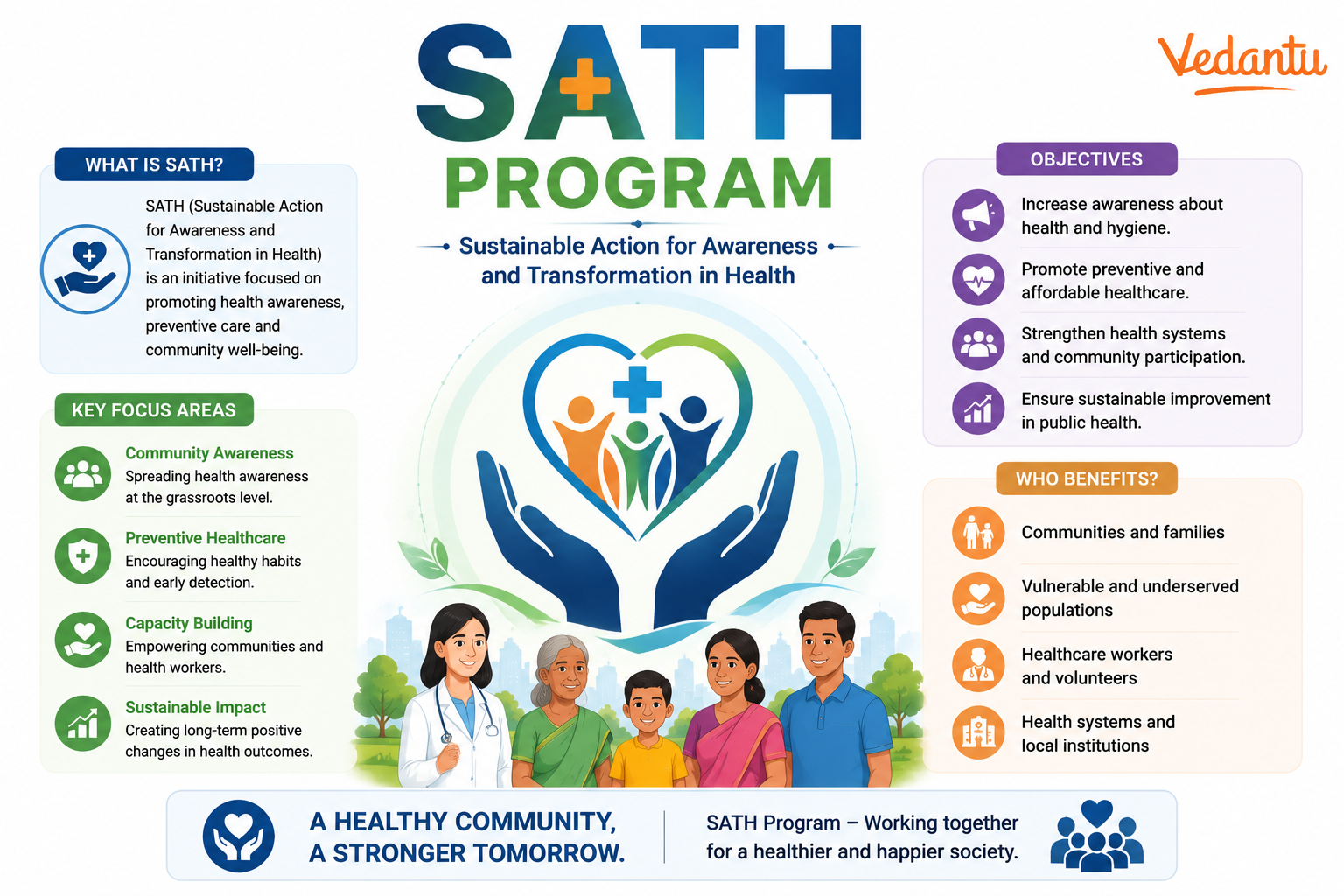
Overview of the SATH Program
SATH was launched by NITI Aayog in 2017 as a part of its efforts to promote competitive and cooperative federalism. The program identified specific states and worked closely with them to improve governance and service delivery in selected sectors. Instead of providing funds, NITI Aayog offered technical assistance and strategic support.
Full Form of SATH
SATH stands for Sustainable Action for Transforming Human Capital.
Year of Launch
The SATH Program was launched in 2017 by NITI Aayog.
Nodal Agency
The nodal agency responsible for implementing the SATH Program was NITI Aayog.
Objectives of the SATH Program
- Improve governance and service delivery in health and education sectors.
- Enhance learning outcomes in schools.
- Strengthen public health systems and healthcare delivery.
- Encourage data driven decision making in state governments.
- Promote sustainable development through capacity building.
Key Features of the SATH Program
- Selection of states through a competitive process.
- Partnership with private sector and knowledge organizations for technical support.
- Focus on measurable outcomes rather than financial grants.
- Time bound transformation strategy.
- Continuous monitoring and performance evaluation.
States Selected Under SATH Program
| Sector | States Selected | Focus Area |
|---|---|---|
| Health | Uttar Pradesh, Assam, Karnataka | Strengthening public healthcare systems |
| Education | Jharkhand, Madhya Pradesh, Odisha | Improving learning outcomes |
These states were chosen after a detailed evaluation process. The aim was to implement sector specific reforms and create scalable models that other states could replicate.
Implementation Strategy
The SATH Program adopted a structured and result oriented approach. Instead of providing financial assistance, it focused on strategic reforms and capacity building within state governments.
- Identification of key problem areas in selected sectors.
- Preparation of detailed action plans with clear milestones.
- Deployment of expert teams and knowledge partners.
- Regular monitoring through data dashboards and reviews.
- Assessment of outcomes and documentation of best practices.
Significance of the SATH Program
The SATH Program holds significance as it reflects a shift from fund based support to knowledge based transformation. It strengthened the concept of cooperative federalism by working closely with states. The focus on human capital development aligns with India’s long term growth strategy and Sustainable Development Goals.
- Encouraged innovation in public service delivery.
- Improved accountability through data tracking.
- Promoted evidence based policymaking.
- Created replicable governance models.
SATH Program and Competitive Exams
The SATH Program is frequently asked in competitive examinations under topics related to government schemes, NITI Aayog initiatives, and social sector reforms. Students should remember its full form, year of launch, implementing agency, selected states, and core objectives.
Important Points for Revision
- Launched in 2017 by NITI Aayog.
- Focus on health and education sectors.
- No direct financial assistance, only technical support.
- Aims to transform human capital in selected states.
Conclusion
The SATH Program represents an innovative governance model aimed at transforming human capital through strategic collaboration and performance driven reforms. By focusing on health and education, it addressed two critical pillars of sustainable development. Understanding the SATH Program helps students grasp how India is strengthening its social sectors through data driven policies and cooperative federalism.
FAQs on English Sath Academic Support Program Overview
1. What is the SATH Program?
The SATH Program (Sustainable Action for Transforming Human Capital) is a flagship initiative launched by NITI Aayog in 2017 to improve key social sectors in Indian states.
• Focuses on transforming education and healthcare sectors
• Aims to build strong human capital for long-term development
• Provides technical support and strategic guidance to selected states
• Encourages cooperative federalism and data-driven governance
2. When was the SATH Program launched and by whom?
The SATH Program was launched in 2017 by NITI Aayog, the policy think tank of the Government of India.
• Introduced to accelerate reforms in social sectors
• Supports state governments through policy planning and implementation frameworks
• Aligns with national goals like Sustainable Development Goals (SDGs) and human development
3. What are the main objectives of the SATH Program?
The main objective of the SATH initiative is to transform social infrastructure by improving governance and service delivery.
• Strengthen school education systems
• Improve public healthcare delivery
• Build institutional capacity in states
• Promote outcome-based monitoring and evaluation
• Enhance overall human capital development in India
4. Which sectors are covered under the SATH Program?
The SATH Program primarily covers the education and health sectors.
• SATH-E (Education) focuses on learning outcomes and school reforms
• SATH-H (Health) targets better primary healthcare systems
• Emphasizes quality, access, and accountability in public services
5. How are states selected under the SATH Program?
States are selected through a competitive and transparent selection process under the SATH scheme.
• States submit an Expression of Interest (EoI)
• Evaluation is based on commitment to reform and governance capacity
• Selected states receive intensive handholding and technical assistance from NITI Aayog and partner organizations
6. What is SATH-E in the SATH Program?
SATH-E refers to the education component of the SATH Program, aimed at improving school education systems.
• Focuses on learning outcomes and teacher training
• Strengthens monitoring and evaluation mechanisms
• Encourages curriculum reforms and digital learning tools
• Supports states in achieving better performance in national assessments
7. What is SATH-H under the SATH initiative?
SATH-H is the healthcare vertical of the Sustainable Action for Transforming Human Capital program.
• Aims to improve primary healthcare services
• Enhances public health infrastructure
• Strengthens disease management and preventive care
• Promotes better health indicators and service delivery systems
8. How does the SATH Program support cooperative federalism?
The SATH Program promotes cooperative federalism by fostering collaboration between the Centre and states.
• Provides customized reform roadmaps for each state
• Encourages knowledge-sharing and best practices
• Offers policy support rather than financial grants
• Strengthens state capacity for long-term governance reforms
9. Why is the SATH Program important for competitive exams?
The SATH Program is important for competitive exams like UPSC, SSC, and State PSC due to its relevance in governance and social sector reforms.
• Frequently asked in General Studies (GS Paper II)
• Related to topics like NITI Aayog initiatives and public policy
• Connected with themes such as human capital development and SDGs
• Useful for essay and interview preparation
10. How does the SATH Program contribute to human capital development?
The SATH initiative contributes to human capital development by strengthening education and healthcare systems in India.
• Improves quality of school education
• Enhances access to affordable healthcare
• Builds skilled and healthy workforce for economic growth
• Supports India’s long-term development and demographic dividend goals
