






Difference Between Economic Recession and Technical Recession with Examples
A recession is a period of significant decline in economic activity that lasts for months or even years. It affects production, employment, income, and overall economic growth. A technical recession, on the other hand, is a specific condition defined by a measurable fall in Gross Domestic Product - GDP. Understanding recession and technical recession is important for students, competitive exam aspirants, and general readers because these concepts are frequently discussed in economics, current affairs, and government policy debates.
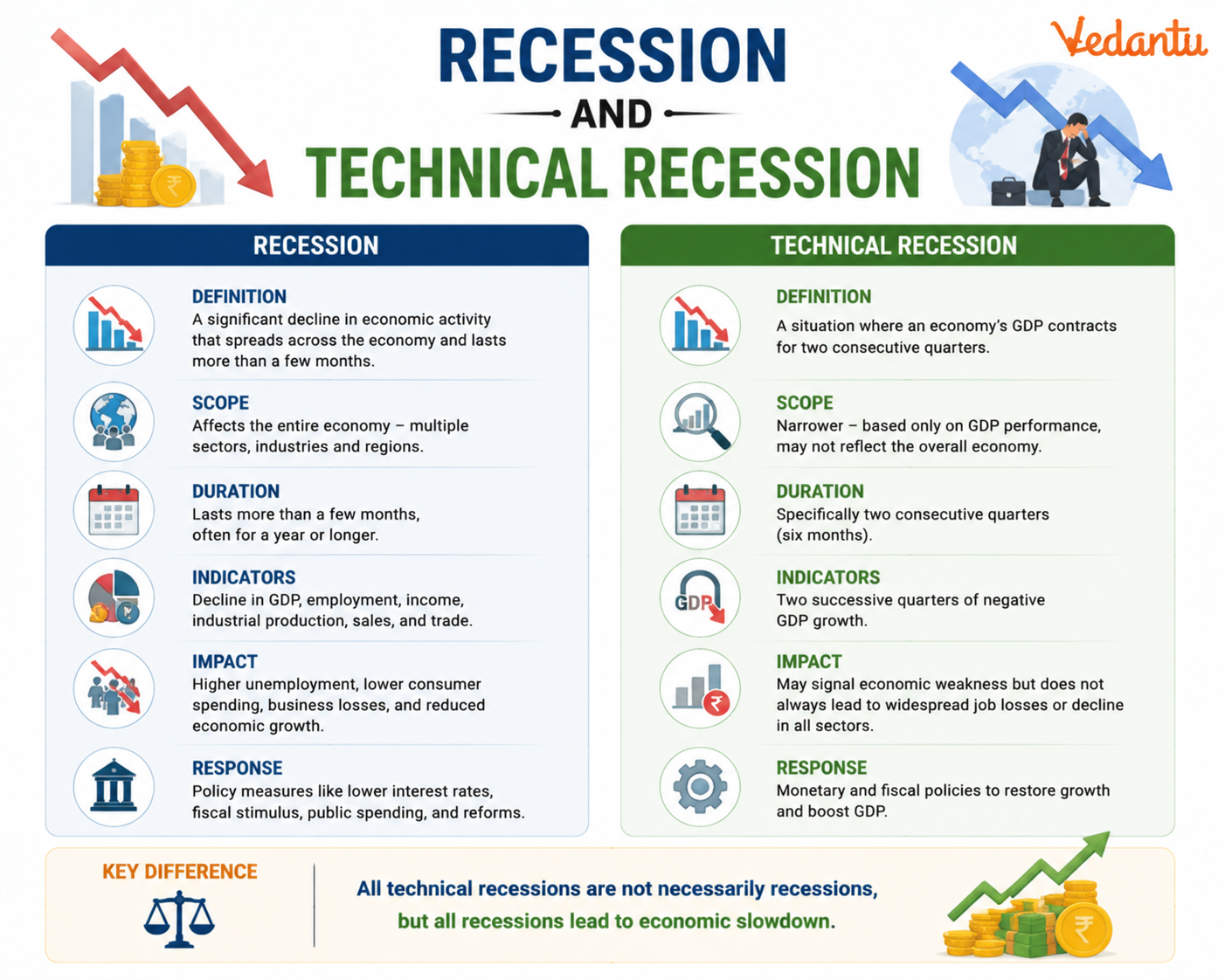
What is a Recession?
A recession is a broad slowdown in economic activity across a country or region. It is characterized by a decline in key economic indicators such as GDP, employment, investment, and consumer spending. Recessions can result from various factors including financial crises, high inflation, external shocks, or policy mistakes.
Key Features of a Recession
- Decline in Gross Domestic Product - GDP
- Rise in unemployment rate
- Fall in consumer spending and business investment
- Decrease in industrial production and trade
- Reduced income and lower demand for goods and services
Causes of Recession
Recessions can be triggered by multiple economic and non-economic factors. Often, a combination of issues leads to a sustained slowdown.
- High inflation leading to reduced purchasing power
- Sharp increase in interest rates
- Financial market crashes
- Global economic slowdown
- Pandemics, wars, or natural disasters
What is a Technical Recession?
A technical recession is defined as two consecutive quarters of negative GDP growth. This definition is widely used because it provides a clear and measurable indicator of economic decline. However, it does not consider other factors like unemployment or income levels.
Why It Is Called Technical
The term technical is used because the definition is based strictly on statistical data - specifically GDP growth rates - rather than a broad assessment of the entire economy. A country may technically be in recession even if other economic indicators are relatively stable.
Difference Between Recession and Technical Recession
| Basis of Comparison | Recession | Technical Recession |
|---|---|---|
| Definition | Broad economic slowdown | Two consecutive quarters of negative GDP growth |
| Indicators Used | GDP, employment, income, production | Mainly GDP data |
| Scope | Comprehensive economic assessment | Limited statistical measure |
In simple terms, all technical recessions may indicate a slowdown, but not all recessions are declared solely on the basis of GDP decline. Economists often look at multiple indicators before officially declaring a recession.
Economic Impact of Recession
Recessions have wide-ranging effects on individuals, businesses, and governments. The severity and duration determine how deeply the economy is affected.
- Job losses and rising unemployment
- Business closures and reduced profits
- Decline in stock markets
- Lower tax revenues for the government
- Increased government borrowing and fiscal deficit
Measures to Control Recession
Governments and central banks adopt various fiscal and monetary measures to control or reduce the impact of recession.
Monetary Policy Measures
- Reducing interest rates
- Increasing money supply
- Encouraging bank lending
Fiscal Policy Measures
- Increasing government spending
- Providing tax cuts
- Offering subsidies and relief packages
Recession in Current Affairs Context
In competitive exams and interviews, questions about recession often relate to global economic trends, inflation, GDP growth rates, and government responses. Understanding the difference between recession and technical recession helps in analyzing economic news and policy decisions more accurately.
Conclusion
Recession and technical recession are important economic concepts that describe periods of declining economic activity. While a technical recession focuses strictly on GDP contraction for two consecutive quarters, a recession involves a broader and deeper economic slowdown. Knowing their definitions, causes, impacts, and control measures helps students and aspirants develop a clear understanding of macroeconomic stability and economic policy decisions.
FAQs on Recession and Technical Recession Explained for Students
1. What is a recession in economics?
A recession is a significant decline in economic activity lasting for months or years. It is characterized by:
• A fall in Gross Domestic Product (GDP)
• Rising unemployment rate
• Decline in industrial production and business profits
• Reduced consumer spending and investment
In simple terms, a recession means the economy is shrinking instead of growing. It is often discussed in contexts like economic slowdown, business cycle, and financial crisis.
2. What is a technical recession?
A technical recession occurs when a country’s GDP declines for two consecutive quarters. It is identified by:
• Negative GDP growth for six months
• Reduced business activity
• Lower consumer confidence
Unlike a general recession, a technical recession is defined strictly by GDP data and may not always reflect a severe economic crisis. It is often searched as two-quarter GDP decline or economic contraction.
3. What is the difference between a recession and a technical recession?
The main difference lies in definition and severity. Recession vs Technical Recession can be understood as:
• Recession: Broad economic decline including unemployment, falling income, and reduced production.
• Technical Recession: Defined only by two consecutive quarters of negative GDP growth.
A technical recession may be mild, while a full recession often involves deeper economic distress and wider impact on society.
4. What are the main causes of a recession?
A recession is usually caused by multiple economic factors working together. Key causes include:
• High inflation and rising interest rates
• Financial crises or banking collapse
• Decline in consumer demand
• Global events like pandemics or wars
• Asset bubbles (e.g., housing market crash)
These factors disturb the economic cycle and reduce overall economic growth.
5. How does a recession affect employment?
A recession typically leads to higher unemployment due to reduced business activity. Its impact includes:
• Job layoffs and hiring freezes
• Reduced wages and working hours
• Closure of small businesses
As companies earn less profit, they cut costs by reducing staff. This leads to a rise in the jobless rate and economic hardship for households.
6. Who declares a recession officially?
A recession is officially declared by authorized economic institutions. For example:
• In the United States, the National Bureau of Economic Research (NBER) declares it.
• In other countries, central banks or statistical agencies analyze GDP and economic indicators.
They consider factors like GDP growth, income levels, employment, and industrial output before confirming a recession.
7. What happens to stock markets during a recession?
During a recession, stock markets often experience volatility and decline. Common effects include:
• Falling share prices
• Reduced investor confidence
• Increased market uncertainty
Investors may shift money to safer assets like gold or government bonds. However, markets sometimes recover before the recession officially ends.
8. Can a technical recession turn into a full recession?
Yes, a technical recession can develop into a full recession if economic conditions worsen. This may happen when:
• Unemployment rises sharply
• Consumer spending declines further
• Inflation remains high
If the downturn spreads across multiple sectors, it becomes a broader economic downturn rather than just a GDP contraction.
9. How can governments control or reduce a recession?
Governments and central banks use economic policies to reduce the impact of a recession. These include:
• Lowering interest rates
• Increasing government spending (fiscal stimulus)
• Reducing taxes
• Providing financial aid to businesses
Such measures aim to boost economic recovery, increase demand, and restore growth.
10. What are some historical examples of recessions?
Several major recessions have impacted the global economy. Notable examples include:
• The Great Depression (1929)
• The Global Financial Crisis (2008)
• The COVID-19 Recession (2020)
These events caused massive declines in GDP, high unemployment, and global economic instability, making them important case studies in economic history and competitive exams.
