






Tripartite struggle between the Pala, Pratihara and Rashtrakuta dynasties for Kannauj
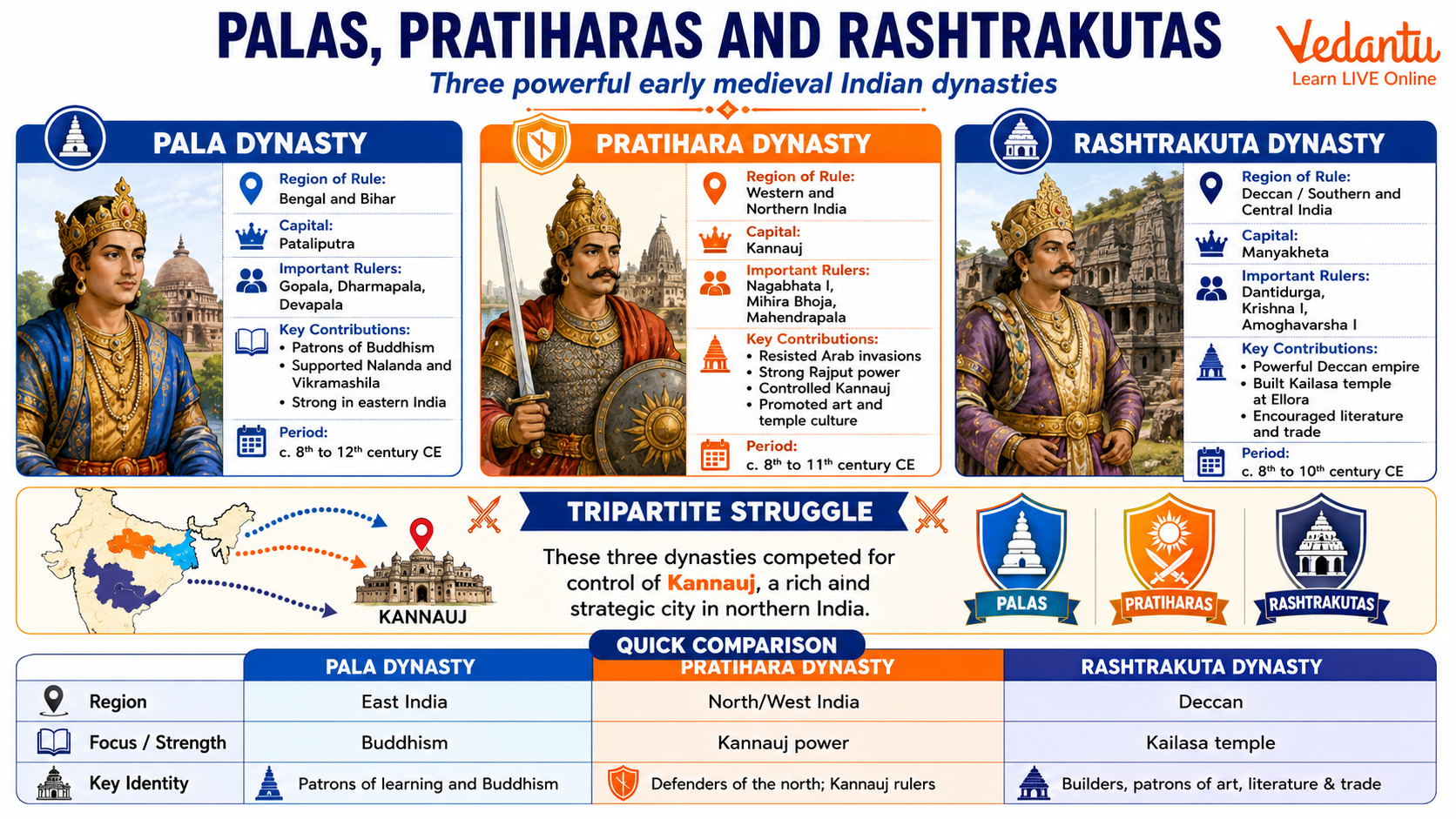
The Palas, Pratiharas, and Rashtrakutas were three powerful dynasties that dominated early medieval India between the 8th and 10th centuries CE. These kingdoms played a crucial role in shaping the political, cultural, religious, and economic landscape of India. Their tripartite struggle for control over Kannauj is one of the most significant political events of this period. Understanding the rise, administration, cultural contributions, and decline of these dynasties is essential for students and competitive exam aspirants as it provides insights into early medieval Indian history.
Historical Background
After the death of Harshavardhana in the 7th century CE, northern India witnessed political fragmentation. This led to the emergence of several regional powers. Among them, the Palas in eastern India, the Pratiharas in western and northern India, and the Rashtrakutas in the Deccan became dominant. Their rivalry for political supremacy, especially over Kannauj, shaped the political history of early medieval India.
The Pala Dynasty
Origin and Important Rulers
The Pala dynasty was founded by Gopala in the mid 8th century CE in Bengal. He was elected by local chieftains to end political instability. The dynasty reached its peak under Dharmapala and Devapala.
- Gopala - Founder of the dynasty.
- Dharmapala - Expanded the empire and participated in the tripartite struggle.
- Devapala - Extended control to Assam and parts of Odisha.
Administration and Culture
The Palas followed a monarchical system. The king was assisted by ministers and local officials. They were strong supporters of Buddhism and contributed significantly to education and art.
- Patronized Mahayana Buddhism.
- Established famous universities like Nalanda and Vikramashila.
- Promoted Pala school of art known for bronze sculptures and palm leaf manuscripts.
The Pratihara Dynasty
Origin and Important Rulers
The Pratiharas, also known as Gurjara Pratiharas, ruled western and northern India. The dynasty was founded by Nagabhata I in the 8th century CE. They defended India against Arab invasions from the west.
- Nagabhata I - Resisted Arab invasions.
- Vatsaraja - Expanded the kingdom.
- Mihira Bhoja - Greatest ruler, consolidated power and strengthened Kannauj.
Administration and Culture
The Pratiharas had a strong military organization. They supported Hinduism and built many temples. Kannauj became a prominent political and cultural center under their rule.
- Promoted temple architecture in north India.
- Encouraged Sanskrit literature.
- Maintained strong cavalry forces.
The Rashtrakuta Dynasty
Origin and Important Rulers
The Rashtrakutas ruled the Deccan region with their capital at Manyakheta. Dantidurga founded the dynasty in the 8th century CE. The empire expanded under Krishna I and Amoghavarsha I.
- Dantidurga - Founder of the dynasty.
- Krishna I - Built the Kailasa temple at Ellora.
- Amoghavarsha I - Promoted literature and Jainism.
Administration and Culture
The Rashtrakutas maintained efficient administration through provincial governors. They were tolerant in religious matters and supported Hinduism, Buddhism, and Jainism.
- Constructed the rock cut Kailasa temple at Ellora.
- Encouraged Kannada and Sanskrit literature.
- Maintained trade relations with Arab countries.
Tripartite Struggle for Kannauj
The tripartite struggle was a long drawn conflict among the Palas, Pratiharas, and Rashtrakutas for control over Kannauj. Kannauj was strategically important due to its location and economic prosperity. Control over Kannauj symbolized political supremacy in northern India.
- Dharmapala of the Palas captured Kannauj initially.
- Vatsaraja and later Mihira Bhoja of the Pratiharas contested it.
- Rashtrakuta rulers like Dhruva and Govinda III intervened from the Deccan.
Comparison of Palas, Pratiharas and Rashtrakutas
| Dynasty | Region | Key Contribution |
|---|---|---|
| Palas | Bengal and Bihar | Patronage of Buddhism and universities |
| Pratiharas | Western and Northern India | Defense against Arabs and temple architecture |
| Rashtrakutas | Deccan region | Kailasa temple and literary growth |
The three dynasties significantly influenced political stability, cultural development, and regional identity in early medieval India. Their rivalry prevented any single power from permanently dominating northern India but contributed to rich cultural and architectural achievements.
Decline of the Three Dynasties
By the 10th century CE, internal conflicts, succession disputes, and external invasions weakened these empires.
- The Palas declined due to weak successors and regional revolts.
- The Pratiharas lost control due to internal fragmentation.
- The Rashtrakutas were replaced by the Later Chalukyas.
Importance for Competitive Exams
The Palas, Pratiharas, and Rashtrakutas are frequently asked topics in General Knowledge and history sections of competitive exams. Questions often focus on the tripartite struggle, important rulers, architectural achievements, and religious patronage. Students should remember key rulers, capitals, cultural contributions, and the significance of Kannauj.
A clear understanding of these three dynasties helps in analyzing the political and cultural transformation of early medieval India. Their contributions to art, architecture, religion, and education continue to influence Indian heritage today.
FAQs on Palas, Pratiharas and Rashtrakutas in Early Medieval India
1. Who were the Palas, Pratiharas, and Rashtrakutas?
The Palas, Pratiharas, and Rashtrakutas were three powerful dynasties that ruled different parts of early medieval India (8th–10th century CE) and fought for supremacy in North India.
• Palas ruled over Bengal and Bihar.
• Pratiharas controlled parts of Western and Northern India.
• Rashtrakutas governed the Deccan region.
This period is known for the Tripartite Struggle, political rivalry, temple architecture, and regional empire-building.
2. What was the Tripartite Struggle?
The Tripartite Struggle was a three-way conflict among the Palas, Pratiharas, and Rashtrakutas for control over Kannauj.
• Kannauj was a symbol of political power in North India.
• The struggle lasted from the 8th to 10th century.
• No dynasty achieved permanent control.
This conflict weakened all three kingdoms and is a key topic in medieval Indian history and competitive exams.
3. Who founded the Pala dynasty?
The Pala dynasty was founded by Gopala in the mid-8th century CE.
• He was elected by local chiefs to end political chaos in Bengal.
• Famous rulers included Dharmapala and Devapala.
• The Palas were major patrons of Buddhism and founded institutions like Vikramashila University.
The Pala Empire is known for its role in spreading Mahayana Buddhism.
4. Who were the important rulers of the Pratihara dynasty?
The most important rulers of the Gurjara-Pratihara dynasty were Nagabhata I, Vatsaraja, and Mihira Bhoja.
• Nagabhata I resisted Arab invasions.
• Mihira Bhoja expanded the empire significantly.
• They ruled from Kannauj as their capital.
The Pratiharas played a key role in protecting North India from foreign invasions.
5. Who founded the Rashtrakuta dynasty?
The Rashtrakuta dynasty was founded by Dantidurga in the 8th century CE.
• Their capital was Manyakheta (in present-day Karnataka).
• Famous rulers included Krishna I and Amoghavarsha I.
• They built the magnificent Kailasa Temple at Ellora.
The Rashtrakutas were known for military power, art, and cultural achievements in the Deccan region.
6. Why was Kannauj important in medieval India?
Kannauj was important because it symbolized political authority over Northern India.
• It was a prosperous trade and cultural center.
• It became the focal point of the Tripartite Struggle.
• Control over Kannauj meant dominance in the Gangetic plains.
Due to its strategic and economic importance, it was highly contested by major dynasties.
7. What were the cultural contributions of the Palas?
The Palas made significant contributions to Buddhist education, art, and architecture.
• Established universities like Nalanda and Vikramashila.
• Promoted Mahayana Buddhism.
• Developed the unique Pala school of art (bronze sculptures, manuscripts).
Their cultural influence spread to Tibet and Southeast Asia.
8. What are the architectural achievements of the Rashtrakutas?
The Rashtrakutas are famous for their rock-cut temple architecture, especially the Kailasa Temple.
• Built at Ellora Caves by Krishna I.
• Carved out of a single rock (monolithic structure).
• Represents Dravidian architectural style.
This temple is considered one of the greatest achievements of Indian temple architecture.
9. How did the Tripartite Struggle affect medieval India?
The Tripartite Struggle weakened the three major dynasties and led to political instability.
• Continuous wars drained resources.
• No permanent empire was formed.
• Regional powers later emerged.
This struggle shaped the political landscape of early medieval Indian history.
10. What led to the decline of the Palas, Pratiharas, and Rashtrakutas?
The decline of these dynasties was mainly due to internal conflicts and external invasions.
• Weak successors after powerful rulers.
• Constant warfare during the Tripartite Struggle.
• Rise of new regional kingdoms like the Cholas and Rajputs.
By the 10th century, their power declined, marking the transition to new political formations in medieval India.
