






Key Features and Challenges of Agricultural Labour in the Rural Economy
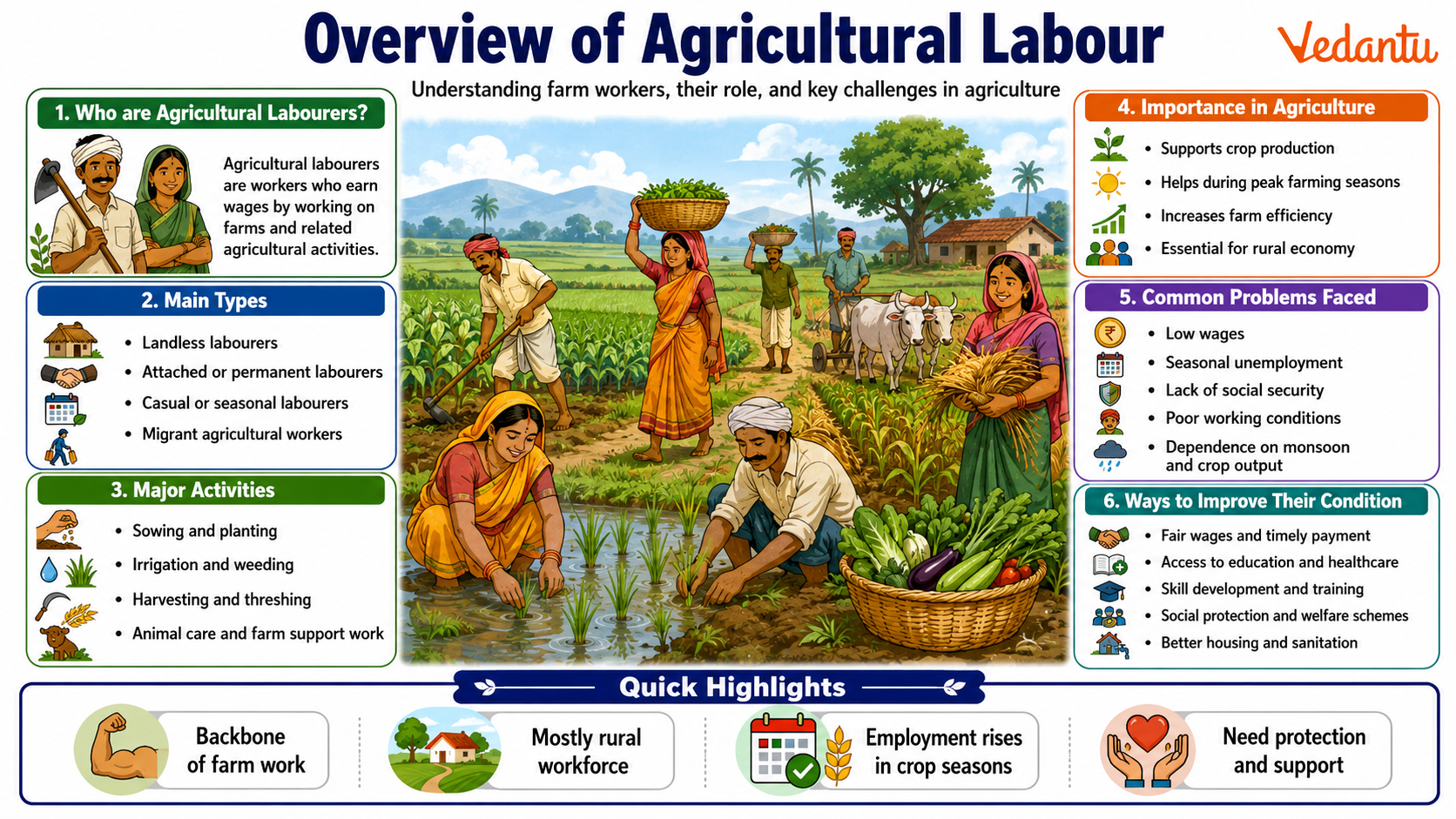
Agricultural labour refers to individuals who work on farms and agricultural fields for wages. These workers play a vital role in the agricultural sector by contributing manual and skilled labor for activities such as sowing, irrigation, harvesting, and post-harvest processing. In many developing countries, especially India, agricultural labour forms a significant part of the rural workforce. Understanding the concept of agricultural labour is important for students, competitive exam aspirants, and general readers because it is closely linked to rural development, poverty, employment, and economic growth.
Meaning and Definition of Agricultural Labour
Agricultural labourers are individuals who work on agricultural land owned by others and earn wages in cash or kind. They generally do not own sufficient land to cultivate on their own and depend primarily on wage employment in agriculture for their livelihood.
- They work on farms owned by landlords or large farmers.
- They are paid daily wages, monthly wages, or a share of the produce.
- They usually belong to economically weaker sections of society.
- Employment is often seasonal and uncertain.
Types of Agricultural Labour
Agricultural labour can be classified based on the nature of employment and duration of work. This classification helps in understanding their working conditions and economic status.
1. Landless Agricultural Labourers
These labourers do not own any land. They depend entirely on wage employment in agriculture for survival.
2. Small and Marginal Farmers as Labourers
These individuals own small plots of land, but their income from farming is insufficient. Therefore, they also work as labourers on other farms.
3. Permanent Agricultural Labourers
They are employed throughout the year by a landlord or farmer and receive regular wages or benefits.
4. Casual or Seasonal Labourers
These labourers are hired temporarily during peak agricultural seasons such as sowing and harvesting.
Role of Agricultural Labour in the Economy
Agricultural labourers are the backbone of the rural agricultural system. Their contribution is essential for ensuring food security and economic stability.
- Support in crop production and harvesting.
- Contribution to rural employment generation.
- Enhancement of agricultural productivity.
- Reduction of rural poverty when adequate wages are provided.
Key Features of Agricultural Labour
| Feature | Description | Impact |
|---|---|---|
| Seasonal Employment | Work depends on crop cycles | Irregular income |
| Low Wages | Paid minimal daily wages | Poverty and low living standards |
| Lack of Job Security | No permanent contracts | Economic uncertainty |
The above features show that agricultural labourers often face economic instability and social challenges due to the nature of their work.
Problems Faced by Agricultural Labourers
Despite their important role, agricultural labourers face several hardships that affect their quality of life and economic well-being.
- Low and irregular wages.
- Seasonal unemployment and underemployment.
- Poor working and living conditions.
- Lack of access to education and healthcare.
- Indebtedness and dependency on landlords.
Measures for Improvement
To improve the socio-economic condition of agricultural labourers, several measures can be implemented by governments and communities.
- Implementation of minimum wage laws in rural areas.
- Provision of employment guarantee schemes.
- Access to education, healthcare, and housing facilities.
- Promotion of skill development and alternative employment opportunities.
Importance for Competitive Exams
Overview of Agricultural Labour is an important topic in General Knowledge, especially for exams that include questions on Indian economy, rural development, and social issues. Questions may be asked about types of agricultural labourers, their problems, government measures, and their role in economic development. Understanding this topic helps aspirants connect agricultural labour with broader themes such as poverty alleviation and employment generation.
Conclusion
Agricultural labour forms the foundation of the farming sector by providing essential manpower for agricultural activities. Although they contribute significantly to food production and rural economy, they often face economic hardship and social challenges. Improving their working conditions, ensuring fair wages, and providing social security are crucial steps toward inclusive rural development and sustainable economic growth.
FAQs on Agricultural Labour: Meaning, Types and Role in Farming
1. What is agricultural labour?
Agricultural labour refers to workers who earn their livelihood by working on farms owned by others for wages.
- They do not own land or have very small landholdings.
- They work in activities like sowing, harvesting, irrigation, and threshing.
- They are paid in cash, kind (grain), or both.
- The term is commonly used in topics like rural economy, farm workers, and agrarian structure.
2. Who are called agricultural labourers?
Agricultural labourers are individuals who depend mainly on wage employment in agriculture for their income.
- They own little or no agricultural land.
- They work seasonally or permanently on others’ farms.
- They are part of the rural workforce and informal sector.
- In India, many belong to economically weaker sections and marginalized communities.
3. What are the main types of agricultural labour?
Agricultural labour is broadly classified based on employment conditions and duration of work.
- Landless labourers: Completely depend on farm wages.
- Small farmers working as labourers: Own tiny plots but also work for others.
- Permanent labourers: Employed throughout the year.
- Casual/Seasonal labourers: Hired during peak seasons like sowing and harvesting.
4. What are the major problems faced by agricultural labourers?
Agricultural labourers face economic and social challenges due to low income and seasonal employment.
- Low wages and wage exploitation.
- Seasonal unemployment and underemployment.
- Poor living conditions and lack of social security.
- Limited access to education, healthcare, and credit facilities.
5. How are agricultural labourers different from farmers?
Agricultural labourers and farmers differ mainly in land ownership and income source.
- Farmers own or lease land and earn profit from crop production.
- Agricultural labourers work on others’ land for wages.
- Farmers bear production risks, while labourers depend on daily wages.
- This distinction is important in understanding the agrarian economy and rural class structure.
6. What is the condition of agricultural labour in India?
The condition of agricultural labour in India is marked by poverty, irregular work, and limited protection.
- A large percentage lives below the poverty line.
- Employment is highly dependent on monsoon and crop cycles.
- Many migrate to cities for alternative work.
- Government schemes like MGNREGA (Mahatma Gandhi National Rural Employment Guarantee Act) aim to provide wage security.
7. What are the causes of the growth of agricultural labour in India?
The growth of agricultural labour in India is linked to population pressure and land fragmentation.
- Rapid population growth in rural areas.
- Subdivision and fragmentation of landholdings.
- Decline of traditional cottage industries.
- Indebtedness leading to loss of land ownership.
8. What role do agricultural labourers play in the rural economy?
Agricultural labourers play a crucial role in crop production and food security.
- They contribute to planting, weeding, irrigation, and harvesting.
- They support large-scale and commercial farming.
- Their labour ensures timely agricultural operations.
- They form the backbone of the agrarian and rural economy.
9. What measures has the government taken for agricultural labour welfare?
The government has introduced welfare schemes to improve the condition of agricultural labourers.
- MGNREGA for guaranteed rural employment.
- Minimum wage laws under the Minimum Wages Act.
- Social security schemes like health insurance and pensions.
- Rural housing and food security programs.
10. Why is agricultural labour important for competitive exams and GK?
Agricultural labour is an important topic in General Knowledge and competitive exams because it relates to India’s rural development and economy.
- Frequently asked in exams like UPSC, SSC, State PSC, and banking exams.
- Linked to topics such as poverty, unemployment, land reforms, and rural development.
- Helps in understanding India’s agrarian structure and socio-economic conditions.
