






How Did the Sacred River Ganga Originate According to Mythology?
The Origin of the Holy River Ganga is a topic of great religious, geographical, and cultural importance in India. The Ganga, also known as the Ganges, is considered the most sacred river in Hinduism and plays a vital role in the lives of millions of people. Its origin is described both scientifically and mythologically. While geography explains its source in the Himalayas, Hindu scriptures narrate a divine story of its descent from heaven to earth. Understanding the origin of the Ganga helps students connect history, geography, culture, and religious traditions in a meaningful way.
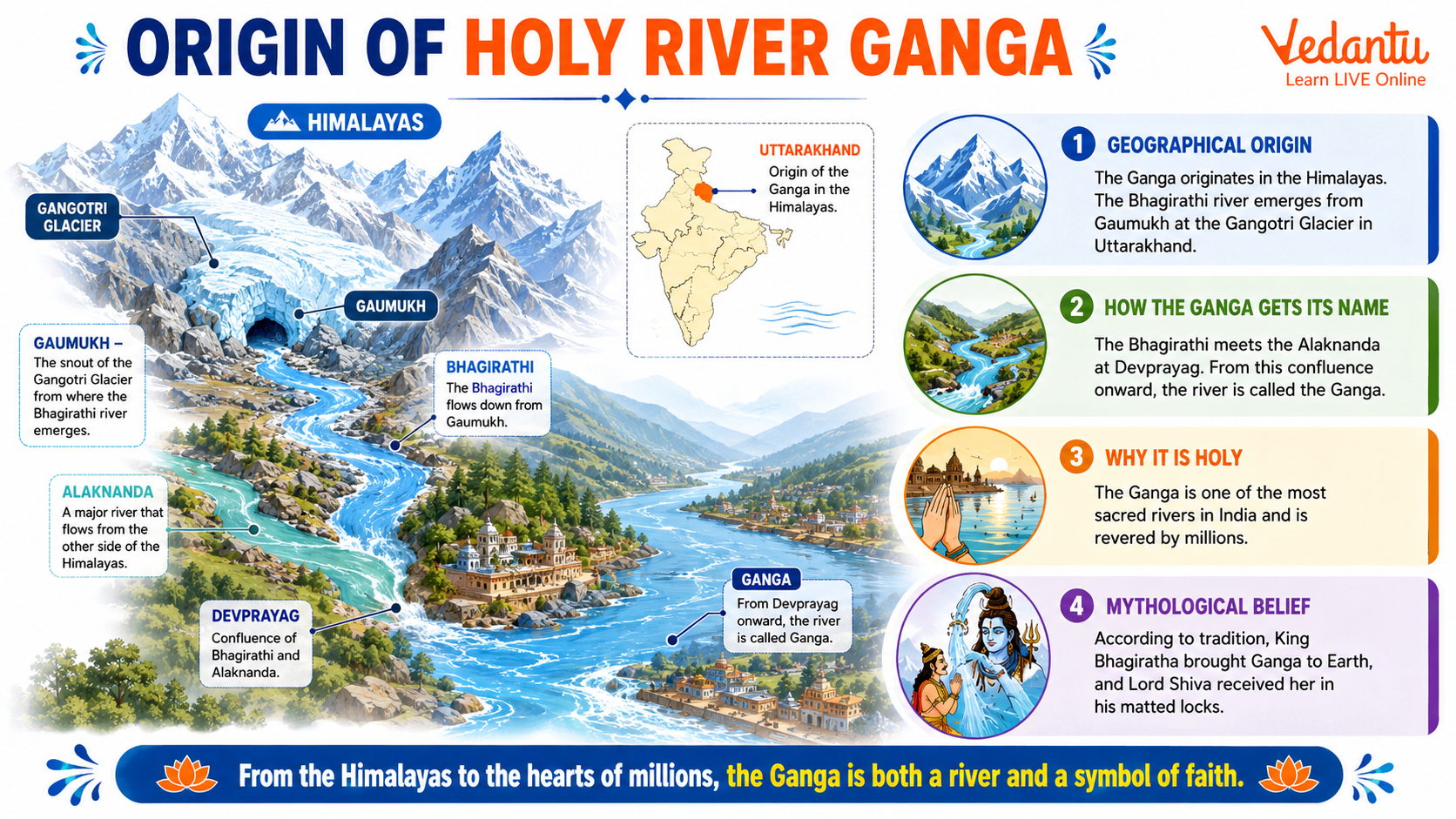
Geographical Origin of River Ganga
From a geographical perspective, the River Ganga originates in the Himalayas in the state of Uttarakhand, India. The main source of the Ganga is the Gangotri Glacier, located at an altitude of about 4,100 meters above sea level. The river begins as a stream called Bhagirathi from a place known as Gaumukh.
The Bhagirathi River later meets the Alaknanda River at Devprayag. From this confluence onward, the river is officially known as the Ganga.
Key Geographical Facts
- Source glacier - Gangotri Glacier
- Origin point - Gaumukh in Uttarakhand
- Initial name - Bhagirathi River
- Confluence - Devprayag where Bhagirathi meets Alaknanda
- Total length - About 2,525 kilometers
Mythological Origin of River Ganga
In Hindu mythology, the origin of the Ganga is linked to a divine story described in ancient scriptures like the Ramayana and the Puranas. According to legend, the river originally flowed in heaven. It was brought down to earth by King Bhagiratha to purify the souls of his ancestors.
The Story of King Bhagiratha
King Bhagiratha performed intense penance to please Lord Brahma and requested him to send the Ganga to earth. Brahma agreed but warned that the force of the descending river would destroy the earth. Bhagiratha then prayed to Lord Shiva for help.
Lord Shiva captured the powerful flow of the Ganga in his matted hair and gently released it onto the earth. This divine descent of the river is known as Ganga Avataran.
- Heavenly origin - Flowed in the celestial world
- Brought to earth by - King Bhagiratha
- Controlled by - Lord Shiva
- Purpose - To liberate ancestors and purify humanity
Comparison Between Geographical and Mythological Origin
| Aspect | Geographical Origin | Mythological Origin |
|---|---|---|
| Source | Gangotri Glacier | Heaven |
| Key Figure | Natural formation | King Bhagiratha and Lord Shiva |
| Purpose | Natural river system | Spiritual purification |
The geographical origin explains the physical source of the river, while the mythological origin highlights its religious and spiritual importance in Indian culture.
Religious Significance of Ganga
The Ganga is regarded as a goddess in Hinduism and is worshipped as Goddess Ganga. It is believed that bathing in the river cleanses sins and helps in attaining salvation. Many important religious cities such as Haridwar, Varanasi, and Prayagraj are situated on its banks.
- Considered sacred in Hindu religion
- Used in rituals, festivals, and ceremonies
- Kumbh Mela is organized on its banks
- Ash immersion rituals are performed in the river
Importance for General Knowledge and Competitive Exams
The origin of the Holy River Ganga is an important topic in General Knowledge, Geography, and History. Questions related to its source, tributaries, religious importance, and mythological stories are frequently asked in school exams and competitive examinations.
Preparation Tips
- Remember the geographical source - Gangotri Glacier at Gaumukh
- Understand the confluence at Devprayag
- Learn the story of King Bhagiratha and Lord Shiva
- Revise important religious cities located on its banks
Conclusion
The Origin of the Holy River Ganga combines both natural science and sacred tradition. Geographically, it begins from the Gangotri Glacier in the Himalayas, while mythologically it descends from heaven through the efforts of King Bhagiratha and the grace of Lord Shiva. This dual significance makes the Ganga not only a major river system of India but also a symbol of faith, purity, and cultural unity. Understanding its origin provides valuable insight into India's geography, history, and spiritual heritage.
FAQs on Origin of the Holy River Ganga and Its Sacred Story
1. What is the origin of the Holy River Ganga according to Hindu mythology?
The Holy River Ganga originated from heaven and descended to Earth through the efforts of King Bhagiratha, according to Hindu mythology.
• Mentioned in Ramayana, Mahabharata, and Puranas
• Believed to have flowed from Lord Vishnu’s feet
• Brought to Earth to liberate the souls of Bhagiratha’s ancestors
• Controlled by Lord Shiva, who held her in his matted hair (Jata)
This story explains why Ganga is considered sacred, divine, and spiritually purifying.
2. Why did King Bhagiratha bring River Ganga to Earth?
King Bhagiratha brought the River Ganga to Earth to free his ancestors from a curse and grant them salvation (moksha).
• His ancestors were cursed by Sage Kapila
• Their souls could only be purified by the holy waters of Ganga
• Bhagiratha performed severe penance (tapasya) for years
• His devotion pleased Lord Brahma and Lord Shiva
This act is why the river is also called Bhagirathi.
3. What role did Lord Shiva play in the origin of Ganga?
Lord Shiva played a crucial role by controlling the powerful descent of Ganga from heaven to Earth.
• Ganga’s force could have destroyed the Earth
• Shiva caught her in his matted locks (Jata)
• He gently released her in small streams
• This symbolizes balance, power, and divine control
Thus, Shiva is known as Gangadhara (Bearer of Ganga).
4. What is the scientific origin of the River Ganga?
Scientifically, the River Ganga originates from the Gangotri Glacier in the Himalayas.
• Begins as Bhagirathi River at Gaumukh, Uttarakhand
• Meets Alaknanda River at Devprayag
• After the confluence, it is called Ganga
• Flows through northern India into the Bay of Bengal
This geographical origin complements its mythological significance.
5. Why is the River Ganga considered holy in Hinduism?
The River Ganga is considered holy because it is believed to cleanse sins and grant salvation.
• Associated with Lord Vishnu, Shiva, and Brahma
• Used in religious rituals, puja, and last rites
• Taking a dip is believed to remove negative karma
• Mentioned in sacred Hindu scriptures
Hence, Ganga is worshipped as Ganga Mata (Mother Ganga).
6. What are the other names of River Ganga?
The River Ganga is known by several sacred and regional names.
• Bhagirathi – Named after King Bhagiratha
• Jahnavi – Linked to Sage Jahnu legend
• Mandakini – Heavenly form of the river
• Alaknanda – One of its main tributaries
These names reflect its mythological, spiritual, and geographical importance.
7. In which scriptures is the story of Ganga’s origin mentioned?
The story of the origin of River Ganga is described in major Hindu scriptures.
• Ramayana – Story of Bhagiratha’s penance
• Mahabharata – Birth of Bhishma linked to Ganga
• Bhagavata Purana and other Puranas
• Ancient Vedic texts
These texts highlight Ganga’s divine descent and spiritual significance.
8. Where does the River Ganga finally end?
The River Ganga finally empties into the Bay of Bengal forming a large delta.
• Creates the Sundarbans Delta
• One of the largest river deltas in the world
• Supports rich biodiversity including the Royal Bengal Tiger
• Flows through India and Bangladesh
This end point is geographically important and ecologically rich.
9. What is the cultural importance of the Ganga River in India?
The Ganga River holds immense cultural and national importance in India.
• Lifeline for millions of people
• Central to festivals like Ganga Dussehra and Kumbh Mela
• Supports agriculture and economy
• Symbol of faith, purity, and Indian civilization
It is often called the National River of India.
10. What is the meaning of the term ‘Bhagirath Prayas’?
The term ‘Bhagirath Prayas’ means a determined and extraordinary effort to achieve a difficult goal.
• Derived from King Bhagiratha’s penance
• Symbolizes dedication and perseverance
• Commonly used in literature and competitive exams
• Reflects the legendary origin of River Ganga
This phrase highlights the moral lesson behind the Ganga’s descent story.
