






What Do Articles 343–351 Say About India’s Official Language Policy?
The Official Language in the Indian Constitution is a significant topic in Indian Polity and General Knowledge. It explains the language used for official purposes of the Union and states in India. Language has always been a sensitive and important issue in India due to its vast cultural and linguistic diversity. The Constitution makers carefully designed provisions related to official language to maintain national unity while respecting regional diversity. This topic is frequently asked in competitive examinations such as UPSC, SSC, State PSC, and other government exams.
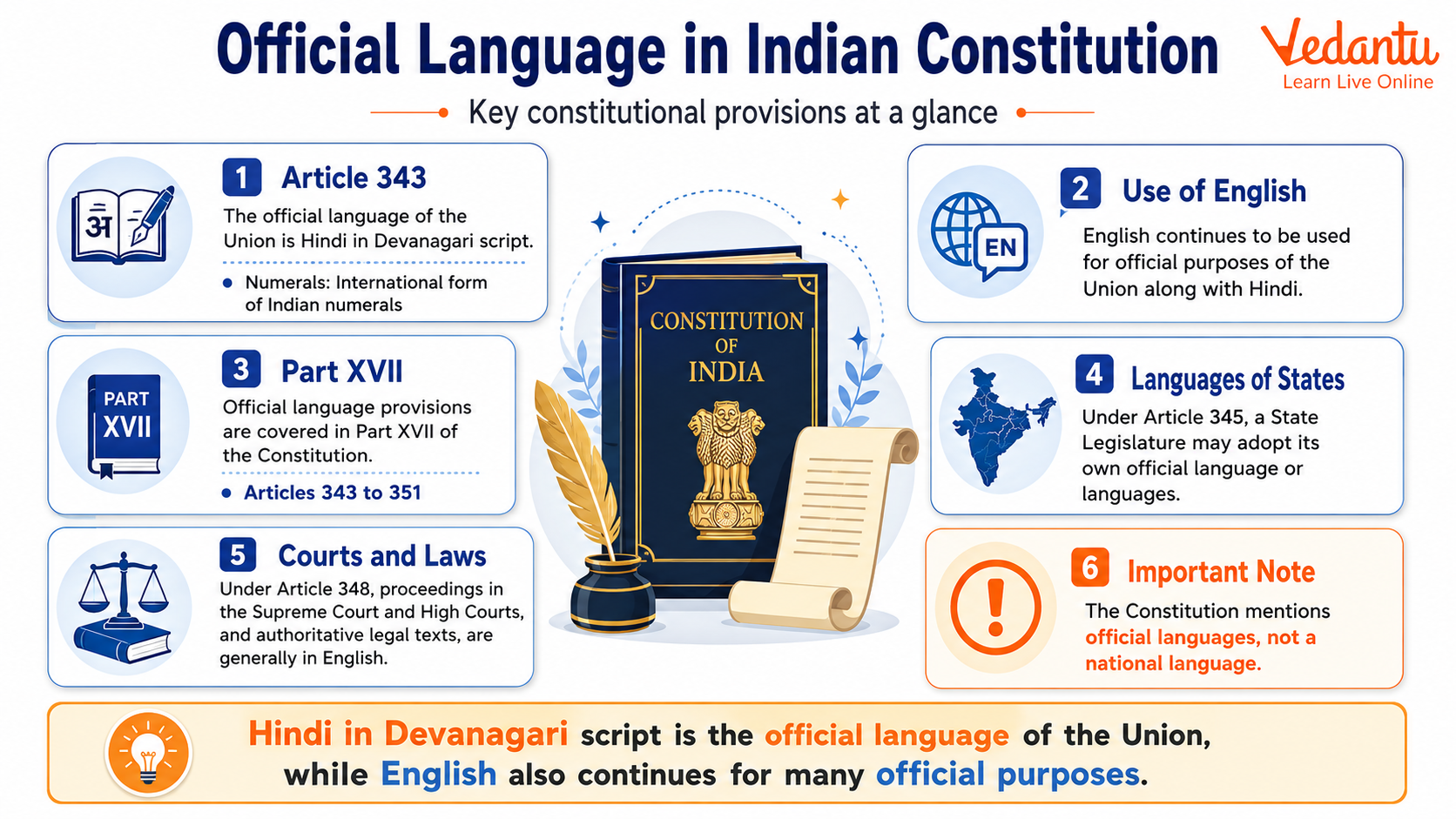
Constitutional Provisions for Official Language
The provisions regarding the Official Language of India are mentioned in Part XVII of the Indian Constitution. It covers Articles 343 to 351 and is divided into four chapters dealing with the language of the Union, regional languages, language of the judiciary, and special directives.
Article 343 - Official Language of the Union
Article 343 states that Hindi in Devanagari script shall be the official language of the Union. The form of numerals to be used for official purposes of the Union shall be the international form of Indian numerals.
- Hindi in Devanagari script is the official language of the Union.
- English was to continue for 15 years from the commencement of the Constitution.
- Parliament can provide for continued use of English even after 15 years.
Official Languages Act, 1963
To address concerns of non Hindi speaking states, the Official Languages Act, 1963 was enacted. It provided for the continued use of English for official purposes of the Union even after 1965.
- English continues along with Hindi for official purposes.
- Communication between the Union and non Hindi states can be in English.
- Ensures linguistic harmony in administration.
Language of States
Article 345 empowers the state legislature to adopt any one or more languages in use in the state or Hindi as the official language of that state. Until the state legislature provides otherwise, English continues to be used for official purposes.
Communication Between States and Union
Articles 346 and 347 deal with communication between states and between states and the Union. The language authorized for official communication is generally Hindi. However, if two states agree, they may communicate in English.
Language of the Judiciary
Article 348 provides that proceedings in the Supreme Court and High Courts shall be in English unless Parliament provides otherwise. Authoritative texts of laws and bills are also in English.
- Supreme Court proceedings are conducted in English.
- High Court proceedings are generally in English.
- Governor can allow use of Hindi in High Court with President's consent.
Special Directives - Article 351
Article 351 directs the Union to promote the spread of Hindi language so that it may serve as a medium of expression for all elements of India's composite culture. It also encourages the development of Hindi by drawing vocabulary from Sanskrit and other languages.
Eighth Schedule of the Constitution
The Eighth Schedule recognizes the scheduled languages of India. Initially, there were 14 languages in the schedule. Currently, there are 22 languages recognized by the Constitution.
Languages in the Eighth Schedule
| Initially Recognized (1950) | Added Later | Total Languages Now |
|---|---|---|
| 14 Languages | 8 Languages | 22 Languages |
| Hindi, Tamil, Telugu etc. | Bodo, Maithili, Santhali etc. | Constitutionally Recognized |
The inclusion of languages in the Eighth Schedule promotes their development and representation in various constitutional bodies. However, it does not automatically make them official languages of the Union.
Key Articles Related to Official Language
Important Articles at a Glance
| Article | Subject | Description |
|---|---|---|
| 343 | Official Language of Union | Hindi in Devanagari script |
| 345 | Official Language of State | State legislature decides |
| 348 | Language of Judiciary | English for Supreme Court and High Courts |
These articles form the constitutional backbone of language policy in India. Understanding these provisions is essential for exams and for grasping how India manages its linguistic diversity.
Importance of Official Language Policy
- Maintains administrative efficiency across the country.
- Ensures unity in diversity.
- Balances national integration with regional identity.
- Frequently asked topic in competitive examinations.
Summary
The Official Language in the Indian Constitution reflects the careful balance between promoting Hindi and respecting India's linguistic diversity. Hindi in Devanagari script is the official language of the Union, while English continues for official purposes under the Official Languages Act, 1963. States have the power to choose their own official languages. The judiciary primarily uses English. The Eighth Schedule recognizes 22 languages for their development and promotion. A clear understanding of Articles 343 to 351 is crucial for competitive exams and general awareness.
FAQs on Official Language in the Indian Constitution: Articles, Rules and Importance
1. What is the Official Language of India according to the Constitution?
The Official Language of India is Hindi in Devanagari script, as stated in Article 343 of the Indian Constitution.
• Hindi is written in the Devanagari script.
• The form of numerals used is the International form of Indian numerals (1, 2, 3...).
• English was permitted to continue for official purposes after 1965 under the Official Languages Act, 1963.
This provision addresses common queries like “What is the national language of India?” and clarifies that India has an official language, not a national language.
2. Which Article of the Indian Constitution deals with the Official Language?
The Official Language provisions are covered under Part XVII (Articles 343 to 351) of the Indian Constitution.
• Article 343 – Official language of the Union
• Article 344 – Commission and Committee on Official Language
• Articles 345–347 – Official language of States
• Articles 348–351 – Language of courts, special directives for Hindi
These Articles are frequently asked in UPSC, SSC, and other competitive exams.
3. Is Hindi the National Language of India?
No, India does not have a National Language; Hindi is the Official Language of the Union.
• The Constitution uses the term “Official Language”, not national language.
• Hindi and English are used for official government work.
• India recognizes 22 Scheduled Languages under the Eighth Schedule.
This clears a common misconception searched as “Is Hindi national language of India?”
4. What is the role of English in the Indian Constitution?
English continues to be used as an associate official language for Union purposes.
• Initially allowed for 15 years (1950–1965).
• Extended through the Official Languages Act, 1963.
• Used in Parliament proceedings, Judiciary, and Central Government communication.
This provision ensures smooth administration in multilingual India and is relevant for questions on Hindi vs English debate.
5. What does Article 351 of the Constitution state?
Article 351 directs the Union to promote the spread and development of Hindi language.
• Promote Hindi as a medium of expression.
• Enrich it by drawing vocabulary from Sanskrit and other Indian languages.
• Develop it as a link language of India.
This Article is important for understanding language policy in India and is frequently asked in GK exams.
6. How many languages are recognized in the Eighth Schedule of the Constitution?
The Eighth Schedule of the Indian Constitution recognizes 22 Scheduled Languages.
• Originally 14 languages in 1950.
• Added through constitutional amendments (e.g., 71st, 92nd, 96th Amendments).
• Includes languages like Hindi, Bengali, Tamil, Telugu, Marathi, Urdu, Gujarati and others.
This is a key topic under official language and regional languages in India.
7. What is the Official Language Act, 1963?
The Official Languages Act, 1963 allows continued use of English along with Hindi for official purposes of the Union.
• Enacted to avoid conflict after 1965.
• Ensures bilingual functioning of the Central Government.
• Amended in 1967 for clarity and continuation.
This Act is crucial in understanding India’s language policy and constitutional provisions.
8. What language is used in the Supreme Court and High Courts?
The English language is used in the Supreme Court and High Courts of India.
• Provided under Article 348 of the Constitution.
• Parliamentary laws and bills are drafted in English.
• States may use Hindi in High Courts with Presidential approval.
This ensures uniformity in the Indian judicial system.
9. Can States choose their own Official Language?
Yes, States can adopt their own Official Language under Article 345.
• State Legislatures can choose any language used in the state.
• Many states use regional languages like Tamil, Kannada, Bengali, Marathi.
• English may continue until the state decides otherwise.
This reflects India’s federal structure and linguistic diversity.
10. Why was Hindi chosen as the Official Language of India?
Hindi was chosen as the Official Language to promote national unity while respecting linguistic diversity.
• Widely spoken across northern India.
• Considered suitable as a link language.
• Debated extensively in the Constituent Assembly (1946–1949).
• Compromise formula included continued use of English.
This historical decision is important for understanding the making of the Indian Constitution and language debate.
