






What Is the Closest Star System to the Solar System and How Far Is It?
The nearest star system to the Solar System is the Alpha Centauri star system. It is located about 4.37 light years away from Earth and is visible from the Southern Hemisphere. Understanding the nearest star system is important in astronomy because it helps scientists study stellar evolution, exoplanets, and the possibility of life beyond Earth. For students and competitive exam aspirants, this topic is frequently asked in General Knowledge and science examinations.
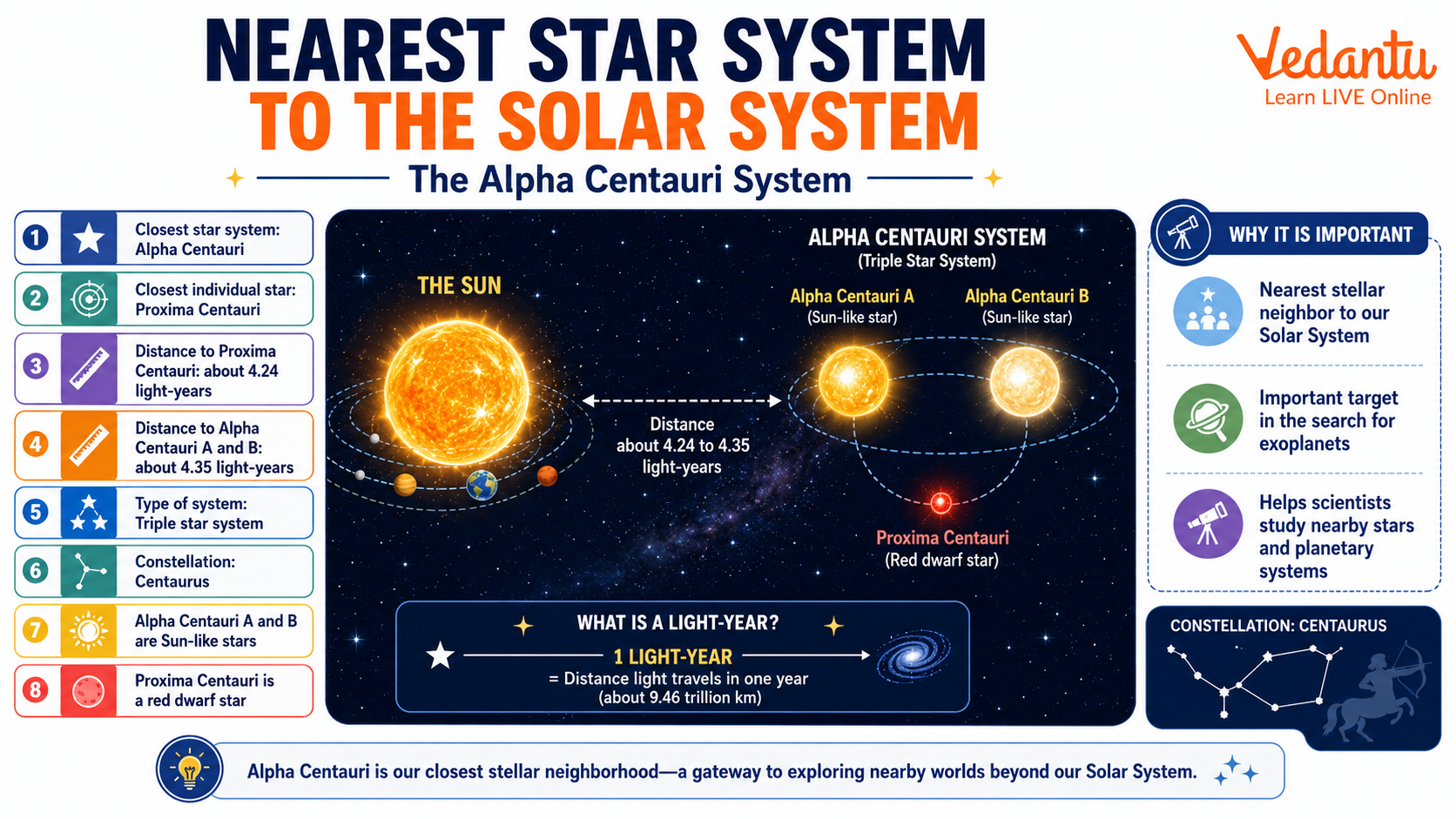
What Is the Nearest Star System?
The nearest star system to the Solar System is Alpha Centauri. A star system is a group of stars that are gravitationally bound and orbit a common center of mass. Unlike our Solar System, which has one star - the Sun - Alpha Centauri consists of three stars.
- Alpha Centauri A
- Alpha Centauri B
- Proxima Centauri
Among these, Proxima Centauri is the closest individual star to the Sun.
Key Facts About the Nearest Star System
| Feature | Details | Importance |
|---|---|---|
| Name of Star System | Alpha Centauri | Closest star system to Earth |
| Distance from Earth | 4.37 light years | Nearest known stellar neighbor |
| Closest Star | Proxima Centauri | About 4.24 light years away |
The relatively short cosmic distance makes Alpha Centauri an important target for space research and future interstellar missions.
Components of Alpha Centauri
1. Alpha Centauri A
Alpha Centauri A is similar to our Sun in size and brightness. It is a main sequence star and slightly larger and brighter than the Sun. It forms a binary pair with Alpha Centauri B.
2. Alpha Centauri B
Alpha Centauri B is slightly smaller and cooler than the Sun. It also belongs to the main sequence category and orbits Alpha Centauri A. Together, they complete one orbit around each other in about 80 years.
3. Proxima Centauri
Proxima Centauri is a red dwarf star and the closest known star to the Sun at approximately 4.24 light years away. It is much smaller and dimmer than the Sun. Despite its small size, it has attracted scientific attention because it hosts at least one confirmed exoplanet in its habitable zone.
Exoplanets in the Nearest Star System
Astronomers have discovered planets orbiting stars in the Alpha Centauri system. The most famous is Proxima Centauri b.
- Proxima Centauri b is an Earth sized exoplanet.
- It lies within the habitable zone of Proxima Centauri.
- It could potentially have liquid water under suitable conditions.
The presence of such planets increases scientific interest in this nearby system.
Why Is Alpha Centauri Important?
The nearest star system is important for several scientific and educational reasons.
- It helps scientists study stellar evolution and binary star systems.
- It is a primary target in the search for extraterrestrial life.
- It is considered for future interstellar travel missions.
- It is commonly asked in competitive exams and quizzes.
Distance in Light Years Explained
A light year is the distance light travels in one year, which is approximately 9.46 trillion kilometers. Since Alpha Centauri is about 4.37 light years away, the light we see from it today started its journey more than four years ago. This shows how vast distances in space are measured and understood.
Quick Revision Points
- Nearest star system - Alpha Centauri
- Closest individual star - Proxima Centauri
- Distance - About 4.37 light years
- Contains three stars
- Hosts potentially habitable exoplanet Proxima Centauri b
In conclusion, the Alpha Centauri star system is our closest stellar neighbor and plays a vital role in modern astronomy. Its proximity allows scientists to study stars and planets outside our Solar System more effectively. For students, remembering key facts about Alpha Centauri is essential for General Knowledge, school exams, and competitive examinations.
FAQs on Nearest Star System to Our Solar System: Distance and Key Facts
1. What is the nearest star system to the Solar System?
The Alpha Centauri star system is the nearest star system to our Solar System.
- It is located about 4.37 light-years away from Earth.
- It consists of three stars: Alpha Centauri A, Alpha Centauri B, and Proxima Centauri.
- It is often searched as "closest star to Earth" and "nearest star system in space."
2. Which is the closest star to Earth after the Sun?
The closest star to Earth after the Sun is Proxima Centauri.
- It is part of the Alpha Centauri system.
- It lies about 4.24 light-years away.
- It is a red dwarf star, smaller and cooler than the Sun.
- Common search terms include "nearest star to Earth" and "Proxima Centauri distance."
3. What are the three stars in the Alpha Centauri system?
The Alpha Centauri system contains three stars forming the nearest stellar system to us.
- Alpha Centauri A – Similar to the Sun in size and brightness.
- Alpha Centauri B – Slightly smaller and cooler than the Sun.
- Proxima Centauri – A faint red dwarf and the closest of the three.
- These stars are key topics in astronomy and space science studies.
4. How far is Alpha Centauri from Earth?
The Alpha Centauri star system is approximately 4.37 light-years from Earth.
- One light-year equals the distance light travels in one year.
- Proxima Centauri is slightly closer at 4.24 light-years.
- This distance is often asked in competitive exams and GK quizzes.
5. Can humans travel to the nearest star system?
Currently, humans cannot travel to the nearest star system with existing technology.
- Modern spacecraft would take thousands of years to reach Alpha Centauri.
- Projects like Breakthrough Starshot aim to develop faster space probes.
- Interstellar travel and deep space exploration remain future scientific goals.
6. Does Proxima Centauri have any planets?
Yes, Proxima Centauri has confirmed exoplanets orbiting it.
- Proxima Centauri b lies in the habitable zone.
- It is considered a potential candidate for liquid water.
- Astronomers study it to explore the possibility of extraterrestrial life and nearby habitable planets.
7. Why is Alpha Centauri important in astronomy?
The Alpha Centauri system is important because it is the closest stellar neighbor to the Solar System.
- It helps scientists study stellar formation and binary star systems.
- It is a target for research on exoplanets and habitable worlds.
- It plays a key role in discussions about interstellar missions.
8. Is Alpha Centauri visible from Earth?
Yes, Alpha Centauri is visible to the naked eye from the Southern Hemisphere.
- It appears as a bright star in the constellation Centaurus.
- It is the third-brightest star system in the night sky.
- It cannot be seen from most northern latitudes.
9. How is Proxima Centauri different from the Sun?
Proxima Centauri differs from the Sun mainly in size, temperature, and brightness.
- It is a red dwarf star, much smaller than the Sun.
- It is cooler and less luminous.
- Unlike the Sun, it produces frequent stellar flares.
- These differences are commonly discussed in solar system vs nearby star comparisons.
10. What is meant by a star system?
A star system is a group of one or more stars bound together by gravity, often with planets orbiting them.
- The Solar System is a single-star system with the Sun.
- Alpha Centauri is a triple-star system.
- Star systems are studied in astronomy, astrophysics, and space science GK topics.
