






How Preventive Detention Works under the National Security Law
The National Security Act (NSA), 1980 is a preventive detention law enacted by the Government of India to safeguard national security and maintain public order. It empowers the central and state governments to detain individuals who are considered a threat to the security of the country, public order, or essential services. The Act plays a significant role in India's internal security framework and is frequently discussed in competitive examinations due to its legal and constitutional importance.
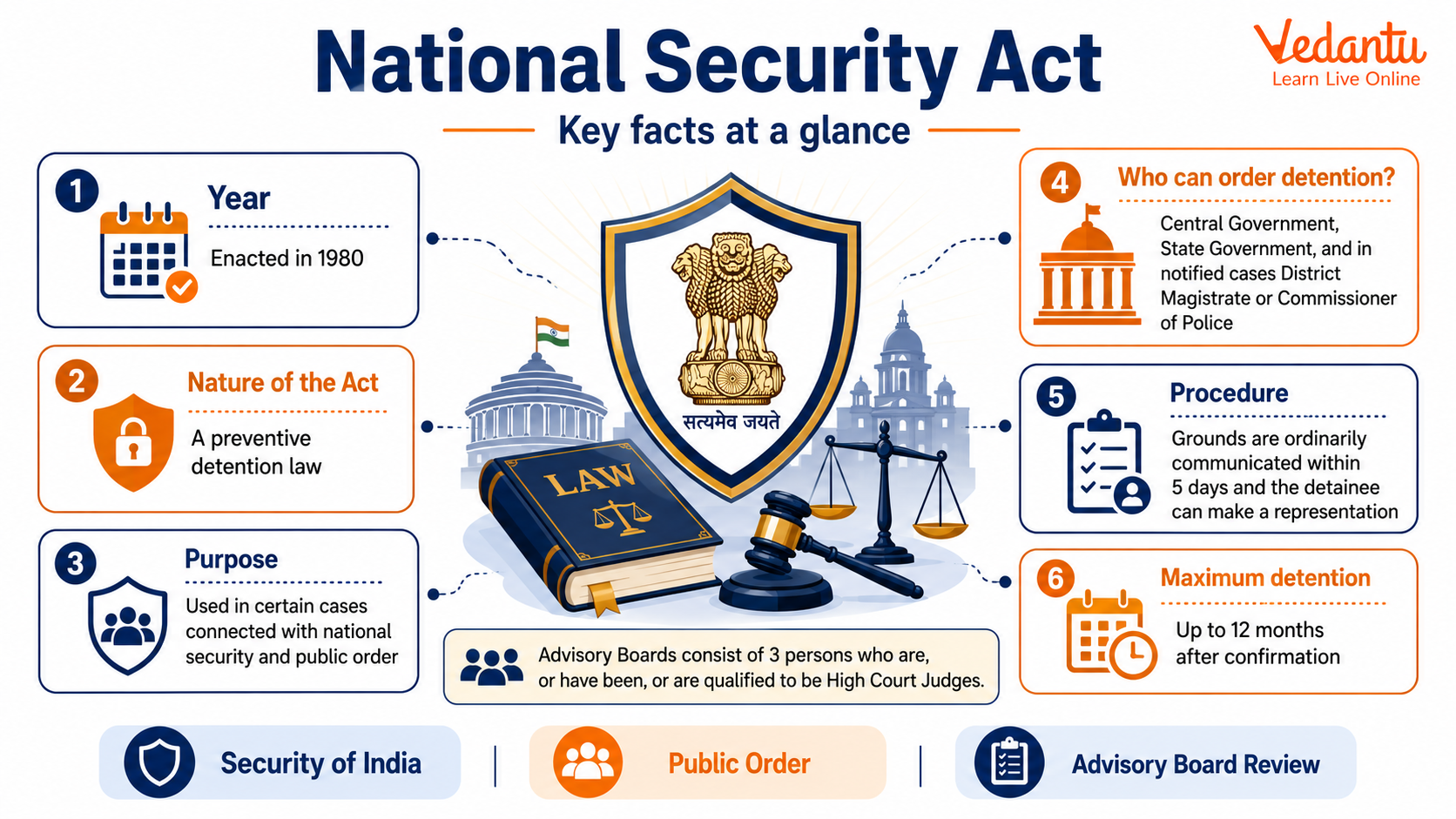
Overview of the National Security Act, 1980
The National Security Act was enacted on 23 September 1980 during the tenure of Prime Minister Indira Gandhi. The Act provides the government with the authority to detain a person without formal charges for a specific period in order to prevent potential threats to national security or public order.
- Enacted in 1980 by the Parliament of India
- Applies across India
- Allows preventive detention without formal charge
- Can be invoked by both Central and State Governments
Objectives of the National Security Act
The primary aim of the NSA is to prevent activities that threaten the security and integrity of the nation. It acts as a preventive mechanism rather than a punitive one.
- To ensure national security and sovereignty
- To maintain public order
- To protect essential services and supplies
- To prevent anti-social and anti-national activities
Key Provisions of the National Security Act
Preventive Detention
Under the NSA, a person can be detained without being informed of the charges for up to 10 days. In certain circumstances, this period can be extended to 15 days. The detention can last for a maximum of 12 months.
Powers of Government Authorities
The District Magistrate or Commissioner of Police can issue detention orders if satisfied that a person poses a threat to national security or public order. The state government must approve such detention within 12 days.
Advisory Board Review
An Advisory Board consisting of High Court judges reviews detention cases. If the board finds insufficient cause for detention, the person must be released.
Grounds for Detention
- Threat to national security
- Disturbance of public order
- Disruption of essential supplies and services
- Foreigners acting against India's interests
Key Features of the National Security Act
| Feature | Provision | Maximum Limit |
|---|---|---|
| Preventive Detention | Detention without formal charge | Up to 12 months |
| Approval Requirement | State Government approval | Within 12 days |
| Advisory Board Review | Review by High Court judges | Within 3 weeks |
The table above summarizes the procedural safeguards and limits imposed under the NSA to balance security needs with individual rights.
Constitutional Basis of Preventive Detention
The National Security Act derives its constitutional validity from Article 22 of the Indian Constitution. Article 22 permits preventive detention laws while also providing certain safeguards to detained individuals.
- Right to be informed of grounds of detention
- Right to representation before Advisory Board
- Review by an independent board
- Maximum detention period defined by law
Criticism and Controversies
Despite its importance in maintaining national security, the NSA has been criticized for potential misuse. Critics argue that it grants wide discretionary powers to authorities and may affect fundamental rights.
- Possibility of misuse for political purposes
- Detention without immediate trial
- Limited judicial intervention at initial stages
- Concerns regarding civil liberties
Importance for Competitive Exams
The National Security Act is an important topic in General Knowledge and is frequently asked in exams such as UPSC, State PSC, SSC, Banking, and other government recruitment examinations. Understanding its provisions, constitutional basis, and limitations helps candidates answer both objective and descriptive questions effectively.
Preparation Tips
- Remember the year of enactment - 1980
- Focus on maximum detention period - 12 months
- Understand the role of the Advisory Board
- Link the Act with Article 22 of the Constitution
Conclusion
The National Security Act, 1980 is a significant preventive detention law aimed at protecting India's sovereignty, integrity, and public order. While it strengthens the government's ability to respond swiftly to security threats, it also raises concerns regarding individual freedoms. A balanced understanding of its provisions, safeguards, and criticisms is essential for students, competitive exam aspirants, and anyone interested in India's legal and security framework.
FAQs on National Security Act: Meaning, Purpose and Key Provisions
1. What is the National Security Act (NSA) in India?
The National Security Act (NSA), 1980 is a preventive detention law that allows the government to detain individuals to safeguard national security and public order.
- Enacted in 1980 during the tenure of Prime Minister Indira Gandhi
- Permits detention without formal charges for up to 12 months
- Applicable to threats against defence, foreign relations, and public safety
- Falls under the concept of preventive detention laws in India
People also ask: What is preventive detention? How is NSA different from other criminal laws?
2. What is preventive detention under the National Security Act?
Preventive detention under the NSA means detaining a person to prevent potential threats before a crime is committed.
- No immediate filing of an FIR required
- Person can be held without regular trial procedures
- Advisory Board reviews detention within 3 weeks
- Based on Article 22(3)(b) of the Indian Constitution
People also search: Preventive detention vs punitive detention, constitutional safeguards under Article 22.
3. Who has the power to invoke the National Security Act?
The power to invoke the National Security Act lies with both the Central and State Governments.
- District Magistrate (DM) or Commissioner of Police can order detention
- State government must approve the order within 12 days
- Central government can also intervene in matters of national importance
Related queries: Who can detain under NSA? Role of District Magistrate in preventive detention.
4. How long can a person be detained under the NSA?
Under the National Security Act, 1980, a person can be detained for a maximum period of 12 months.
- Initial detention may last up to 3 months
- Can be extended after Advisory Board review
- Detainee may not receive full grounds immediately for security reasons
People also ask: Maximum detention period under NSA? Can NSA detention be extended?
5. What are the constitutional provisions related to the National Security Act?
The National Security Act derives constitutional backing from Article 22 of the Indian Constitution.
- Article 22(3) allows preventive detention
- Article 22(4) mandates Advisory Board review
- Protects rights like communication of grounds of detention
Semantic keywords: constitutional safeguards, fundamental rights, preventive detention provisions.
6. What is the role of the Advisory Board under the NSA?
The Advisory Board reviews detention orders under the National Security Act to ensure legality and fairness.
- Composed of High Court judges or qualified members
- Reviews case within 3 weeks
- Recommends whether detention should continue or be revoked
People also search: Advisory Board in preventive detention, judicial review of NSA.
7. How is the National Security Act different from UAPA?
The NSA is a preventive detention law, while the Unlawful Activities (Prevention) Act (UAPA) deals with terrorism-related offences.
- NSA focuses on preventing threats to public order
- UAPA involves terrorism investigations and prosecution
- NSA allows detention without trial; UAPA requires formal charges
Related searches: NSA vs UAPA difference, preventive detention vs anti-terror law.
8. Can a person detained under NSA get bail?
Bail under the National Security Act is difficult because it is a preventive detention law.
- Regular criminal bail provisions may not apply
- High Courts or Supreme Court can intervene via habeas corpus petition
- Judicial review ensures limited legal remedy
People also ask: Is NSA bailable? How to challenge NSA detention?
9. Why is the National Security Act controversial?
The National Security Act, 1980 is controversial due to concerns about misuse and civil liberties.
- Allows detention without formal charges
- Limited transparency in grounds of detention
- Criticized for potential misuse against dissenters
Semantic keywords: human rights concerns, misuse of preventive detention, civil liberties debate.
10. What is the importance of the National Security Act for competitive exams?
The National Security Act (NSA) is important for exams like UPSC, SSC, State PSCs, and Judiciary due to its link with constitutional law and internal security.
- Questions related to Article 22 and preventive detention
- Current affairs cases involving NSA
- Comparison with laws like UAPA and AFSPA
People also search: NSA UPSC notes, preventive detention GK questions, internal security laws in India.
