






What Does Article 14 Say About Equality Before Law?
Article 14 of the Indian Constitution guarantees the Right to Equality to every person within the territory of India. It ensures that the State treats all individuals equally before the law and provides equal protection of the laws. This Article is a cornerstone of Indian democracy because it promotes fairness, prevents discrimination, and upholds the rule of law. Understanding the meaning of Article 14 is essential for students, competitive exam aspirants, and anyone interested in Indian polity and constitutional law.
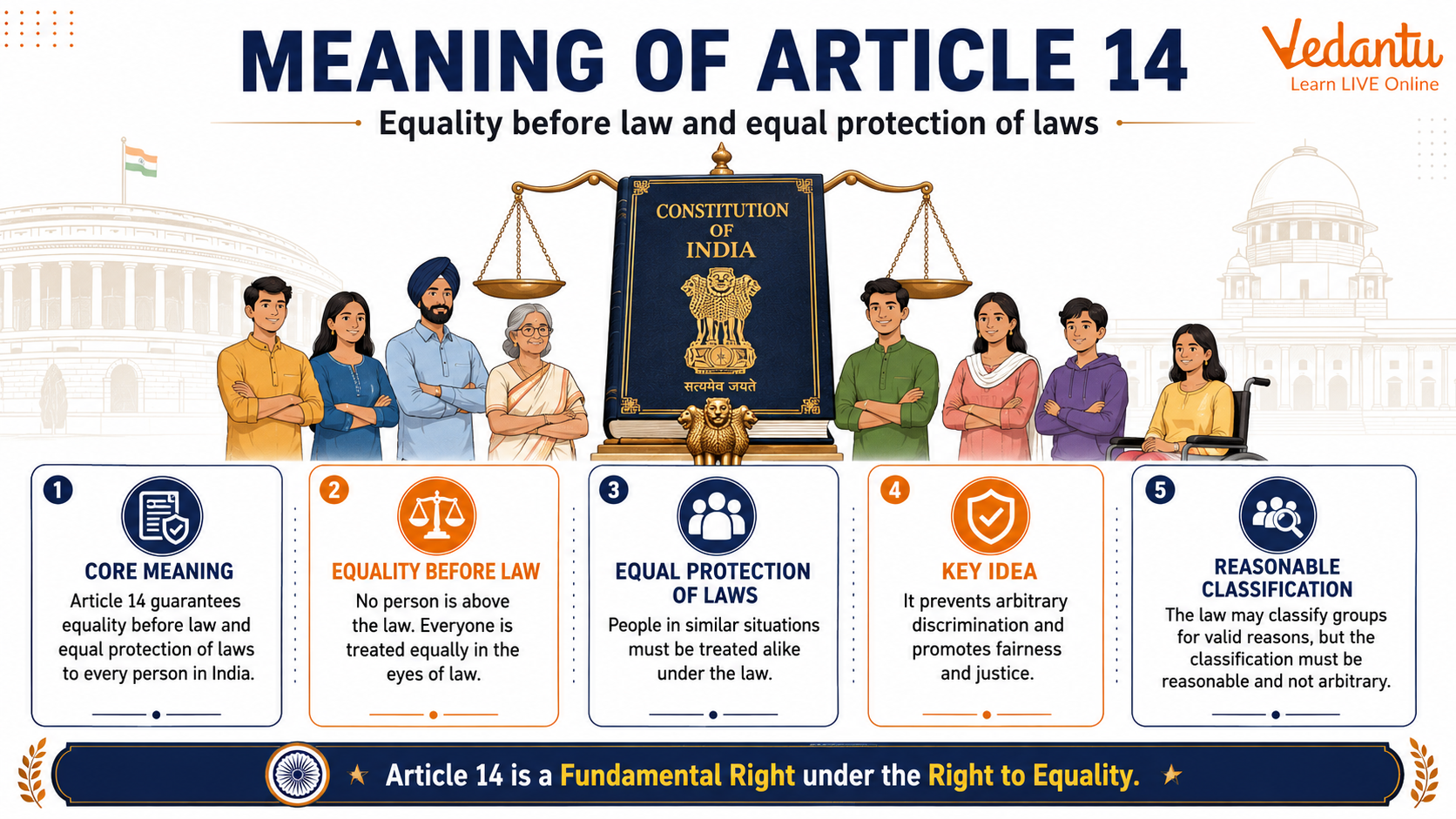
Meaning of Article 14
Article 14 states that "The State shall not deny to any person equality before the law or the equal protection of the laws within the territory of India." This provision has two main components - Equality before Law and Equal Protection of Laws. Both concepts aim to establish legal equality, but they have slightly different meanings and origins.
1. Equality Before Law
The concept of Equality before Law is derived from the British legal system. It implies that all individuals, regardless of their status, rank, or wealth, are subject to the same laws of the land. No person is above the law, including government officials.
- Every person is equal in the eyes of law.
- No special privileges are given to any individual.
- All are subject to the jurisdiction of ordinary courts.
2. Equal Protection of Laws
The concept of Equal Protection of Laws is borrowed from the American Constitution. It means that the State must treat similarly situated individuals in a similar manner. However, it allows reasonable classification for achieving fairness and justice.
- Equal treatment to people in similar circumstances.
- Permits reasonable classification based on intelligible differentia.
- Ensures laws are applied fairly and without arbitrariness.
Difference Between the Two Concepts
| Basis | Equality Before Law | Equal Protection of Laws |
|---|---|---|
| Origin | British Constitution | American Constitution |
| Meaning | No special privilege to anyone | Equal treatment in similar situations |
| Nature | Negative concept | Positive concept |
While Equality before Law prevents special privileges, Equal Protection of Laws ensures fairness by allowing reasonable classification when necessary. Together, they promote substantive equality in society.
Reasonable Classification Under Article 14
Article 14 does not prohibit classification. However, classification must be reasonable and not arbitrary. The Supreme Court has laid down two conditions for valid classification.
- The classification must be based on intelligible differentia that distinguishes those included from others.
- The differentia must have a rational relation to the objective sought to be achieved.
If these conditions are not satisfied, the classification can be declared unconstitutional.
Exceptions to Article 14
Although Article 14 ensures equality, certain exceptions are recognized in the Constitution to maintain administrative and constitutional functioning.
- The President and Governors enjoy immunity for official acts.
- Diplomatic immunity is granted to foreign diplomats.
- Parliament and State Legislatures have certain special privileges.
These exceptions do not violate Article 14 because they are constitutionally sanctioned and serve public interest.
Importance of Article 14
Article 14 plays a vital role in maintaining democracy and rule of law in India. It acts as a safeguard against arbitrary actions of the State and ensures fairness in governance.
- Promotes social and legal equality.
- Prevents discrimination and arbitrariness.
- Strengthens the concept of rule of law.
- Forms the foundation of other Fundamental Rights.
Key Points for Competitive Exams
For competitive examinations, it is important to remember the core elements and judicial interpretation of Article 14.
- Article 14 is part of Part III of the Constitution.
- It applies to both citizens and non citizens.
- It includes two concepts - Equality before Law and Equal Protection of Laws.
- Reasonable classification is permitted but arbitrary action is prohibited.
In conclusion, the meaning of Article 14 lies in ensuring fairness, equality, and justice in Indian society. It is a powerful constitutional provision that protects individuals against discrimination and arbitrary State action. A clear understanding of this Article helps students grasp the broader framework of Fundamental Rights and strengthens their preparation for competitive examinations.
FAQs on Article 14 Meaning and Its Importance in the Constitution
1. What is the meaning of Article 14 of the Indian Constitution?
Article 14 guarantees Equality before Law and Equal Protection of Laws to all persons within India.
Key aspects of Article 14:
• Ensures equality before the law for every individual.
• Prohibits arbitrary discrimination by the State.
• Applies to citizens and non-citizens alike.
• Forms part of the Fundamental Rights (Part III) of the Indian Constitution.
This Article promotes the concept of rule of law, non-arbitrariness, and fairness in governance.
2. What is meant by Equality before Law in Article 14?
Equality before Law means that no person is above the law and all are subject to the same legal authority.
Main features:
• Derived from the British concept of Rule of Law.
• No special privileges for any individual.
• Equal subjection of all citizens to ordinary law.
• Government officials are also accountable under the law.
This principle ensures legal equality and prevents misuse of power.
3. What is Equal Protection of Laws under Article 14?
Equal Protection of Laws means that similar individuals in similar circumstances must be treated equally by the law.
Important points:
• Inspired by the 14th Amendment of the U.S. Constitution.
• Allows reasonable classification by the State.
• Prohibits class legislation but permits logical differentiation.
• Ensures fairness in application of laws.
This concept promotes substantive equality rather than just formal equality.
4. What is the difference between Equality before Law and Equal Protection of Laws?
The two phrases under Article 14 differ in origin and application but together ensure equality.
Key differences:
• Equality before Law – Negative concept; prohibits special privileges.
• Equal Protection of Laws – Positive concept; ensures equal treatment in similar situations.
• First is of British origin; second is of American origin.
• One ensures absence of discrimination; the other ensures fairness in implementation.
Both collectively strengthen the principle of constitutional equality.
5. Does Article 14 allow any exceptions?
Yes, Article 14 permits certain constitutional exceptions and reasonable classifications.
Recognized exceptions include:
• Immunity to the President and Governors (Article 361).
• Special provisions for women and children.
• Protective discrimination or affirmative action for backward classes.
• Diplomatic immunity for foreign envoys.
These exceptions are allowed to achieve social justice and administrative efficiency.
6. What is reasonable classification under Article 14?
Reasonable classification allows the State to treat different groups differently if the classification is logical and justified.
Two essential conditions:
• Must be based on an intelligible differentia (clear distinction).
• Must have a rational nexus with the objective of the law.
This principle ensures that equality does not mean uniform treatment in all situations.
7. How does Article 14 relate to the Rule of Law?
Article 14 embodies the principle of Rule of Law, meaning law is supreme and applies equally to all.
Core elements:
• Supremacy of law over arbitrary power.
• Equality of all persons before ordinary courts.
• Protection of fundamental rights.
This concept was influenced by A.V. Dicey and ensures accountability of government authorities.
8. Who can claim the protection of Article 14?
Article 14 applies to all “persons” within Indian territory, not just citizens.
Covered under Article 14:
• Indian citizens.
• Foreign nationals.
• Legal persons like companies and corporations.
• Stateless individuals residing in India.
This broad scope strengthens the constitutional guarantee of equality.
9. Why is Article 14 important for competitive exams and GK?
Article 14 is a frequently asked topic in UPSC, SSC, and other competitive exams due to its constitutional significance.
Exam relevance:
• Forms the foundation of Fundamental Rights.
• Linked with Articles 15, 16, and 21.
• Important landmark judgments interpret its scope.
• Key concept in Indian Polity and General Knowledge.
Understanding Article 14 helps in answering polity and constitutional law questions accurately.
10. What are some landmark judgments related to Article 14?
Several Supreme Court cases have expanded the scope of Article 14 beyond mere classification.
Important judgments:
• E.P. Royappa v. State of Tamil Nadu (1974) – Linked equality with non-arbitrariness.
• Maneka Gandhi v. Union of India (1978) – Expanded interpretation of fairness and reasonableness.
• Indra Sawhney Case (1992) – Upheld reservations under reasonable classification.
These cases strengthened constitutional equality and prevented arbitrary state action.
