






Why Was Mahatma Gandhi Not Given the Bharat Ratna or a Nobel Prize?
Mahatma Gandhi, known as the Father of the Nation in India, was one of the greatest leaders of the 20th century. He led India’s freedom struggle against British rule through the principles of truth and non-violence. Despite his immense contribution to humanity and global peace, Mahatma Gandhi was never awarded the Bharat Ratna, India’s highest civilian award, nor did he receive the Nobel Peace Prize. This topic is important for General Knowledge, competitive exams, and understanding historical debates related to national and international awards.
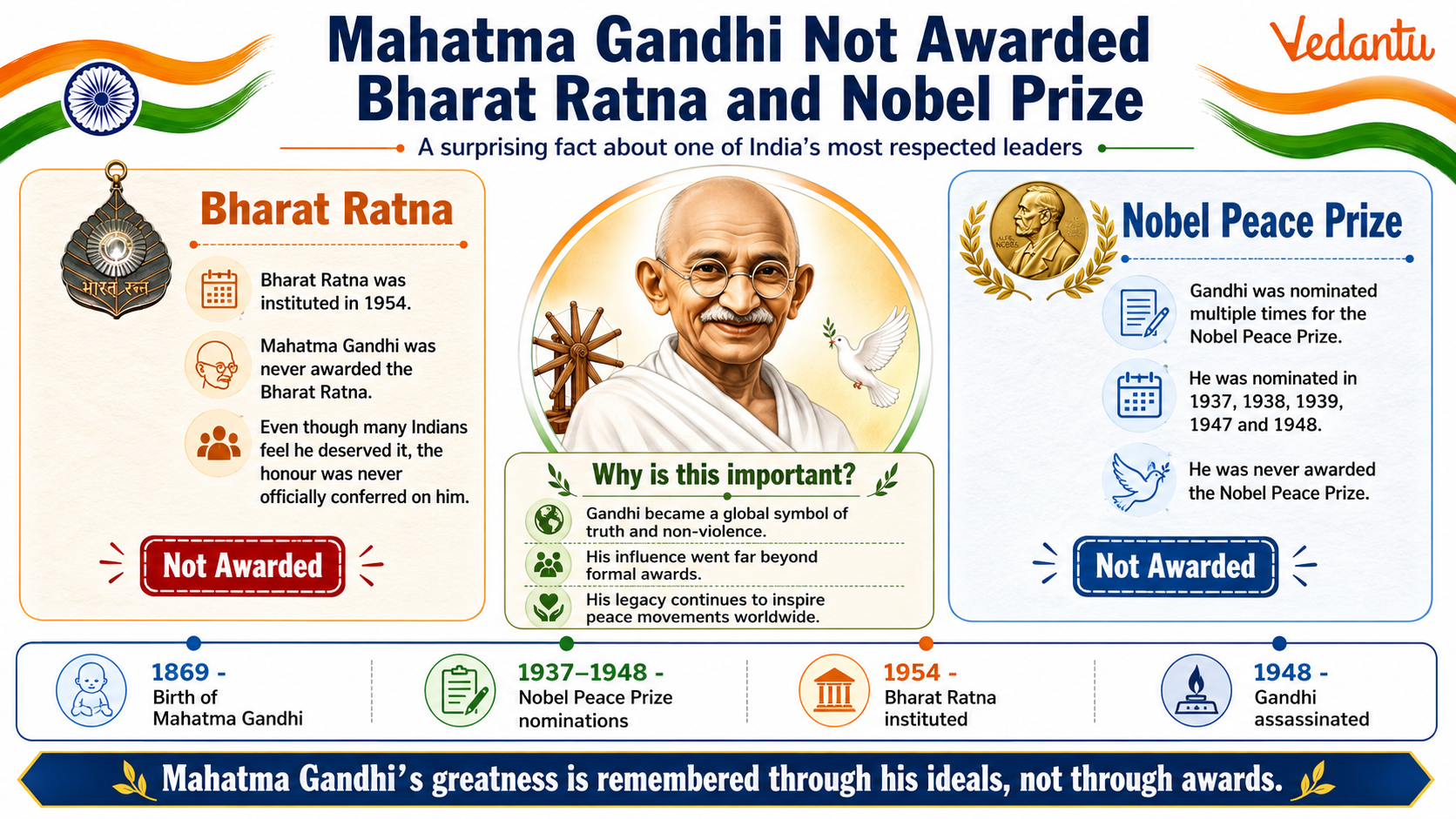
Why Mahatma Gandhi Was Not Awarded Bharat Ratna
The Bharat Ratna was instituted in 1954 as India’s highest civilian award for exceptional service in any field of human endeavor. Mahatma Gandhi was assassinated in 1948, six years before the award was established. Therefore, he was never considered for the award during his lifetime.
Key Reasons
- The Bharat Ratna was started in 1954, after Gandhi’s death in 1948.
- Initially, the award was not meant to be given posthumously.
- The rules were later amended in 1955 to allow posthumous awards.
- Many believe that Gandhi is beyond any award, as he is already honored as the Father of the Nation.
Although posthumous awards became possible after 1955, no government has formally awarded Bharat Ratna to Mahatma Gandhi. Several discussions have taken place over the years, but no official decision has been made.
Mahatma Gandhi and Bharat Ratna - Key Facts
| Aspect | Details | Year |
|---|---|---|
| Gandhi’s Death | Assassinated in New Delhi | 1948 |
| Bharat Ratna Established | India’s Highest Civilian Award | 1954 |
| Posthumous Provision Added | Rules Amended | 1955 |
The timeline clearly shows that Mahatma Gandhi passed away before the award was created. Even after the rules were changed to allow posthumous recognition, he has not been awarded the Bharat Ratna.
Why Mahatma Gandhi Did Not Receive the Nobel Peace Prize
Mahatma Gandhi was nominated multiple times for the Nobel Peace Prize but never received it. His philosophy of non-violence influenced leaders like Martin Luther King Jr. and Nelson Mandela. Despite his global impact, the Nobel Committee did not select him as a laureate during his lifetime.
Nobel Prize Nominations
- Nominated in 1937
- Nominated in 1938
- Nominated in 1939
- Nominated in 1947
- Nominated in 1948, the year of his assassination
Reasons Often Cited
- Political complexities during India’s partition.
- Debates within the Nobel Committee regarding his methods and political involvement.
- In 1948, after his assassination, the Nobel Peace Prize was not awarded to anyone, stating that there was no suitable living candidate.
In later years, members of the Nobel Committee expressed regret that Gandhi was never awarded the prize. Many historians consider this one of the biggest omissions in Nobel history.
Mahatma Gandhi and Nobel Peace Prize - Key Facts
| Aspect | Details | Remarks |
|---|---|---|
| Total Nominations | 5 Times | Between 1937 and 1948 |
| Prize in 1948 | Not Awarded | No Suitable Living Candidate |
| Committee Statement | Expressed Regret Later | Historical Omission |
These facts highlight that although Mahatma Gandhi was globally respected and repeatedly nominated, he never became a Nobel laureate.
Significance of This Topic in General Knowledge
The question of why Mahatma Gandhi was not awarded Bharat Ratna and the Nobel Peace Prize is frequently asked in competitive exams, quizzes, and interviews. It reflects important historical timelines and decisions related to national and international recognition.
Important Points for Exams
- Gandhi died in 1948 before Bharat Ratna was established in 1954.
- Posthumous Bharat Ratna awards were allowed only after 1955.
- He was nominated five times for the Nobel Peace Prize.
- The Nobel Peace Prize was not awarded in 1948 after his death.
Understanding these facts helps students answer objective questions accurately and strengthens their knowledge of modern Indian history and global recognition systems.
Conclusion
Mahatma Gandhi’s absence from the list of Bharat Ratna awardees and Nobel Peace Prize winners remains a significant historical discussion. However, his influence on India and the world goes far beyond formal awards. His principles of truth, non-violence, and civil disobedience continue to inspire millions globally. For students and competitive exam aspirants, this topic highlights the importance of timelines, award criteria, and historical context in understanding why even the greatest leaders may not receive certain honors.
FAQs on Mahatma Gandhi and the Missing Bharat Ratna and Nobel Prize: Reasons Explained
1. Why was Mahatma Gandhi not awarded the Bharat Ratna?
Mahatma Gandhi was not awarded the Bharat Ratna because the award was established after his death.
• The Bharat Ratna was instituted in 1954, six years after Gandhi’s assassination in 1948.
• Initially, the award was not given posthumously.
• Although posthumous awards were later allowed, Gandhi was never formally conferred the honour.
• Many believe his title as the Father of the Nation places him above any civilian award in India.
2. Why did Mahatma Gandhi never receive the Nobel Peace Prize?
Mahatma Gandhi never received the Nobel Peace Prize despite multiple nominations due to political and historical circumstances.
• He was nominated five times between 1937 and 1948.
• The Nobel Committee cited the complex political situation during India’s independence and Partition.
• In 1948, after his assassination, the Prize was not awarded to anyone.
• Later, the Nobel Committee admitted that not awarding Gandhi was a significant omission.
3. How many times was Mahatma Gandhi nominated for the Nobel Prize?
Mahatma Gandhi was nominated five times for the Nobel Peace Prize.
• Nominations occurred in 1937, 1938, 1939, 1947, and 1948.
• His philosophy of non-violence (Ahimsa) and Satyagraha gained global recognition.
• Despite global influence, he was never selected as the laureate.
• His contributions later inspired Nobel winners like Martin Luther King Jr. and Nelson Mandela.
4. Can Bharat Ratna be awarded posthumously?
Yes, the Bharat Ratna can be awarded posthumously.
• The provision for posthumous awards was added after 1955.
• Several leaders like Lal Bahadur Shastri and B. R. Ambedkar received it after death.
• However, Mahatma Gandhi was never considered under this provision.
• The government has stated that Gandhi’s legacy transcends formal awards.
5. Did the Nobel Committee regret not giving the award to Gandhi?
Yes, the Nobel Committee later expressed regret for not awarding Mahatma Gandhi.
• In official statements, members acknowledged Gandhi’s global impact.
• In 1948, the Peace Prize was left vacant as a mark of respect.
• The Committee described the decision as a historic oversight.
• Gandhi is often cited among the most notable Nobel Prize omissions.
6. What were the main reasons cited for not awarding Gandhi the Nobel Prize?
The main reasons included political complexities and differing interpretations of his role during Partition.
• Concerns over communal violence during India’s Partition (1947).
• Debate over whether Gandhi was solely a peace leader or also a political figure.
• European-centric outlook of the Nobel Committee at the time.
• Lack of precedent for awarding non-state actors leading mass movements.
7. Has any Indian received both the Bharat Ratna and the Nobel Prize?
Yes, some Indians have received both prestigious honours, but Mahatma Gandhi did not.
• Rabindranath Tagore won the Nobel Prize in 1913 and later received the Bharat Ratna posthumously.
• C. V. Raman won the Nobel Prize in Physics and was also awarded the Bharat Ratna.
• Gandhi, despite global recognition, received neither award.
• His influence remains foundational in Indian history and world peace movements.
8. Is Mahatma Gandhi officially recognized as the Father of the Nation?
Mahatma Gandhi is popularly known as the Father of the Nation, though no official constitutional title exists.
• The title was first used by Subhas Chandra Bose in 1944.
• The Indian government has clarified there is no formal constitutional declaration.
• Despite this, Gandhi is widely respected as the leader of India’s freedom struggle.
• His principles of Ahimsa and civil disobedience define his legacy.
9. Why is Gandhi considered deserving of the Nobel Peace Prize?
Gandhi is considered deserving because of his lifelong commitment to non-violence and peace.
• He led India’s freedom movement through non-violent resistance.
• His philosophy influenced global leaders like Martin Luther King Jr..
• He promoted communal harmony during times of conflict.
• His concept of Satyagraha remains central to peace studies worldwide.
10. Has there been any proposal to award Bharat Ratna to Gandhi posthumously?
There have been discussions and public demands, but no official proposal has resulted in awarding Gandhi the Bharat Ratna.
• Several public petitions have urged the government to confer the honour.
• Authorities have indicated that Gandhi’s stature is beyond awards.
• The Bharat Ratna selection process is at the discretion of the President of India on the Prime Minister’s recommendation.
• Gandhi’s legacy continues to be honoured through national holidays like Gandhi Jayanti (2 October).
