






Mahajanapadas Kingdoms: Names, Capitals and Key Features
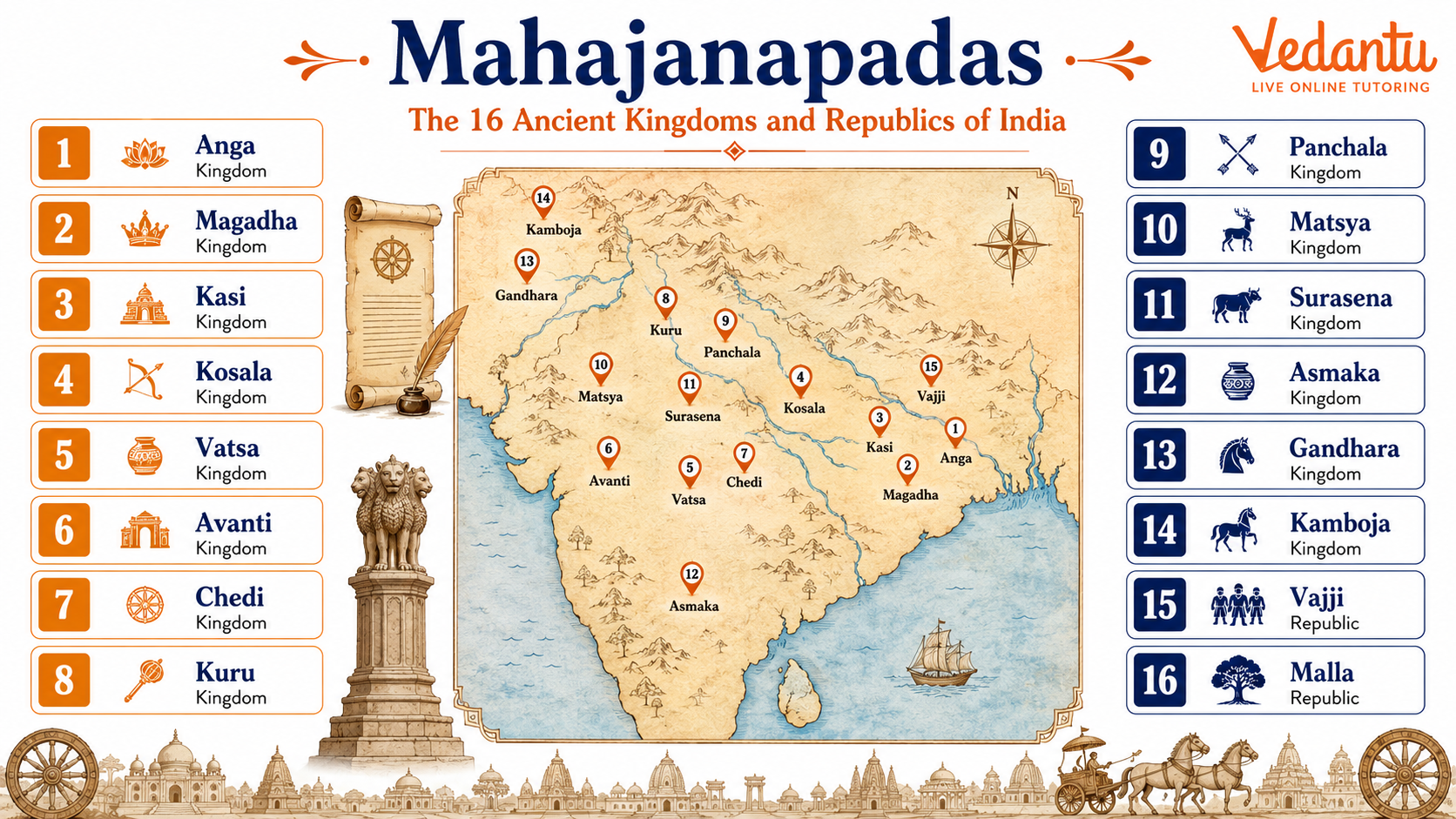
The Mahajanapadas were the sixteen powerful kingdoms and republics that emerged in northern India during the 6th century BCE. This period marks an important phase in ancient Indian history when small tribal settlements gradually transformed into large territorial states. The rise of the Mahajanapadas laid the foundation for political organization, economic development, urbanization, and the later emergence of powerful empires like the Mauryan Empire. Understanding the Mahajanapadas is essential for students preparing for competitive exams and for gaining insight into early Indian civilization.
Meaning and Historical Background
The word Mahajanapada is derived from two Sanskrit words - Maha meaning great and Janapada meaning foothold of a tribe. Initially, society was organized into tribes called Jana. Over time, these tribes settled in specific territories known as Janapadas. As political power and territorial control expanded, some Janapadas grew into large and powerful states called Mahajanapadas.
The period of the Mahajanapadas coincided with significant social and economic changes such as the use of iron tools, agricultural expansion, development of trade routes, rise of cities, and the introduction of coinage. It was also the time when new religious movements like Buddhism and Jainism emerged.
The Sixteen Mahajanapadas
| Mahajanapada | Capital | Present Location |
|---|---|---|
| Magadha | Rajagriha and Pataliputra | Bihar |
| Kosala | Sravasti | Uttar Pradesh |
| Avanti | Ujjaini | Madhya Pradesh |
| Vatsa | Kausambi | Uttar Pradesh |
| Anga | Champa | Bihar |
| Kashi | Varanasi | Uttar Pradesh |
| Kuru | Indraprastha | Delhi region |
| Panchala | Ahichhatra | Uttar Pradesh |
| Matsya | Viratanagara | Rajasthan |
| Surasena | Mathura | Uttar Pradesh |
| Chedi | Sotthivatinagara | Madhya Pradesh |
| Vrijji | Vaishali | Bihar |
| Malla | Kusinara | Uttar Pradesh |
| Asmaka | Potana | Maharashtra |
| Gandhara | Taxila | Pakistan and Afghanistan |
| Kamboja | Rajapura | North west region |
Among these sixteen states, Magadha, Kosala, Avanti, and Vatsa were the most powerful. Eventually, Magadha emerged as the strongest kingdom and laid the foundation for a vast empire.
Types of Government
The Mahajanapadas had two main forms of government - monarchy and republic.
Monarchical States
- Ruled by a king whose position was hereditary.
- Examples include Magadha, Kosala, Avanti, and Vatsa.
- The king was assisted by ministers, priests, and military officials.
Republican States
- Also known as Ganas or Sanghas.
- Ruled by assemblies of chiefs or elected representatives.
- Examples include Vrijji and Malla.
- Decisions were taken collectively in assemblies.
Economic and Social Features
The period of the Mahajanapadas witnessed rapid economic growth and social transformation.
- Use of iron tools increased agricultural productivity.
- Growth of trade and commerce led to the rise of towns and cities.
- Punch marked coins were introduced for trade.
- Trade routes connected northern India with Central Asia and other regions.
- Society became more complex with clearer division of occupations.
Rise of Magadha
Magadha became the most powerful Mahajanapada due to several advantages.
- Fertile land of the Ganga plains supported agriculture.
- Availability of iron ore in nearby regions.
- Strategic location for trade and communication.
- Efficient rulers like Bimbisara and Ajatashatru.
- Strong military organization.
The expansion of Magadha ultimately led to the formation of the Mauryan Empire under Chandragupta Maurya.
Religious Importance
The Mahajanapada period was closely associated with the rise of Buddhism and Jainism. Gautama Buddha and Mahavira lived and preached during this time. Many rulers of the Mahajanapadas supported these new religions, which emphasized non violence, moral conduct, and spiritual development.
Importance of Mahajanapadas in Indian History
- Marked the beginning of large territorial states in India.
- Laid the foundation for centralized administration.
- Encouraged trade, urbanization, and economic development.
- Witnessed the rise of major religious movements.
- Prepared the ground for the Mauryan Empire.
Key Points for Exam Preparation
- Remember the names of all sixteen Mahajanapadas.
- Focus on the powerful states like Magadha, Kosala, Avanti, and Vatsa.
- Understand the difference between monarchy and republic.
- Learn the reasons for the rise of Magadha.
- Know the connection between Mahajanapadas and the rise of Buddhism and Jainism.
In conclusion, the Mahajanapadas represent a turning point in ancient Indian history. They transformed the political landscape from tribal groups to organized states and contributed significantly to economic growth, cultural development, and religious change. A clear understanding of this topic helps students build a strong foundation in early Indian history and perform well in competitive examinations.
FAQs on Mahajanapadas Period in Ancient India: Rise of Powerful Kingdoms
1. What were the Mahajanapadas in ancient Indian history?
The Mahajanapadas were sixteen powerful kingdoms and republics that existed in ancient India during the 6th century BCE.
• The term Mahajanapada means "great realm" or "great kingdom".
• They emerged during the Later Vedic Period.
• These states marked the beginning of urbanization, political organization, and territorial kingdoms.
• Important for understanding the rise of Magadha Empire, Buddhism, and Jainism.
• Frequently asked in UPSC, SSC, State PCS, and school exams.
2. How many Mahajanapadas were there and what were their names?
There were sixteen Mahajanapadas mentioned in ancient Buddhist texts like the Anguttara Nikaya.
• Anga
• Magadha
• Kashi
• Kosala
• Vajji
• Malla
• Chedi
• Vatsa
• Kuru
• Panchala
• Matsya
• Surasena
• Assaka
• Avanti
• Gandhara
• Kamboja
• Key focus areas include Magadha, Kosala, Avanti, and Vatsa due to their political importance.
3. Which Mahajanapada became the most powerful and why?
Magadha emerged as the most powerful Mahajanapada due to its strategic and economic advantages.
• Rich deposits of iron ore in Bihar region.
• Fertile lands of the Ganga plains.
• Strong rulers like Bimbisara, Ajatashatru, and Mahapadma Nanda.
• Efficient administration and powerful army.
• Laid foundation for the Mauryan Empire.
4. What were the main features of the Mahajanapadas?
The Mahajanapadas had organized political systems and marked a shift from tribal rule to territorial states.
• Introduction of taxation systems.
• Use of punch-marked coins.
• Fortified capitals like Rajgir and Kaushambi.
• Development of trade, agriculture, and urban centers.
• Existence of both monarchies and republics (Gana-Sanghas).
5. What is the difference between monarchies and republics in the Mahajanapada period?
During the Mahajanapada period, some states were ruled by kings while others followed republican systems.
• Monarchies: Ruled by hereditary kings (e.g., Magadha, Kosala).
• Republics (Gana-Sanghas): Governed by assemblies or councils (e.g., Vajji, Malla).
• Republics had elected chiefs called Rajas.
• Early example of collective decision-making in India.
6. What were the capitals of important Mahajanapadas?
Each Mahajanapada had a well-developed capital city for administration and trade.
• Magadha – Rajgir (later Pataliputra)
• Kosala – Shravasti
• Avanti – Ujjaini
• Vatsa – Kaushambi
• Kashi – Varanasi
• Capitals were often fortified and located near rivers and trade routes.
7. How did the Mahajanapadas contribute to the rise of Buddhism and Jainism?
The Mahajanapada period provided the social and economic conditions for new religions like Buddhism and Jainism to flourish.
• Urban growth created dissatisfaction with Vedic rituals.
• Support from rulers like Bimbisara and Ajatashatru.
• Teachings of Gautama Buddha and Mahavira spread widely.
• Trade networks helped in spreading religious ideas.
• Important centers included Rajgir, Vaishali, and Sarnath.
8. What economic changes took place during the Mahajanapada period?
The Mahajanapada period witnessed significant economic growth and urbanization.
• Use of iron tools improved agriculture.
• Introduction of punch-marked coins for trade.
• Expansion of long-distance trade routes.
• Growth of cities known as second urbanization.
• Rise of merchant and artisan classes.
9. Which sources provide information about the Mahajanapadas?
Information about the Mahajanapadas comes from both literary and archaeological sources.
• Buddhist texts like Anguttara Nikaya.
• Jain texts such as Bhagavati Sutra.
• Sanskrit epics like the Mahabharata.
• Archaeological evidence including coins, pottery, and city ruins.
• Important for reconstructing ancient Indian political history.
10. Why are the Mahajanapadas important for competitive exams?
The Mahajanapadas are a crucial topic in Ancient Indian History for competitive examinations.
• Frequently asked in UPSC, SSC, NDA, CDS, and State PSC exams.
• Forms the base for understanding the Mauryan Empire.
• Linked with topics like Buddhism, Jainism, and early kingdoms.
• Helps in map-based and chronological questions.
• Essential for NCERT Class 6 and 12 History preparation.
