






Order of Secretaries-General of the United Nations and Their Terms of Office
The Secretary-General of the United Nations is the chief administrative officer of the UN and one of the most influential diplomatic figures in the world. The position was created in 1945 when the United Nations was established after World War II. The Secretary-General plays a key role in maintaining international peace and security, promoting human rights, supporting sustainable development, and coordinating humanitarian efforts. This page provides a complete and updated list of Secretaries-General of the United Nations along with their tenure, country, and major contributions.
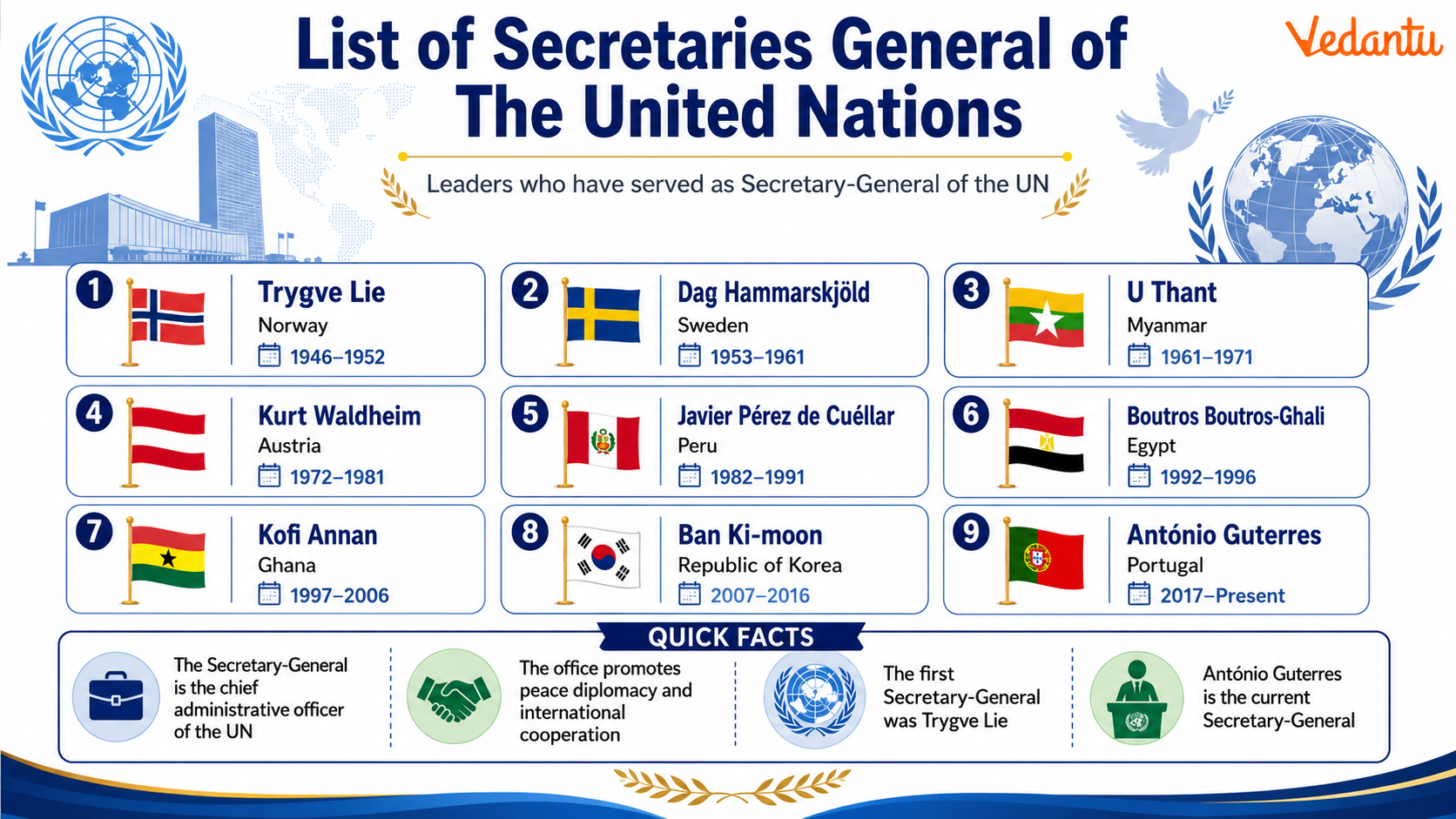
About the Secretary-General of the United Nations
The Secretary-General is appointed by the UN General Assembly upon the recommendation of the UN Security Council. The term of office is typically five years and can be renewed. The Secretary-General acts as a spokesperson and leader of the United Nations, bringing global attention to critical issues such as climate change, conflict resolution, poverty, and international cooperation.
Key Responsibilities
- Act as the chief administrative officer of the United Nations.
- Implement decisions taken by the General Assembly and Security Council.
- Mediate international disputes and promote peaceful conflict resolution.
- Represent the UN at global forums and international meetings.
- Prepare reports on global issues such as peacekeeping, development, and human rights.
List of Secretaries-General of the United Nations
| S.No | Name | Country | Tenure |
|---|---|---|---|
| 1 | Trygve Lie | Norway | 1946 - 1952 |
| 2 | Dag Hammarskjold | Sweden | 1953 - 1961 |
| 3 | U Thant | Myanmar | 1961 - 1971 |
| 4 | Kurt Waldheim | Austria | 1972 - 1981 |
| 5 | Javier Perez de Cuellar | Peru | 1982 - 1991 |
| 6 | Boutros Boutros-Ghali | Egypt | 1992 - 1996 |
| 7 | Kofi Annan | Ghana | 1997 - 2006 |
| 8 | Ban Ki-moon | South Korea | 2007 - 2016 |
| 9 | Antonio Guterres | Portugal | 2017 - Present |
Since its establishment, the United Nations has had nine Secretaries-General. Each leader has contributed significantly to addressing global challenges, from Cold War tensions to climate change and humanitarian crises. Antonio Guterres is the current Secretary-General, serving since 2017.
Major Contributions of Selected Secretaries-General
Dag Hammarskjold
Dag Hammarskjold strengthened UN peacekeeping operations and played an important role during the Congo Crisis. He was posthumously awarded the Nobel Peace Prize in 1961.
U Thant
U Thant helped defuse the Cuban Missile Crisis and promoted international cooperation during the Cold War period.
Kofi Annan
Kofi Annan focused on UN reforms, development goals, and global health initiatives. He and the United Nations were jointly awarded the Nobel Peace Prize in 2001.
Ban Ki-moon
Ban Ki-moon emphasized climate change action and played a key role in the adoption of the Paris Agreement in 2015.
Antonio Guterres
Antonio Guterres has focused on climate action, sustainable development, refugee protection, and global peacebuilding efforts.
Appointment Process
The appointment of the Secretary-General involves the following steps:
- The UN Security Council recommends a candidate.
- The recommendation must receive no veto from the five permanent members of the Security Council.
- The UN General Assembly appoints the candidate by majority vote.
Important Facts for Competitive Exams
- The first Secretary-General was Trygve Lie from Norway.
- Dag Hammarskjold and Kofi Annan received the Nobel Peace Prize.
- Antonio Guterres is the ninth and current Secretary-General.
- The headquarters of the United Nations is located in New York, USA.
- The usual term of office is five years, renewable.
Conclusion
The Secretaries-General of the United Nations have played a vital role in shaping global diplomacy and international cooperation. From managing Cold War tensions to addressing modern challenges like climate change and humanitarian crises, each Secretary-General has left a lasting impact. Understanding the list of Secretaries-General of the United Nations is essential for general knowledge, competitive examinations, and a deeper awareness of global governance.
FAQs on List of Secretaries-General of the United Nations: Names, Terms and Key Roles
1. Who is the current Secretary-General of the United Nations?
António Guterres is the current Secretary-General of the United Nations (UN), serving since 1 January 2017.
- He is from Portugal.
- He was re-elected for a second term (2022–2026).
- Before becoming UN chief, he served as the Prime Minister of Portugal and UN High Commissioner for Refugees.
- He focuses on climate change, global peace, sustainable development, and humanitarian issues.
2. How many Secretaries-General have served in the United Nations?
Nine individuals have served as the Secretary-General of the United Nations since its establishment in 1945.
- The first Secretary-General was Trygve Lie (Norway).
- The current Secretary-General is António Guterres.
- They represent different regions, ensuring geographical rotation and global representation.
3. Who was the first Secretary-General of the United Nations?
Trygve Lie of Norway was the first UN Secretary-General, serving from 1946 to 1952.
- He was appointed after the formation of the UN in 1945.
- He played a key role during the early years of the Cold War.
- His tenure focused on establishing the UN’s administrative structure.
4. What is the role of the Secretary-General of the United Nations?
The Secretary-General is the chief administrative officer and spokesperson of the United Nations.
- Leads the UN Secretariat.
- Acts as a mediator in international conflicts.
- Implements decisions of the UN Security Council and General Assembly.
- Promotes international peace, security, human rights, and sustainable development.
5. How is the Secretary-General of the United Nations appointed?
The UN Secretary-General is appointed by the UN General Assembly on the recommendation of the UN Security Council.
- The Security Council recommends a candidate.
- The General Assembly votes to appoint the candidate.
- The term lasts for five years, renewable.
6. Who was the longest-serving Secretary-General of the United Nations?
Kurt Waldheim and Javier Pérez de Cuéllar each served two full terms (10 years), making them among the longest-serving UN Secretaries-General.
- Kurt Waldheim (Austria): 1972–1981
- Javier Pérez de Cuéllar (Peru): 1982–1991
- Most Secretaries-General serve a maximum of two five-year terms.
7. Has any woman served as Secretary-General of the United Nations?
No, no woman has yet served as the Secretary-General of the United Nations.
- All nine Secretaries-General so far have been men.
- There have been global calls for a female UN Secretary-General.
- Gender equality remains a major discussion in UN reforms.
8. Who was the first Asian Secretary-General of the United Nations?
U Thant from Myanmar (Burma) was the first Asian UN Secretary-General.
- He served from 1961 to 1971.
- He handled major crises like the Cuban Missile Crisis.
- He promoted decolonization and peacekeeping operations.
9. Which Secretary-General won the Nobel Peace Prize?
Dag Hammarskjöld and Kofi Annan were awarded the Nobel Peace Prize.
- Dag Hammarskjöld (Sweden): Awarded posthumously in 1961.
- Kofi Annan (Ghana): Awarded in 2001 along with the United Nations.
- They were recognized for promoting global peace and international cooperation.
10. What is the complete list of Secretaries-General of the United Nations in order?
The following is the complete list of UN Secretaries-General in chronological order:
- Trygve Lie (Norway) – 1946–1952
- Dag Hammarskjöld (Sweden) – 1953–1961
- U Thant (Myanmar) – 1961–1971
- Kurt Waldheim (Austria) – 1972–1981
- Javier Pérez de Cuéllar (Peru) – 1982–1991
- Boutros Boutros-Ghali (Egypt) – 1992–1996
- Kofi Annan (Ghana) – 1997–2006
- Ban Ki-moon (South Korea) – 2007–2016
- António Guterres (Portugal) – 2017–Present
