






State-wise Sex Ratio in India: Latest Census Rankings and Key Insights
The sex ratio is an important demographic indicator that shows the number of females per 1000 males in a population. In India, the sex ratio reflects social, cultural, and economic conditions across different states and union territories. It is a key topic in General Knowledge and is frequently asked in competitive exams such as UPSC, SSC, Banking, Railways, and state-level examinations. Understanding the List of Indian States on the Basis of Sex Ratio helps students analyze population trends, gender balance, and regional variations in India.
What is Sex Ratio?
Sex ratio is defined as the number of females per 1000 males in a given population. It is calculated using population census data. A higher sex ratio indicates better gender balance, while a lower sex ratio may reflect gender inequality and social challenges.
- Sex Ratio Formula - (Number of Females / Number of Males) × 1000
- Measured during the Census of India conducted every 10 years
- Used to assess gender equality and social development
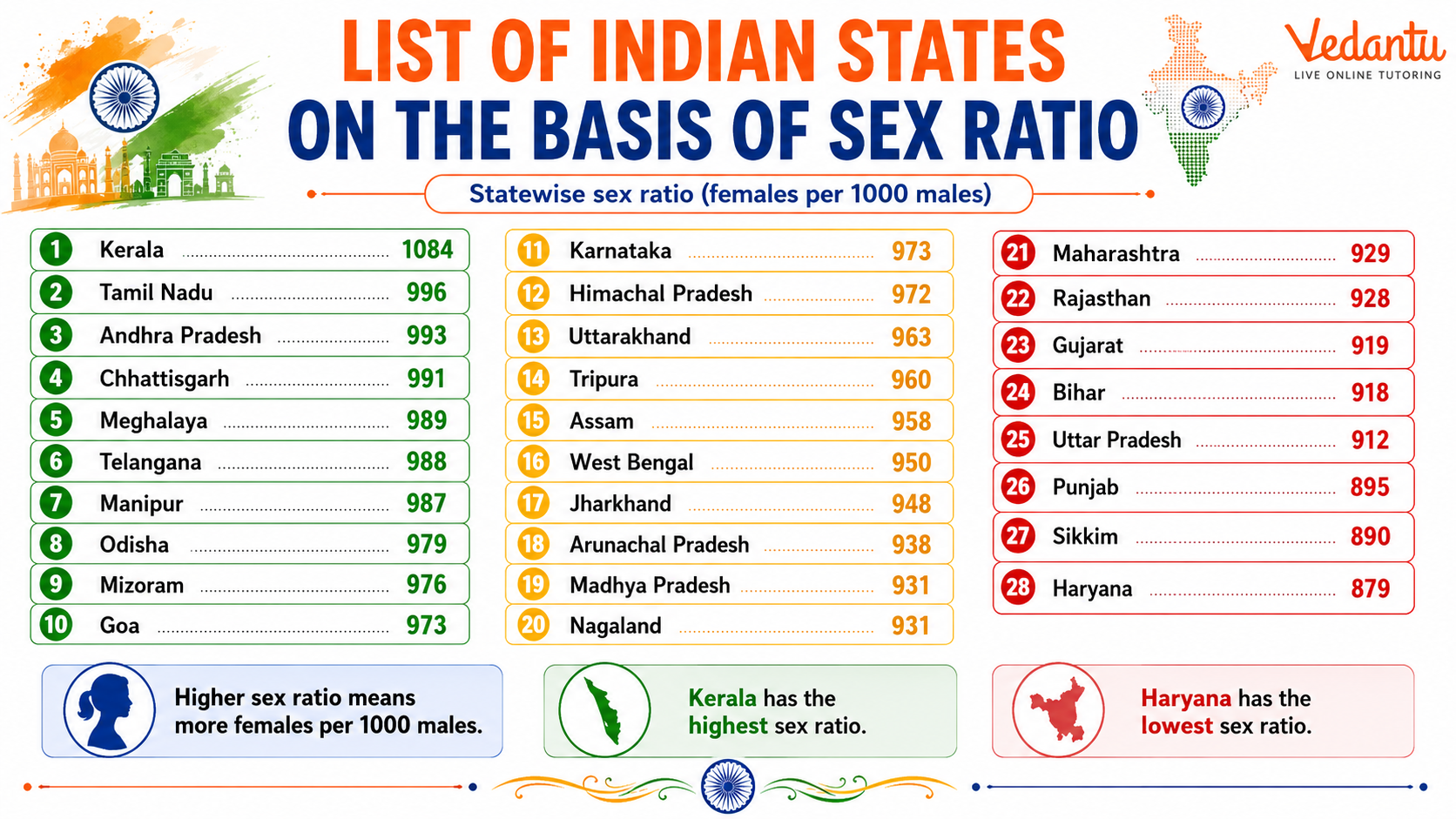
List of Indian States on the Basis of Sex Ratio (Census 2011)
| State | Sex Ratio (Females per 1000 Males) | Rank |
|---|---|---|
| Kerala | 1084 | 1 |
| Tamil Nadu | 996 | 2 |
| Andhra Pradesh | 993 | 3 |
| Chhattisgarh | 991 | 4 |
| Odisha | 979 | 5 |
| Karnataka | 973 | 6 |
| Maharashtra | 929 | 7 |
| Gujarat | 919 | 8 |
| Uttar Pradesh | 912 | 9 |
| Haryana | 879 | 10 |
According to Census 2011, Kerala has the highest sex ratio among Indian states, while Haryana has one of the lowest among major states. Southern states generally show better gender balance compared to some northern and western states.
States with Highest and Lowest Sex Ratio
Highest Sex Ratio States
- Kerala - 1084 females per 1000 males
- Tamil Nadu - 996 females per 1000 males
- Andhra Pradesh - 993 females per 1000 males
Lowest Sex Ratio States
- Haryana - 879 females per 1000 males
- Punjab - 895 females per 1000 males
- Uttar Pradesh - 912 females per 1000 males
Factors Affecting Sex Ratio in India
The variation in sex ratio across Indian states is influenced by several social and economic factors. These factors play a crucial role in determining gender balance.
- Female literacy rate and education level
- Access to healthcare facilities
- Cultural attitudes towards gender
- Government schemes promoting girl child welfare
- Urbanization and migration patterns
Importance of Sex Ratio in Competitive Exams
The list of Indian states on the basis of sex ratio is frequently asked in General Awareness and GK sections. Questions may focus on the highest or lowest sex ratio state, census data, or trends over time. Memorizing key states and their rankings can help candidates score better in exams.
- Remember Kerala as the state with the highest sex ratio
- Recall Haryana as one of the lowest sex ratio states
- Understand regional trends such as better performance of southern states
- Revise Census 2011 figures for accuracy in exams
Conclusion
The List of Indian States on the Basis of Sex Ratio highlights the demographic diversity and gender balance across the country. Kerala leads with the highest sex ratio, reflecting better social indicators, while some northern states continue to face challenges. For students and competitive exam aspirants, understanding sex ratio rankings, census data, and influencing factors is essential for scoring well in General Knowledge sections. Regular revision of these figures ensures better retention and exam performance.
FAQs on List of Indian States on the Basis of Sex Ratio – State-wise Data & Comparison
1. What is the sex ratio in India?
The sex ratio in India refers to the number of females per 1,000 males in the population.
• As per the Census 2011, India’s overall sex ratio was 943 females per 1,000 males.
• According to the National Family Health Survey (NFHS-5, 2019–21), it improved to 1020 females per 1,000 males.
• It is an important demographic indicator used in competitive exams and General Knowledge.
Related terms: gender ratio, population statistics, demographic data, Census of India.
2. Which Indian state has the highest sex ratio?
The Indian state with the highest sex ratio is Kerala.
• As per Census 2011, Kerala recorded 1084 females per 1,000 males.
• It is followed by Tamil Nadu and Andhra Pradesh.
• Kerala’s high ratio is linked to better literacy, healthcare, and women empowerment.
People also ask: Which state has more females than males?
3. Which Indian state has the lowest sex ratio?
The state with the lowest sex ratio in India is Haryana (Census 2011).
• Haryana recorded 879 females per 1,000 males.
• Other low-ranking states include Punjab and Delhi.
• Causes include gender bias, female foeticide, and socio-cultural factors.
Related searches: lowest gender ratio state, female population statistics.
4. How is sex ratio calculated?
The sex ratio is calculated by dividing the number of females by the number of males and multiplying by 1,000.
• Formula: (Number of Females / Number of Males) × 1000.
• It is officially measured during the Population Census of India.
• It helps in understanding gender balance and demographic trends.
People also search: sex ratio formula, population calculation method.
5. What is the child sex ratio in India?
The child sex ratio refers to the number of girls per 1,000 boys in the age group of 0–6 years.
• As per Census 2011, India’s child sex ratio was 919.
• It is lower than the overall sex ratio.
• It reflects issues like female foeticide and gender discrimination.
Related terms: girl child ratio, child population data, demographic imbalance.
6. Why is sex ratio an important indicator?
The sex ratio is an important indicator of gender equality and social development.
• It shows the status of women in society.
• Helps policymakers design women welfare and health programs.
• Used in UPSC, SSC, and other competitive exams.
People also ask: Why is gender ratio important?
7. Which Union Territory has the highest sex ratio in India?
Among Union Territories, Puducherry has the highest sex ratio.
• As per Census 2011, Puducherry recorded 1037 females per 1,000 males.
• It performs better than many Indian states.
• Contributing factors include urban development and better healthcare facilities.
Related searches: UT sex ratio list, highest female population UT.
8. How does India’s sex ratio compare globally?
India’s sex ratio is moderate compared to global standards but shows regional imbalance.
• Many developed countries have a ratio close to 1000 females per 1,000 males.
• Some Asian countries show similar gender imbalance trends.
• Improvement has been seen in recent NFHS and survey reports.
People also search: global gender ratio, sex ratio comparison by country.
9. What are the main causes of low sex ratio in some Indian states?
The low sex ratio in India is mainly due to social and cultural factors.
• Female foeticide and sex-selective abortion.
• Preference for male child.
• Lower access to education and healthcare for women.
• Early marriages and poor maternal health.
Related terms: gender discrimination, population imbalance, social inequality.
10. Which Indian states have a sex ratio above 1000?
Several Indian states have a sex ratio above 1000, meaning more females than males.
• Kerala – 1084
• Tamil Nadu – 996 (close to 1000, improved in surveys)
• Andhra Pradesh – 993 (Census 2011, higher in NFHS)
• States like Chhattisgarh and Odisha also show favorable trends.
People also ask: Which states have more women than men in India?
