






Who Was the First and Current RBI Governor? Tenure & Key Highlights
The List of Governors of Reserve Bank of India is an important topic in General Knowledge, especially for competitive exams such as UPSC, SSC, Banking, Railways, and other state-level examinations. The Governor of the Reserve Bank of India (RBI) is the chief executive officer of the central bank and plays a crucial role in managing the country’s monetary policy, banking regulation, and financial stability. Since the establishment of the RBI in 1935, several distinguished personalities have served as Governors and shaped India’s economic framework.
About the Reserve Bank of India (RBI)
The Reserve Bank of India was established on 1 April 1935 under the Reserve Bank of India Act, 1934. Initially, it was privately owned, but it was nationalized on 1 January 1949. The RBI acts as India’s central bank and regulates the country’s monetary and financial system.
Key Functions of RBI
- Formulates and implements monetary policy.
- Regulates and supervises banks and financial institutions.
- Manages foreign exchange reserves.
- Issues and controls currency notes.
- Acts as banker to the Government of India.
Role of the RBI Governor
The Governor is appointed by the Government of India and usually holds office for a term of three years, though it can vary. The Governor heads the Central Board of Directors and represents India in international financial institutions such as the International Monetary Fund.
Major Responsibilities
- Chairing the Monetary Policy Committee.
- Controlling inflation and ensuring price stability.
- Ensuring stability of the banking system.
- Signing currency notes issued by RBI.
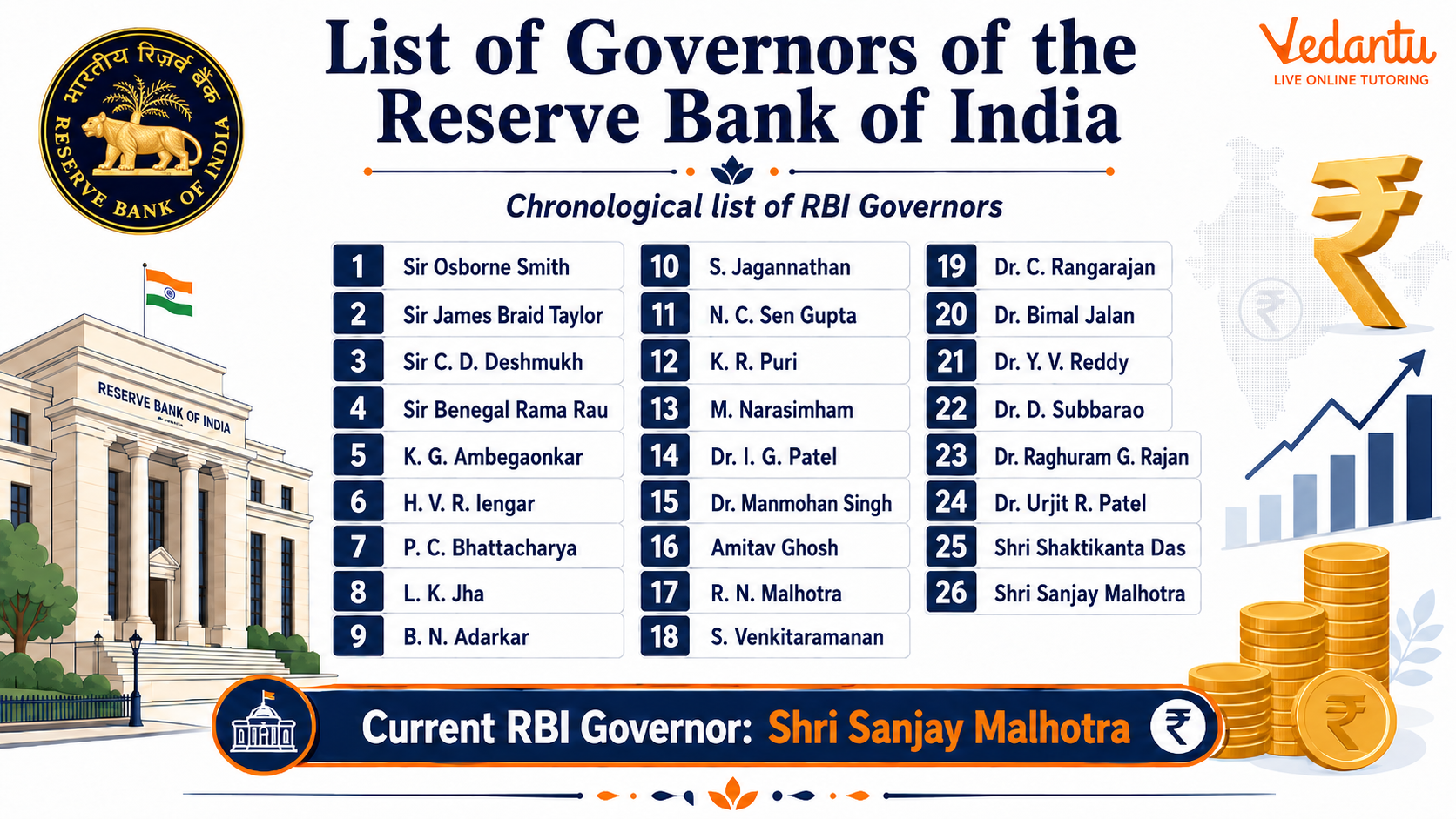
List of Governors of Reserve Bank of India
| S.No | Name of Governor | Tenure |
|---|---|---|
| 1 | Sir Osborne Smith | 1935 - 1937 |
| 2 | Sir James Braid Taylor | 1937 - 1943 |
| 3 | C. D. Deshmukh | 1943 - 1949 |
| 4 | Benegal Rama Rau | 1949 - 1957 |
| 5 | K. G. Ambegaonkar | 1957 |
| 6 | H. V. R. Iyengar | 1957 - 1962 |
| 7 | P. C. Bhattacharya | 1962 - 1967 |
| 8 | L. K. Jha | 1967 - 1970 |
| 9 | B. N. Adarkar | 1970 |
| 10 | S. Jagannathan | 1970 - 1975 |
| 11 | N. C. Sen Gupta | 1975 |
| 12 | K. R. Puri | 1975 - 1977 |
| 13 | M. Narasimham | 1977 |
| 14 | I. G. Patel | 1977 - 1982 |
| 15 | Manmohan Singh | 1982 - 1985 |
| 16 | Amitav Ghosh | 1985 |
| 17 | R. N. Malhotra | 1985 - 1990 |
| 18 | S. Venkitaramanan | 1990 - 1992 |
| 19 | C. Rangarajan | 1992 - 1997 |
| 20 | Bimal Jalan | 1997 - 2003 |
| 21 | Y. V. Reddy | 2003 - 2008 |
| 22 | D. Subbarao | 2008 - 2013 |
| 23 | Raghuram Rajan | 2013 - 2016 |
| 24 | Urjit Patel | 2016 - 2018 |
| 25 | Shaktikanta Das | 2018 - 2024 |
| 26 | Sanjay Malhotra | 2024 - Present |
The above table provides the complete list of Governors of the Reserve Bank of India from 1935 to the present. For exam preparation, candidates should focus on important Governors, their tenure periods, and major economic events during their time in office.
Important Facts About RBI Governors
- Sir Osborne Smith was the first Governor of RBI.
- C. D. Deshmukh was the first Indian Governor of RBI.
- Manmohan Singh later became the Prime Minister of India.
- Raghuram Rajan is known for introducing inflation targeting framework.
- Shaktikanta Das handled major economic challenges including the COVID-19 pandemic.
Importance of This Topic in Competitive Exams
The List of Governors of Reserve Bank of India is frequently asked in banking exams, SSC, UPSC, and other government examinations. Questions are generally based on first Governor, first Indian Governor, current Governor, tenure-related facts, and major reforms introduced during specific periods.
Preparation Tips
- Memorize the first and current Governor.
- Focus on Governors after economic reforms of 1991.
- Revise important economic events linked with specific tenures.
- Practice MCQs related to RBI and monetary policy.
Conclusion
The Governors of the Reserve Bank of India have played a vital role in shaping India’s financial and monetary system. From managing colonial currency systems to handling global financial crises and digital banking transformation, each Governor has contributed significantly to India’s economic stability. A clear understanding of the list, tenure periods, and major contributions is essential for strong performance in competitive examinations and for enhancing overall general knowledge.
FAQs on List of Governors of the Reserve Bank of India Since 1935
1. Who was the first Governor of the Reserve Bank of India?
The first Governor of the Reserve Bank of India (RBI) was Sir Osborne Smith, who served from 1935 to 1937.
• He was appointed when the RBI was established on April 1, 1935.
• He was a British banker and did not sign Indian currency notes.
• His tenure marked the beginning of India’s central banking system.
This question is commonly asked in GK, banking awareness, UPSC, SSC, and RBI Grade B exams.
2. Who is the current Governor of the Reserve Bank of India?
The current Governor of the Reserve Bank of India is Shaktikanta Das (appointed in December 2018).
• He is a former IAS officer.
• He oversees monetary policy, inflation control, and financial stability.
• He chairs the Monetary Policy Committee (MPC).
This is an important question under current affairs, RBI Governor list, and Indian economy GK.
3. Who was the first Indian Governor of RBI?
The first Indian Governor of RBI was Sir C. D. Deshmukh, who served from 1943 to 1949.
• He was the first Indian to sign Indian currency notes.
• He later became India’s Finance Minister.
• He played a key role in the post-independence financial framework.
This fact is frequently asked in Indian economy GK and competitive exams.
4. How many Governors have served in the Reserve Bank of India?
A total of 25+ Governors have served in the Reserve Bank of India since its establishment in 1935.
• The list includes British and Indian Governors.
• Governors are appointed by the Government of India.
• Each Governor typically serves a term of three years (extendable).
This is a common query related to the complete list of RBI Governors and banking GK.
5. Who had the longest tenure as RBI Governor?
The longest-serving RBI Governor was Sir Benegal Rama Rau.
• He served from 1949 to 1957.
• His tenure lasted around 7 years and 6 months.
• He played a major role in strengthening India’s monetary policy framework.
This question is important in RBI Governor tenure list and exam-oriented GK.
6. Who was the first woman Deputy Governor of RBI?
The first woman Deputy Governor of RBI was K. J. Udeshi.
• She served from 2003 to 2005.
• She handled portfolios related to banking regulation and foreign exchange.
• RBI has not yet had a woman Governor.
This question is relevant under women in banking, RBI leadership, and Indian financial system GK.
7. Who was the RBI Governor during demonetization in 2016?
The RBI Governor during demonetization in November 2016 was Dr. Urjit Patel.
• Demonetization involved banning ₹500 and ₹1000 notes.
• It aimed to curb black money, corruption, and counterfeit currency.
• He served as Governor from 2016 to 2018.
This is a popular question in current affairs and Indian economy exams.
8. What are the main functions of the RBI Governor?
The RBI Governor is the chief executive of India’s central bank and oversees monetary policy and banking regulation.
Key functions include:
• Formulating and implementing monetary policy.
• Controlling inflation and interest rates.
• Regulating banks and financial institutions.
• Issuing and signing currency notes.
This topic is essential in understanding the role of RBI Governor in Indian economy.
9. Who appoints the Governor of the Reserve Bank of India?
The Governor of RBI is appointed by the Government of India under the RBI Act, 1934.
• The appointment is made by the Central Government.
• The term is generally three years (can be extended).
• The Governor acts as the head of India’s monetary authority.
This question is frequently asked in Indian polity and banking awareness GK.
10. Who was the RBI Governor during India’s economic reforms in 1991?
The RBI Governor during the 1991 economic reforms was S. Venkitaramanan.
• He served from 1990 to 1992.
• He managed India’s balance of payments crisis.
• His tenure coincided with major liberalization, privatization, and globalization (LPG) reforms.
This is an important GK question related to Indian economic reforms and RBI history.
