






Who Are the Current Cabinet Ministers of India and Their Portfolios?
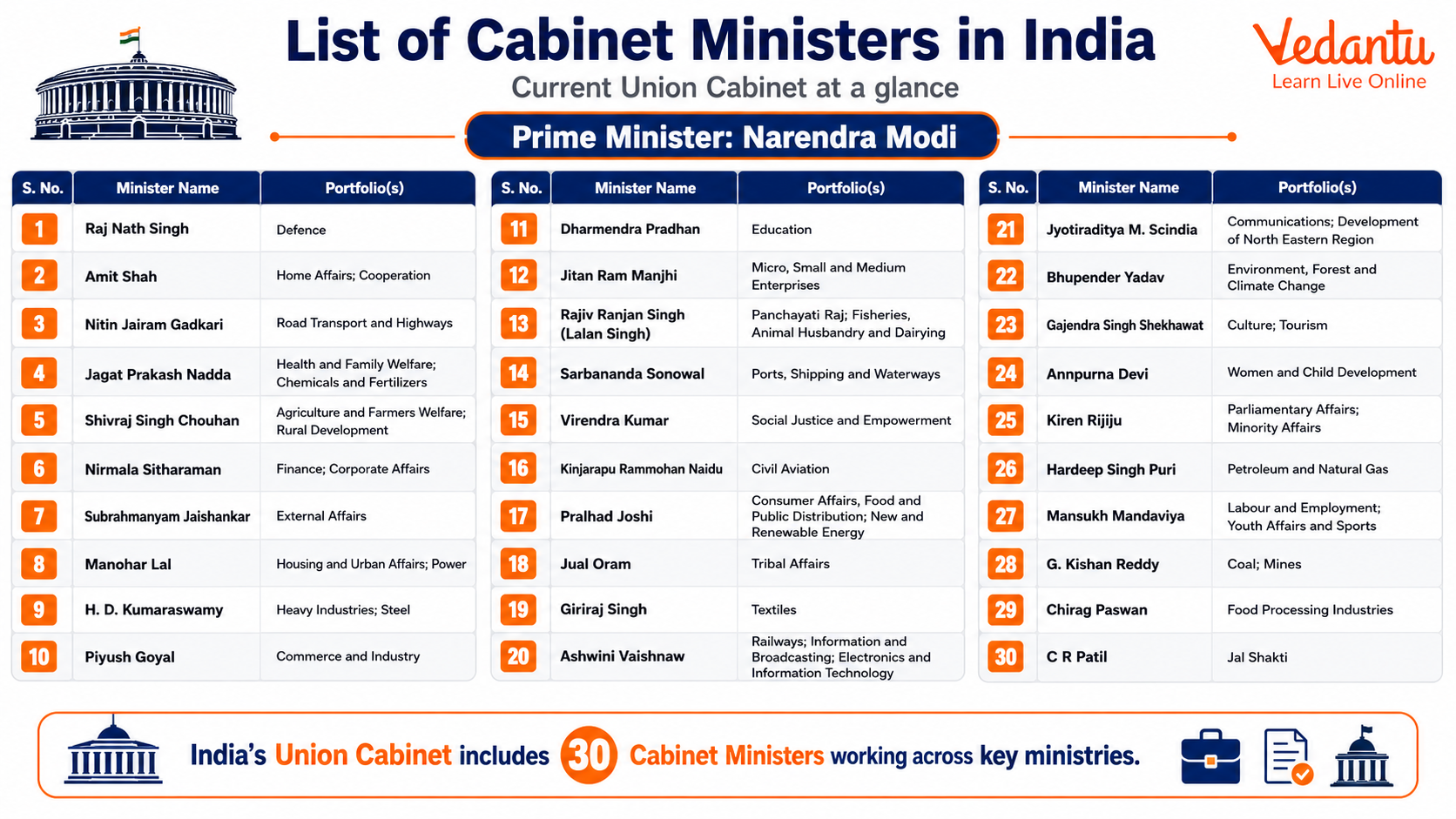
The List of Cabinet Ministers of India is an important topic in General Knowledge and is frequently asked in competitive exams such as UPSC, SSC, Banking, Railways, State PSC, and other government examinations. Cabinet Ministers are senior members of the Union Council of Ministers and head important ministries of the Government of India. They play a crucial role in policy formulation, decision-making, and administration of the country. Understanding the structure, roles, and current cabinet composition is essential for students and aspirants preparing for competitive exams.
What is the Cabinet of India?
The Cabinet of India is the highest decision-making body in the Union Council of Ministers. It consists of senior ministers chosen by the Prime Minister and appointed by the President of India. The Cabinet is responsible for formulating policies, implementing laws, and managing the administration of the country.
- Headed by the Prime Minister of India
- Consists of Cabinet Ministers, Ministers of State, and Deputy Ministers
- Collectively responsible to the Lok Sabha
- Formed under Article 74 and 75 of the Indian Constitution
Current List of Major Cabinet Ministers of India
| Name of Minister | Portfolio | Constituency / Role |
|---|---|---|
| Narendra Modi | Prime Minister, Personnel, Public Grievances, Atomic Energy | Prime Minister of India |
| Rajnath Singh | Ministry of Defence | Senior Cabinet Minister |
| Amit Shah | Ministry of Home Affairs and Cooperation | Senior Cabinet Minister |
| Nirmala Sitharaman | Ministry of Finance and Corporate Affairs | Cabinet Minister |
| S. Jaishankar | Ministry of External Affairs | Cabinet Minister |
| Nitin Jairam Gadkari | Ministry of Road Transport and Highways | Cabinet Minister |
| Jagat Prakash Nadda | Ministry of Health and Family Welfare | Cabinet Minister |
The above table highlights some of the key Cabinet Ministers holding important portfolios in the Government of India. The Cabinet may change after elections, reshuffles, or resignations, so candidates should always verify the latest information before exams.
Categories of Ministers in India
The Union Council of Ministers is divided into different categories based on seniority and responsibilities. Understanding these categories is important for polity and general awareness sections.
1. Cabinet Ministers
They are the senior-most ministers and head major ministries such as Defence, Home, Finance, and External Affairs. They attend Cabinet meetings and take key policy decisions.
2. Ministers of State (Independent Charge)
They head specific ministries independently but are not part of the Cabinet unless specially invited. They function without a supervising Cabinet Minister.
3. Ministers of State
They assist Cabinet Ministers in handling their ministries and perform assigned responsibilities.
Functions of Cabinet Ministers
Cabinet Ministers perform several crucial functions in the governance of India. Their responsibilities extend beyond administration to strategic and legislative decision-making.
- Formulating national policies and development programs
- Introducing and guiding bills in Parliament
- Managing their respective ministries and departments
- Advising the President of India
- Representing India at national and international platforms
Appointment and Tenure of Cabinet Ministers
Cabinet Ministers are appointed by the President of India on the advice of the Prime Minister. They hold office during the pleasure of the President, which practically means as long as they enjoy the confidence of the Prime Minister and the Lok Sabha.
- Must be a member of either House of Parliament or become one within 6 months
- Take oath of office and secrecy
- Collectively responsible to Lok Sabha
Important Facts About Cabinet Ministers of India
- The maximum strength of the Council of Ministers cannot exceed 15 percent of the total strength of the Lok Sabha.
- This limit was introduced by the 91st Constitutional Amendment Act, 2003.
- The Prime Minister allocates portfolios to ministers.
- Cabinet decisions are binding on all ministers under the principle of collective responsibility.
Why the List of Cabinet Ministers is Important for Exams
Questions related to Cabinet Ministers are commonly asked in General Awareness, Indian Polity, and Current Affairs sections. Examiners may ask about the current holder of a specific ministry, constitutional provisions, or recent cabinet reshuffles. Candidates should regularly update themselves with official government sources to ensure accuracy.
- Memorize key ministries such as Defence, Home, Finance, and External Affairs.
- Revise constitutional articles related to the Council of Ministers.
- Stay updated with recent cabinet expansions and reshuffles.
In conclusion, the List of Cabinet Ministers of India is a vital topic for General Knowledge. A clear understanding of their roles, responsibilities, constitutional provisions, and current portfolios enhances both exam performance and awareness about the functioning of the Indian government.
FAQs on List of Cabinet Ministers in India: Names and Portfolios (2026)
1. Who are the current Cabinet Ministers of India?
The Cabinet Ministers of India are senior members of the Union Government appointed by the Prime Minister and headed by the President of India.
- They lead important ministries such as Home Affairs, Defence, Finance, External Affairs, and Education.
- As of the latest update, key leaders include the Prime Minister of India and ministers heading major portfolios.
- The list may change after cabinet reshuffles or general elections.
This list is important for General Knowledge (GK), UPSC, SSC, and other competitive exams.
2. How many Cabinet Ministers are there in India?
The number of Cabinet Ministers in India varies but is governed by constitutional limits.
- Under the 91st Constitutional Amendment Act, 2003, the total number of ministers (including Cabinet, Ministers of State, and Deputy Ministers) cannot exceed 15% of the total Lok Sabha strength.
- The Cabinet is a smaller group within the Union Council of Ministers.
- The exact number changes during cabinet reshuffles.
This question is commonly asked in Indian Polity and GK exams.
3. What is the role of Cabinet Ministers in India?
Cabinet Ministers are responsible for policy-making and administration of key ministries in India.
- They head major government departments like Finance, Defence, Home, and External Affairs.
- They participate in Cabinet meetings to take crucial national decisions.
- They advise the President of India through the Prime Minister.
Their role is central to the functioning of the Parliamentary system of government.
4. Who appoints the Cabinet Ministers of India?
The President of India appoints Cabinet Ministers on the advice of the Prime Minister.
- Article 75 of the Indian Constitution governs their appointment.
- The Prime Minister selects the ministers.
- Ministers take an oath of office and secrecy.
This process reflects India’s parliamentary democracy structure.
5. What is the difference between Cabinet Ministers and Ministers of State?
The key difference lies in authority and responsibility within the Union Council of Ministers.
- Cabinet Ministers head major ministries and attend Cabinet meetings.
- Ministers of State (MoS) assist Cabinet Ministers or handle independent charge of smaller ministries.
- Cabinet Ministers hold higher rank and decision-making power.
This distinction is important in Indian Polity and governance studies.
6. What is the Union Council of Ministers in India?
The Union Council of Ministers is the executive body that aids and advises the President of India.
- It is headed by the Prime Minister.
- It includes Cabinet Ministers, Ministers of State, and Deputy Ministers.
- The Cabinet forms the core decision-making group.
This structure ensures smooth functioning of the Central Government of India.
7. Which are the most important ministries under the Cabinet of India?
Some ministries are considered highly significant due to their national importance.
- Ministry of Home Affairs
- Ministry of Defence
- Ministry of Finance
- Ministry of External Affairs
- Ministry of Education
These ministries play a major role in internal security, economic policy, foreign relations, and national development.
8. How often is the list of Cabinet Ministers updated?
The list of Cabinet Ministers is updated after general elections or cabinet reshuffles.
- Changes occur when a new government is formed.
- The Prime Minister may reshuffle portfolios.
- Ministers may resign or be replaced.
Students preparing for current affairs and competitive exams should check the latest official list regularly.
9. Where can I find the official list of Cabinet Ministers of India?
The official list of Cabinet Ministers is available through government sources.
- Published by the Government of India.
- Announced after oath-taking ceremonies.
- Updated following cabinet expansions or reshuffles.
Referring to official announcements ensures accurate information for GK, UPSC, SSC, and State PSC exams.
10. Why is the list of Cabinet Ministers important for competitive exams?
The list of Cabinet Ministers is important because it is frequently asked in General Knowledge and current affairs sections.
- Questions may ask about the minister holding a specific portfolio.
- Important for exams like UPSC, SSC, Banking, Railways, and State PCS.
- Helps in understanding the Indian political system and governance.
Keeping updated improves performance in Indian Polity and current affairs preparation.
