






Who Was the First and Who Is the Current Chief Justice of India?
The Chief Justice of India (CJI) is the head of the judiciary of India and the highest-ranking judge of the Supreme Court of India. The Chief Justice plays a crucial role in upholding the Constitution, safeguarding fundamental rights, and ensuring the rule of law in the country. Since the establishment of the Supreme Court on 26 January 1950, several distinguished judges have served as the Chief Justice of India. This topic is important for General Knowledge, competitive exams like UPSC, SSC, State PSC, and other government examinations.
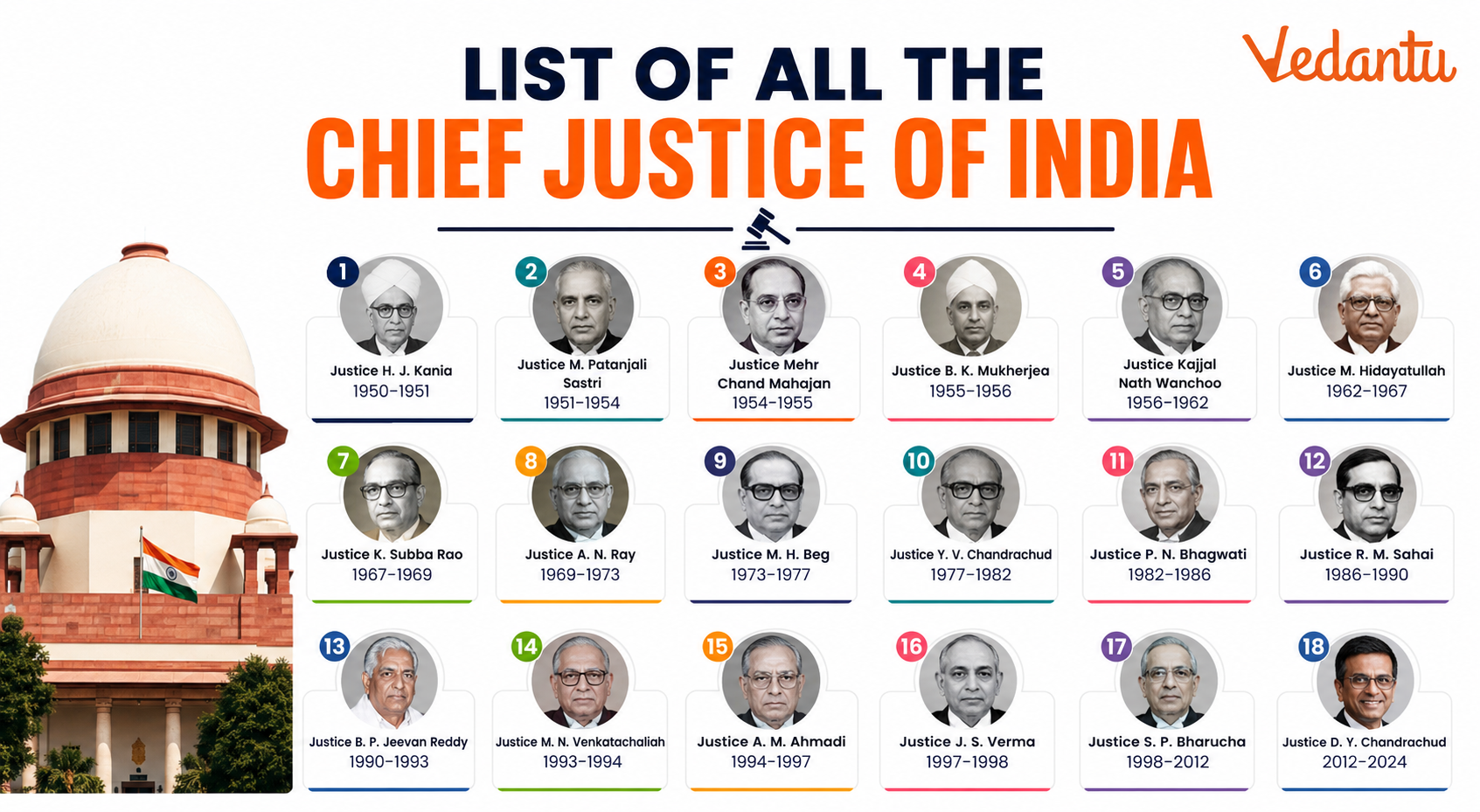
About the Chief Justice of India
The Chief Justice of India is appointed by the President of India. By convention, the senior-most judge of the Supreme Court is appointed as the CJI. The tenure of the Chief Justice continues until the age of 65 years, which is the retirement age for Supreme Court judges.
- Head of the Supreme Court of India
- Appointed by the President of India
- Retirement age - 65 years
- Responsible for allocation of cases and constitution of benches
- Plays a key role in judicial appointments through the collegium system
List of All Chief Justices of India (1950 - Present)
| S.No. | Name | Tenure |
|---|---|---|
| 1 | H. J. Kania | 1950 - 1951 |
| 2 | M. Patanjali Sastri | 1951 - 1954 |
| 3 | Mehr Chand Mahajan | 1954 |
| 4 | B. K. Mukherjea | 1954 - 1956 |
| 5 | S. R. Das | 1956 - 1959 |
| 6 | B. P. Sinha | 1959 - 1964 |
| 7 | P. B. Gajendragadkar | 1964 - 1966 |
| 8 | A. K. Sarkar | 1966 |
| 9 | K. Subba Rao | 1966 - 1967 |
| 10 | K. N. Wanchoo | 1967 - 1968 |
| 11 | M. Hidayatullah | 1968 - 1970 |
| 12 | J. C. Shah | 1970 - 1971 |
| 13 | S. M. Sikri | 1971 - 1973 |
| 14 | A. N. Ray | 1973 - 1977 |
| 15 | M. H. Beg | 1977 - 1978 |
| 16 | Y. V. Chandrachud | 1978 - 1985 |
| 17 | P. N. Bhagwati | 1985 - 1986 |
| 18 | R. S. Pathak | 1986 - 1989 |
| 19 | E. S. Venkataramiah | 1989 |
| 20 | Sabyasachi Mukharji | 1989 - 1990 |
| 21 | Ranganath Misra | 1990 - 1991 |
| 22 | K. N. Singh | 1991 |
| 23 | M. H. Kania | 1991 - 1992 |
| 24 | L. M. Sharma | 1992 - 1993 |
| 25 | M. N. Venkatachaliah | 1993 - 1994 |
| 26 | A. M. Ahmadi | 1994 - 1997 |
| 27 | J. S. Verma | 1997 - 1998 |
| 28 | M. M. Punchhi | 1998 |
| 29 | A. S. Anand | 1998 - 2001 |
| 30 | S. P. Bharucha | 2001 - 2002 |
| 31 | B. N. Kirpal | 2002 - 2002 |
| 32 | G. B. Pattanaik | 2002 - 2003 |
| 33 | V. N. Khare | 2003 - 2004 |
| 34 | S. Rajendra Babu | 2004 |
| 35 | R. C. Lahoti | 2004 - 2005 |
| 36 | Y. K. Sabharwal | 2005 - 2007 |
| 37 | K. G. Balakrishnan | 2007 - 2010 |
| 38 | S. H. Kapadia | 2010 - 2012 |
| 39 | Altamas Kabir | 2012 - 2013 |
| 40 | P. Sathasivam | 2013 - 2014 |
| 41 | R. M. Lodha | 2014 |
| 42 | H. L. Dattu | 2014 - 2015 |
| 43 | T. S. Thakur | 2015 - 2017 |
| 44 | J. S. Khehar | 2017 |
| 45 | Dipak Misra | 2017 - 2018 |
| 46 | Ranjan Gogoi | 2018 - 2019 |
| 47 | S. A. Bobde | 2019 - 2021 |
| 48 | N. V. Ramana | 2021 - 2022 |
| 49 | U. U. Lalit | 2022 |
| 50 | D. Y. Chandrachud | 2022 - 2024 |
| 51 | Sanjiv Khanna | 2024 - Present |
The above table provides a complete chronological list of all Chief Justices of India from 1950 to the present. Students preparing for competitive exams should remember important names, longest serving Chief Justice, first CJI, and current CJI for quick revision.
Important Facts for Exams
- First Chief Justice of India - H. J. Kania
- Longest serving Chief Justice - Y. V. Chandrachud
- First woman judge of the Supreme Court - Justice Fathima Beevi (not CJI but important GK fact)
- Current Chief Justice of India - Sanjiv Khanna
- Retirement age of CJI - 65 years
Role and Powers of the Chief Justice of India
The Chief Justice of India holds significant administrative and judicial powers. As the head of the Indian judiciary, the CJI ensures smooth functioning of the Supreme Court and protects constitutional values.
Judicial Powers
- Presides over constitutional benches
- Hears important cases of national importance
- Interprets the Constitution of India
Administrative Powers
- Allocates cases among judges
- Appoints court officials
- Heads the collegium for appointment and transfer of judges
Why This Topic is Important for GK
The list of all Chief Justices of India is frequently asked in competitive exams. Questions may be asked about the first CJI, current CJI, longest serving CJI, or the order of appointment. Understanding this topic also helps students grasp the structure of the Indian judiciary and its constitutional significance. Regular revision of the chronological list is recommended for better retention.
This comprehensive list and explanation provide a clear understanding of all the Chief Justices of India from 1950 to the present, making it a valuable resource for General Knowledge preparation.
FAQs on List of Chief Justices of India from 1950 to 2026
1. Who is the current Chief Justice of India?
The current Chief Justice of India (CJI) is the head of the Indian judiciary and the Supreme Court of India.
• The Chief Justice of India is appointed by the President of India.
• The senior-most judge of the Supreme Court is usually appointed as CJI.
• The CJI is considered the highest judicial authority in India.
This position plays a key role in constitutional interpretation, judicial administration, and landmark judgments in Indian legal history.
2. Who was the first Chief Justice of India?
Justice Harilal Jekisundas Kania was the first Chief Justice of India.
• Served from 26 January 1950 to 6 November 1951.
• Took office when the Supreme Court of India was established.
• Played a foundational role in shaping the Indian judicial system.
He is an important figure in Indian polity and is frequently asked about in competitive exams like UPSC, SSC, and State PSC.
3. How many Chief Justices of India have there been?
India has had multiple Chief Justices since 1950, starting from Justice H.J. Kania to the present CJI.
• The number increases as new appointments are made.
• Each CJI serves until the retirement age of 65 years.
• The list includes distinguished judges who shaped constitutional law.
Questions about the list of all Chief Justices of India are common in General Knowledge and judiciary-related exams.
4. What is the tenure of the Chief Justice of India?
The tenure of the Chief Justice of India lasts until the age of 65 years.
• There is no fixed term in years.
• Retirement age is defined under the Constitution of India.
• Some CJIs have served short tenures due to late appointments.
The tenure depends on the date of appointment and date of birth of the judge.
5. How is the Chief Justice of India appointed?
The Chief Justice of India is appointed by the President of India based on seniority.
• The senior-most Supreme Court judge is recommended.
• Appointment follows the Collegium System convention.
• It ensures judicial independence and transparency.
This process is a vital part of India’s constitutional framework and judicial appointment system.
6. What are the powers and functions of the Chief Justice of India?
The Chief Justice of India performs administrative and judicial functions in the Supreme Court.
• Acts as the master of the roster (allocates cases).
• Heads the Collegium for judicial appointments.
• Presides over constitutional benches.
• Advises the President in certain matters.
The CJI plays a central role in interpreting the Constitution and protecting fundamental rights.
7. Who was the longest-serving Chief Justice of India?
Justice Yeshwant Vishnu Chandrachud was the longest-serving Chief Justice of India.
• Served from 1978 to 1985.
• Held office for over 7 years.
• Delivered several landmark constitutional judgments.
His tenure is significant in Indian judicial history and frequently asked in GK questions.
8. Who was the first female Chief Justice of India?
India has not yet had a female Chief Justice of India.
• However, several women have served as Supreme Court judges.
• Justice M. Fathima Beevi was the first woman judge of the Supreme Court.
This remains an important topic in discussions about gender representation in the Indian judiciary.
9. Where can I find the complete list of all Chief Justices of India?
The complete list of all Chief Justices of India starts from 1950 to the present.
• Begins with Justice H.J. Kania (1950).
• Includes notable CJIs like Justice P.N. Bhagwati, Justice Y.V. Chandrachud, and others.
• Updated whenever a new CJI is appointed.
This list is important for competitive exams, legal studies, and General Knowledge preparation.
10. What is the salary of the Chief Justice of India?
The Chief Justice of India receives a fixed salary as per constitutional provisions.
• Salary is determined by the Parliament of India.
• The CJI also receives official residence and allowances.
• Salary revisions occur through legislative amendments.
The salary structure ensures the dignity and independence of the highest judicial office in India.
