






What Would Happen if India Boycotts Chinese Imports?
The question "Is India In The Position To Boycott Chinese Products" has become highly relevant in recent years due to geopolitical tensions, trade imbalances, and growing calls for economic self-reliance. China is one of India’s largest trading partners, and Chinese goods are deeply integrated into various sectors of the Indian economy. While emotional and political sentiments often support a boycott, the economic realities are complex. This topic is important for students preparing for competitive exams, group discussions, and current affairs sections, as it combines economics, international relations, and national policy.
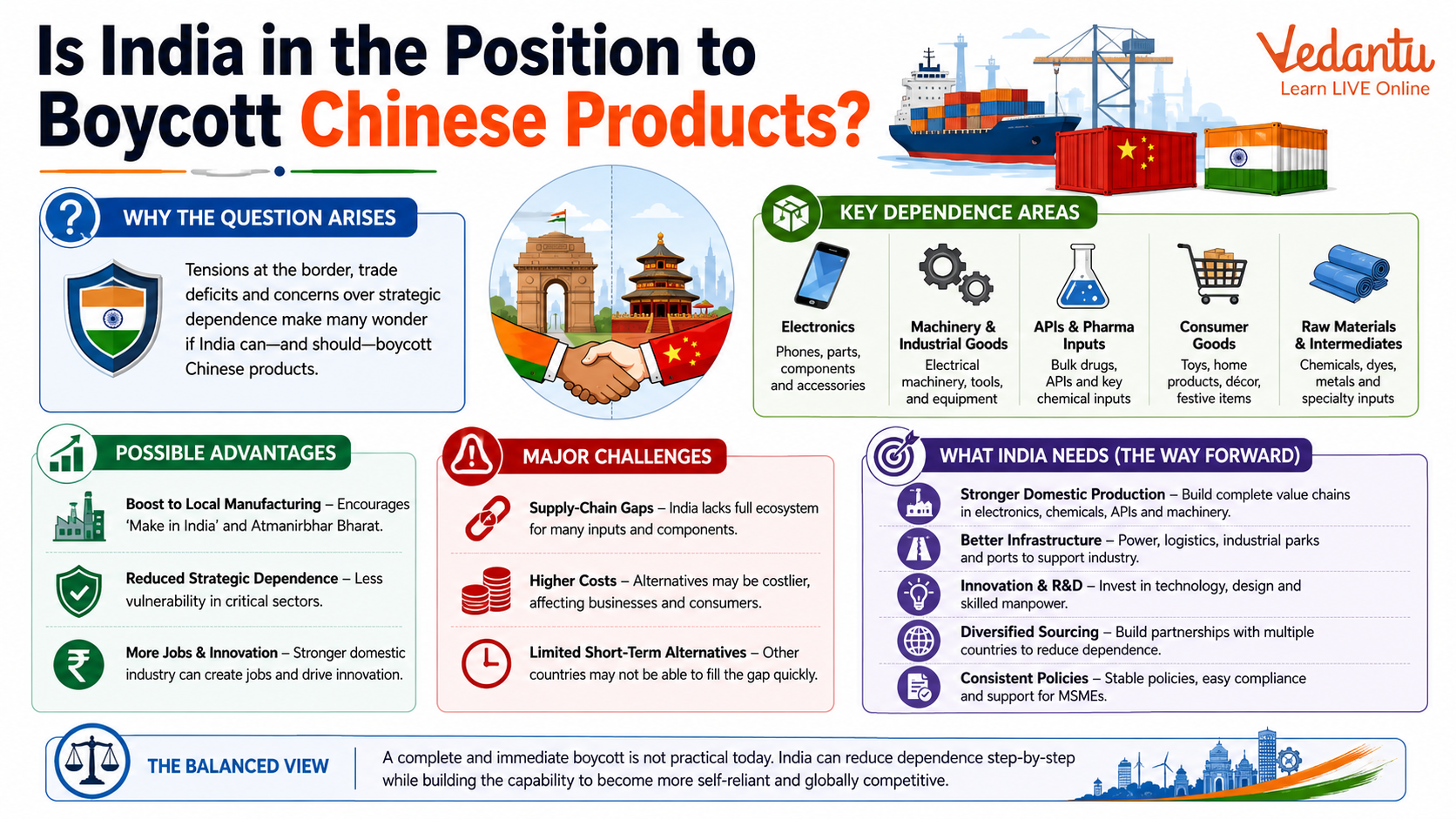
India-China Trade Relations Overview
India and China share a significant trade relationship. Over the years, China has become one of India’s biggest sources of imports. However, the trade balance is heavily tilted in China’s favor, leading to a large trade deficit for India.
India-China Trade Snapshot
| Aspect | India Imports from China | India Exports to China |
|---|---|---|
| Main Goods | Electronics, machinery, APIs, chemicals | Iron ore, cotton, petroleum products |
| Trade Balance | Very High | Relatively Low |
The table shows that India imports high-value manufactured goods while exporting mainly raw materials. This imbalance creates economic dependency in certain critical sectors.
Why Is There a Demand to Boycott Chinese Products?
The demand to boycott Chinese goods arises from political, economic, and strategic reasons. Border tensions and national security concerns have intensified public sentiment.
- Border disputes and security concerns between India and China.
- Large trade deficit affecting India’s economic balance.
- Support for the Make in India and Atmanirbhar Bharat initiatives.
- Encouraging domestic industries and job creation.
Sectors Dependent on Chinese Imports
India’s economy is closely linked to Chinese supply chains in several key industries. An immediate and complete boycott could disrupt production and increase prices.
1. Electronics and Mobile Phones
A large percentage of mobile phone components, semiconductors, and electronic parts are imported from China. Many Indian smartphone brands depend heavily on Chinese manufacturing units.
2. Pharmaceutical Industry
India is known as the pharmacy of the world, but it imports a significant portion of Active Pharmaceutical Ingredients - APIs from China. A sudden boycott may affect medicine production and pricing.
3. Automobile Sector
Auto components and spare parts are sourced from Chinese manufacturers due to lower costs. Disruption could increase vehicle prices.
4. Power and Infrastructure
Chinese equipment is widely used in power plants, solar panels, and infrastructure projects due to competitive pricing.
Is India Economically Ready for a Complete Boycott?
A complete and immediate boycott may not be practical due to high import dependence and global supply chain integration. However, gradual reduction is possible through policy measures and domestic capacity building.
Challenges
- Higher production costs in India compared to China.
- Lack of immediate alternatives for critical components.
- Risk of inflation due to increased import costs.
- Impact on small businesses dependent on cheap imports.
Opportunities
- Boost to domestic manufacturing under Atmanirbhar Bharat.
- Diversification of imports from countries like Vietnam, Japan, and South Korea.
- Encouragement for innovation and local entrepreneurship.
- Long-term strategic economic independence.
Steps Taken by India to Reduce Dependence
Instead of a sudden boycott, India has adopted a gradual strategy to reduce reliance on Chinese imports.
- Promotion of Production Linked Incentive - PLI schemes to boost manufacturing.
- Increased scrutiny of foreign direct investment from neighboring countries.
- Ban on certain Chinese mobile applications citing national security.
- Encouragement of local startups and MSMEs.
Conclusion
India is not currently in a position to impose a complete and immediate boycott of Chinese products without facing economic disruptions. However, India is gradually strengthening its domestic manufacturing capacity and reducing strategic dependence through policy reforms and diversification. A phased and strategic reduction is more practical than an abrupt boycott. For students and competitive exam aspirants, this topic highlights the balance between nationalism and economic pragmatism, making it an important area in General Knowledge and current affairs preparation.
FAQs on Is India in a Position to Boycott Chinese Products? A Balanced Analysis for Students
1. Is India in a position to boycott Chinese products completely?
India is currently not in a complete position to boycott Chinese products due to strong trade dependence and supply chain integration.
• China is one of India’s largest trading partners.
• India imports electronics, machinery, pharmaceutical APIs, and telecom equipment from China.
• Sudden boycott may increase prices, inflation, and production costs.
• However, India is promoting self-reliance (Atmanirbhar Bharat) to reduce dependency gradually.
2. Why does India import so many products from China?
India imports heavily from China because Chinese products are cost-effective, mass-produced, and technologically competitive.
• China has strong manufacturing infrastructure and economies of scale.
• Key imports include mobile phones, solar panels, electronics, and chemicals.
• Chinese goods are often cheaper than domestic alternatives.
• Many Indian industries depend on Chinese raw materials and components.
3. What are the major sectors in India dependent on Chinese imports?
Several key sectors in India are highly dependent on Chinese imports for raw materials and finished goods.
• Electronics and mobile manufacturing
• Pharmaceutical industry (Active Pharmaceutical Ingredients - APIs)
• Automobile components
• Solar energy equipment
• Telecommunication and power equipment
4. What is Atmanirbhar Bharat in relation to Chinese products?
The Atmanirbhar Bharat Abhiyan is India’s initiative to reduce dependency on imports, including Chinese goods, and boost domestic manufacturing.
• Launched in 2020.
• Promotes Make in India and local production.
• Encourages MSMEs and startups.
• Focuses on self-reliance, indigenous manufacturing, and economic independence.
5. How would a boycott of Chinese products affect Indian consumers?
A boycott of Chinese products may initially lead to higher prices and limited product availability for Indian consumers.
• Increase in cost of electronics and gadgets.
• Possible supply chain disruptions.
• Rise in prices due to lack of cheaper alternatives.
• Long-term benefits may include growth of Indian industries.
6. What steps has the Indian government taken to reduce dependence on China?
The Indian government has taken several measures to reduce economic dependence on China.
• Imposed restrictions on Chinese apps after 2020 border tensions.
• Increased custom duties on certain imports.
• Promoted Production Linked Incentive (PLI) Scheme.
• Encouraged FDI screening and strategic trade diversification.
7. What is the trade balance between India and China?
India has a trade deficit with China, meaning imports are much higher than exports.
• China is among India’s top import sources.
• India exports mainly iron ore, cotton, and chemicals.
• Imports include electronics, machinery, and industrial goods.
• The trade imbalance raises concerns about economic vulnerability.
8. Can India become self-reliant without Chinese imports?
India can become self-reliant gradually but not immediately without Chinese imports.
• Requires strong infrastructure and investment.
• Development of domestic supply chains.
• Support through technology transfer and skill development.
• Long-term strategy under Make in India and Atmanirbhar Bharat.
9. How do India-China border tensions influence boycott calls?
India-China border tensions, such as the Galwan Valley clash (2020), have intensified public calls to boycott Chinese products.
• Rise in nationalistic sentiment.
• Demand for economic retaliation.
• Government actions like banning Chinese mobile apps.
• Increased focus on strategic and economic security.
10. What are the advantages and disadvantages of boycotting Chinese goods?
Boycotting Chinese goods has both economic advantages and practical challenges for India.
• Advantages: Boost to local industries, job creation, reduced trade deficit, stronger self-reliance.
• Disadvantages: Higher prices, supply shortages, impact on MSMEs, slower industrial growth initially.
• A balanced approach focusing on gradual diversification and domestic production is considered more practical.
