






Amazing Features and Hidden Details of the New ₹50 Currency Note
The new Rs 50 note is a part of the Mahatma Gandhi New Series introduced by the Reserve Bank of India after the 2016 currency revision. Designed with advanced security features and vibrant colors, this note plays an important role in daily transactions across India. Apart from its monetary value, the Rs 50 note carries cultural and historical significance through its design elements and symbols. Understanding interesting facts about the new Rs 50 note is useful for students, competitive exam aspirants, and general readers preparing for banking and general knowledge sections.
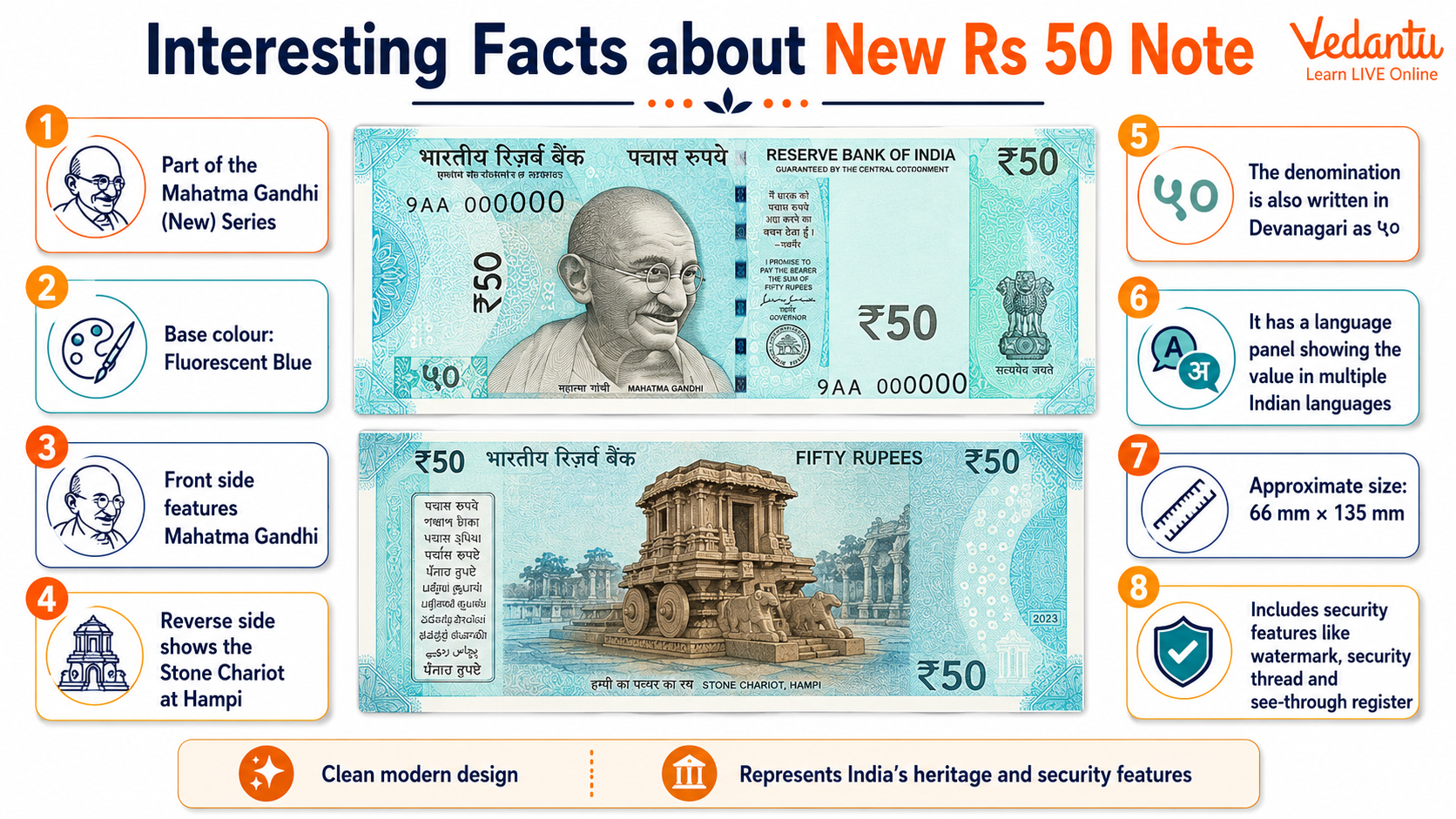
Introduction to the New Rs 50 Note
The new Rs 50 note was issued by the Reserve Bank of India in August 2017 under the Mahatma Gandhi New Series. It replaced the old Rs 50 note but both remain legal tender. The new design reflects India's heritage and incorporates improved security features to prevent counterfeiting.
Key Details of the New Rs 50 Note
| Feature | Details | Importance |
|---|---|---|
| Color | Fluorescent Blue | Easy identification |
| Theme | Hampi with Chariot | Represents Indian heritage |
| Year of Issue | 2017 | Part of currency revision |
These features make the new Rs 50 note visually distinct and culturally meaningful while maintaining modern security standards.
Interesting Facts About New Rs 50 Note
- The new Rs 50 note is fluorescent blue in color, making it easily distinguishable from other denominations.
- The reverse side features the image of Hampi with a chariot, a UNESCO World Heritage Site located in Karnataka.
- It carries the Swachh Bharat logo with the slogan "Ek Kadam Swachhata Ki Ore."
- The note includes a portrait of Mahatma Gandhi at the center on the front side.
- It contains a language panel displaying the denomination in 15 Indian languages.
- Both old and new Rs 50 notes are valid and can be used for transactions.
Security Features of the New Rs 50 Note
To prevent counterfeiting and ensure authenticity, the new Rs 50 note includes several advanced security features.
Visible Security Features
- See through register with denominational numeral 50.
- Security thread with inscriptions Bharat, RBI, and 50.
- Guarantee clause and promise clause with Governor's signature.
- Ashoka Pillar emblem on the right side.
Features for Visually Impaired
- Intaglio printing of Mahatma Gandhi portrait.
- Raised identification mark of a square shape.
- Raised printing of denomination numeral.
Dimensions and Design Specifications
The physical size and layout of the note are also important identifying features.
- Length - 135 mm
- Width - 66 mm
- Base color - Fluorescent blue
- Motif on reverse - Hampi Chariot
Importance for Competitive Exams
Questions about currency notes, their themes, colors, and security features are frequently asked in banking exams, SSC, UPSC, state PSC, and other competitive examinations. Knowing facts about the new Rs 50 note helps candidates answer questions related to Indian economy, banking awareness, and general knowledge sections.
How to Prepare This Topic
- Remember the color and theme of each denomination.
- Learn the year of issue and the series name.
- Revise important security features introduced after 2016.
- Stay updated with RBI announcements regarding currency.
Conclusion
The new Rs 50 note is more than just a medium of exchange. It reflects India's cultural heritage through the Hampi chariot motif and incorporates advanced security features to ensure authenticity. Its distinctive fluorescent blue color, compact size, and improved design make it unique among Indian currency notes. Understanding these interesting facts not only enhances general awareness but also helps students and aspirants prepare effectively for competitive examinations.
FAQs on Interesting Facts About the New ₹50 Note Every Student Should Know
1. What are the interesting facts about the new Rs 50 note?
The new Rs 50 note introduced by the Reserve Bank of India (RBI) has several unique features related to design, security, and heritage.
• Issued under the Mahatma Gandhi (New) Series
• Base color: Fluorescent Blue
• Features the image of Hampi with Stone Chariot (UNESCO World Heritage Site)
• Printed at Nashik, Dewas, Mysuru, and Salboni presses
• Includes advanced security features like a security thread and watermark
This Indian currency note reflects India’s cultural heritage and modern anti-counterfeiting measures.
2. When was the new Rs 50 note introduced in India?
The new Rs 50 note was introduced in August 2017 after demonetisation reforms.
• Announced by the Reserve Bank of India (RBI)
• Part of the new currency series launched after 2016 demonetisation
• Designed to improve security features and reduce counterfeiting
This release updated the old Rs 50 note with enhanced safety and modern design elements.
3. What is printed on the back of the new Rs 50 note?
The back side of the new Rs 50 note features the historic Hampi Stone Chariot.
• Represents India’s cultural heritage
• Symbolizes the architectural brilliance of the Vijayanagara Empire
• Recognized as a UNESCO World Heritage Site
This design promotes India’s tourism and historical monuments through Indian paper currency.
4. What are the security features of the new Rs 50 note?
The security features of the new Rs 50 note help prevent fake currency circulation.
• See-through register with numeral 50
• Security thread with inscriptions ‘भारत’ and ‘RBI’
• Mahatma Gandhi watermark
• Latent image of denomination
• Micro-lettering and color-shifting ink
These anti-counterfeit features ensure safe and authentic Indian banknotes.
5. Who appears on the front side of the new Rs 50 note?
The front side of the new Rs 50 note displays the portrait of Mahatma Gandhi.
• Part of the Mahatma Gandhi (New) Series
• Includes the RBI Governor’s signature
• Shows the Ashoka Pillar emblem
This design maintains continuity with other Indian currency notes while upgrading visual elements.
6. What is the color and size of the new Rs 50 note?
The new Rs 50 note is fluorescent blue in color and smaller in size than the old version.
• Base color: Fluorescent Blue
• Dimensions: 66 mm × 135 mm
• Distinct design compared to old brownish Rs 50 note
This change helps people easily identify different denominations of Indian currency.
7. Is the old Rs 50 note still valid after the release of the new one?
Yes, the old Rs 50 note remains legal tender even after the introduction of the new series.
• RBI confirmed both versions are valid currency
• No exchange deadline announced
• Both circulate simultaneously in India
This ensures smooth currency transition without affecting daily transactions.
8. Why was Hampi chosen for the new Rs 50 note design?
The Hampi Stone Chariot was chosen to highlight India’s rich cultural and architectural heritage.
• Represents the Vijayanagara Empire
• A famous tourist attraction in Karnataka
• Recognized as a UNESCO World Heritage Site
This theme promotes historical awareness through Indian currency design.
9. Which authority issues the new Rs 50 note in India?
The Reserve Bank of India (RBI) is the sole authority that issues the new Rs 50 note.
• Operates under the RBI Act, 1934
• Responsible for printing and circulation of Indian banknotes
• Ensures security and authenticity of currency
The RBI manages India’s monetary system and currency regulation.
10. How can you identify a genuine new Rs 50 note?
A genuine new Rs 50 note can be identified by checking its official security elements.
• Presence of Mahatma Gandhi watermark
• Color-changing security thread
• Raised printing for visually impaired identification
• Clear micro-lettering and denomination numerals
Verifying these features helps detect fake Indian currency and ensures safe transactions.
