






Why the Inner Line Permit Is Important for Protected Areas and Tribal Communities
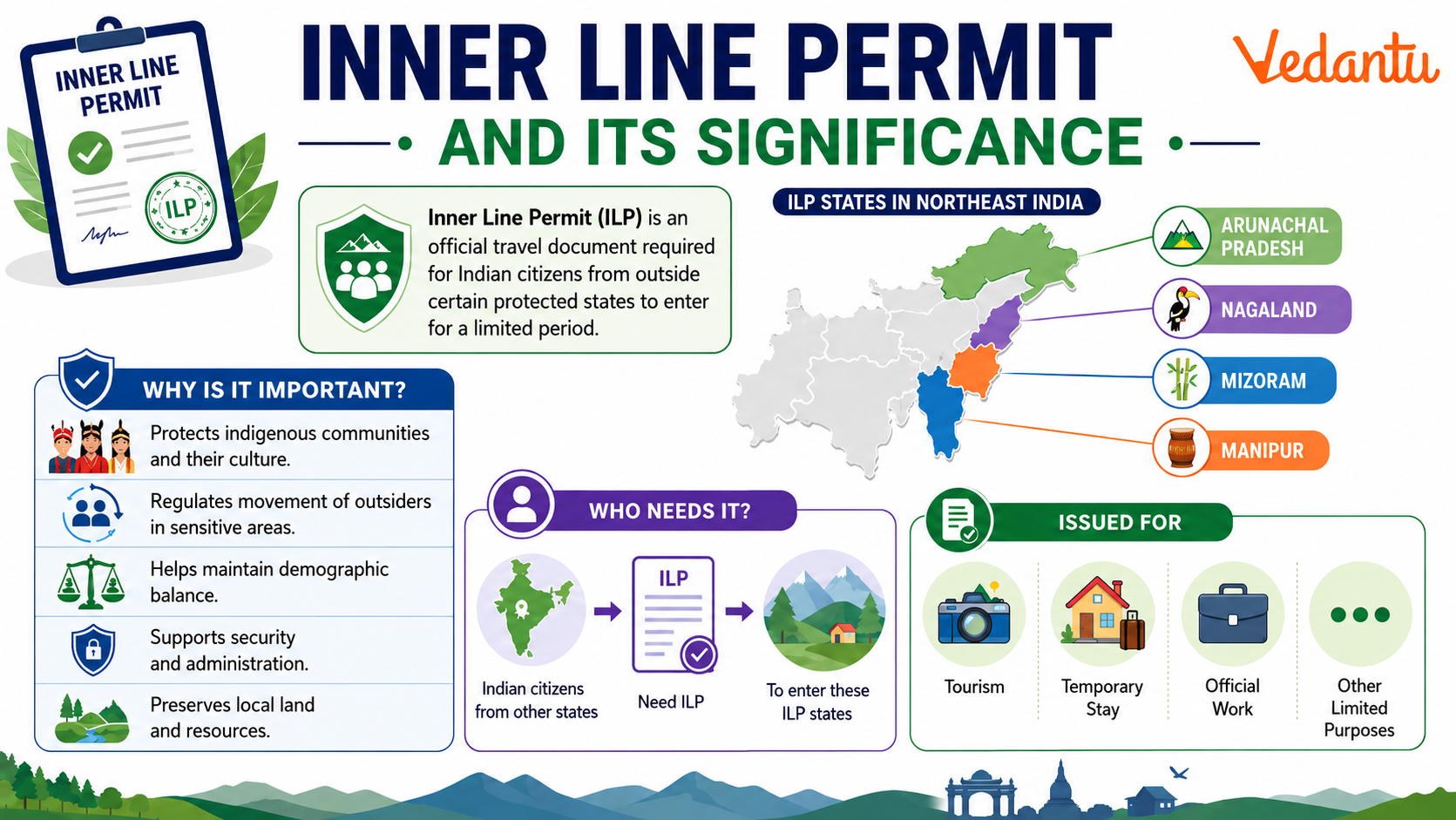
The Inner Line Permit (ILP) is an official travel document required by Indian citizens to enter certain protected states in Northeast India. It is a special regulatory mechanism designed to protect the indigenous communities, their culture, land, and economic interests. Introduced during the British colonial period, the Inner Line Permit system continues to play an important role in maintaining the demographic balance and preserving tribal heritage. Understanding the Inner Line Permit and its significance is important for students preparing for competitive exams and for anyone interested in Indian polity and regional governance.
What is Inner Line Permit (ILP)?
The Inner Line Permit is a travel document that Indian citizens from outside certain northeastern states must obtain before entering those states. It is not required for foreign nationals, as they require a Protected Area Permit under separate rules. The ILP regulates the movement of people to protect tribal populations and prevent exploitation of natural resources.
Legal Basis of ILP
The Inner Line Permit system is governed by the Bengal Eastern Frontier Regulation Act of 1873. The British government introduced this regulation to restrict the entry of outsiders into tribal areas. After independence, the Government of India retained this system to safeguard the interests of indigenous communities.
States Where ILP is Applicable
Currently, the Inner Line Permit is mandatory for entry into the following Indian states:
- Arunachal Pradesh
- Nagaland
- Mizoram
- Manipur
These states have significant tribal populations and distinct cultural identities, which the ILP system seeks to preserve.
Key Features of Inner Line Permit
| Feature | Description | Purpose |
|---|---|---|
| Legal Framework | Bengal Eastern Frontier Regulation Act, 1873 | Regulates entry of outsiders |
| Applicable States | Arunachal Pradesh, Nagaland, Mizoram, Manipur | Protection of tribal areas |
| Validity | Limited duration permit | Controls temporary stay |
The permit is usually issued for a specific duration and purpose such as tourism, employment, or official visits. Visitors must leave the state before the permit expires unless it is renewed.
Objectives of Inner Line Permit
The Inner Line Permit system serves multiple objectives related to governance and cultural protection.
- Protect tribal communities from exploitation
- Prevent illegal settlement by outsiders
- Safeguard traditional land ownership rights
- Preserve local culture, customs, and language
- Maintain demographic balance in sensitive regions
Significance of Inner Line Permit
Cultural Protection
The ILP helps in preserving the unique traditions, festivals, languages, and customs of tribal communities. By limiting unrestricted migration, it reduces cultural dilution and ensures continuity of indigenous heritage.
Economic Safeguards
Local populations benefit from protection against economic exploitation. Restrictions on land ownership by outsiders help maintain community control over natural resources and property.
Administrative Control
The ILP system enables state governments to monitor the movement of people. This enhances security and helps in maintaining law and order in border and tribal areas.
How to Obtain an Inner Line Permit
The process for obtaining an ILP is simple and can be completed both online and offline depending on the state.
- Visit the official state government ILP portal or designated office.
- Fill out the application form with required details.
- Submit identity proof and necessary documents.
- Pay the prescribed fee.
- Receive the permit for a fixed duration.
Difference Between ILP and Protected Area Permit
It is important to distinguish between the Inner Line Permit and the Protected Area Permit.
- ILP is required for Indian citizens entering specific northeastern states.
- Protected Area Permit is required for foreign nationals visiting restricted areas.
- ILP focuses on protecting tribal interests within India.
Recent Developments
In December 2019, Manipur was brought under the Inner Line Permit system to address concerns related to demographic changes and to strengthen protection of indigenous communities. This expansion highlighted the continuing relevance of the ILP in modern governance.
Conclusion
The Inner Line Permit is a significant administrative mechanism that balances national integration with regional protection. Rooted in colonial legislation but adapted to modern needs, it safeguards the cultural, economic, and social interests of tribal communities in Northeast India. For students of General Knowledge, understanding the ILP system provides insights into India's federal structure, tribal rights, and regional diversity. Its continued relevance reflects the importance of preserving cultural identity while promoting responsible development.
FAQs on Inner Line Permit: Meaning, Purpose and Benefits in India
1. What is an Inner Line Permit (ILP)?
Inner Line Permit (ILP) is an official travel document required by Indian citizens to enter certain protected states in India. It regulates movement to protect indigenous communities and their culture.
Key points about ILP:
• Introduced under the Bengal Eastern Frontier Regulation Act, 1873
• Required for travel to states like Arunachal Pradesh, Nagaland, Mizoram, and Manipur
• Aims to safeguard tribal culture, land rights, and demographic balance
• Also known as a restricted area permit in general discussion (PAS keywords)
2. Why was the Inner Line Permit introduced?
The Inner Line Permit was introduced to protect tribal communities and regulate external influence. It was initially implemented during British rule for administrative and economic control.
Main objectives:
• Protect indigenous tribes from exploitation
• Prevent illegal land acquisition by outsiders
• Preserve traditional customs and identity
• Control trade and migration in frontier regions
Today, ILP continues to ensure cultural preservation and internal security (People also ask: Why is ILP important?).
3. Which Indian states require an Inner Line Permit?
Currently, four Indian states require an Inner Line Permit (ILP). These states are primarily located in the North-East region of India.
States under ILP system:
• Arunachal Pradesh
• Nagaland
• Mizoram
• Manipur (added in 2019)
These states enforce ILP to protect tribal land rights, cultural heritage, and demographic balance.
4. Who needs to obtain an Inner Line Permit?
All Indian citizens who are not residents of ILP states must obtain an Inner Line Permit before entry. However, residents of these states are exempted.
Important details:
• Required for Indian citizens visiting ILP states
• Not required for permanent residents of the respective state
• Foreign nationals require a Protected Area Permit (PAP), not ILP
This ensures controlled migration and protection of local tribal communities.
5. How can one apply for an Inner Line Permit?
An Inner Line Permit can be applied online or offline through state government portals. The process is simple and regulated by the respective state authorities.
Application process:
• Apply via official state ILP website
• Submit identity proof and travel details
• Pay the prescribed ILP fee
• Receive permit valid for a limited duration
This system ensures legal entry into restricted or protected areas.
6. What is the validity period of an Inner Line Permit?
The validity of an Inner Line Permit varies depending on the state and purpose of visit. It is usually issued for a short duration.
General validity guidelines:
• Tourist ILP: 7 to 30 days
• Employment or business ILP: Longer duration with renewal option
• Extension possible with approval from authorities
The limited validity helps regulate temporary residence and migration control.
7. What is the significance of the Inner Line Permit in India?
The significance of ILP lies in protecting tribal identity, culture, and land rights. It plays a major role in maintaining regional stability.
Importance of Inner Line Permit:
• Preserves indigenous traditions and customs
• Prevents demographic imbalance
• Protects tribal land from external acquisition
• Strengthens internal security in border areas
ILP is often discussed in context with citizenship laws, migration issues, and North-East politics (People also search).
8. What is the difference between Inner Line Permit (ILP) and Protected Area Permit (PAP)?
The key difference is that ILP is for Indian citizens, while PAP is for foreign nationals. Both regulate entry into restricted regions.
Comparison:
• ILP: Required for Indian citizens entering ILP states
• PAP (Protected Area Permit): Required for foreigners visiting protected areas
• ILP governed by Bengal Eastern Frontier Regulation, 1873
• PAP governed by Foreigners (Protected Areas) Order, 1958
Both permits aim at safeguarding sensitive border regions.
9. Is Inner Line Permit related to Article 371 of the Indian Constitution?
Yes, ILP complements the special provisions granted under Article 371 for certain North-Eastern states. Though ILP originates from a colonial law, it supports constitutional protections.
Connection with Article 371:
• Provides special safeguards for tribal customs and laws
• Protects ownership of land and resources
• Ensures administrative autonomy
Together, ILP and Article 371 strengthen federalism and regional identity protection.
10. Why is Inner Line Permit frequently discussed in current affairs and competitive exams?
Inner Line Permit is important for competitive exams because it relates to polity, governance, and North-East issues. It is frequently asked in UPSC, SSC, and state PSC exams.
Reasons for relevance:
• Linked to Citizenship Amendment Act (CAA) debates
• Connected with North-East political developments
• Important for topics like internal security and constitutional provisions
• Frequently appears in GK and current affairs sections
Understanding ILP helps students grasp issues of migration control, tribal protection, and Indian federal structure.
