






List of Indians Who Won the Ramon Magsaysay Award with Year and Category
The Ramon Magsaysay Award is one of Asia’s most prestigious honors, often referred to as Asia’s Nobel Prize. Established in 1957 in memory of Ramon Magsaysay, the former President of the Philippines, the award recognizes individuals and organizations in Asia who have demonstrated integrity, courage, and selfless service in various fields. Over the years, several distinguished Indians have received this award for their outstanding contributions in public service, journalism, literature, social leadership, community development, and peace initiatives. The Indian recipients of the Ramon Magsaysay Award reflect the country’s strong tradition of social reform, innovation, and humanitarian work.
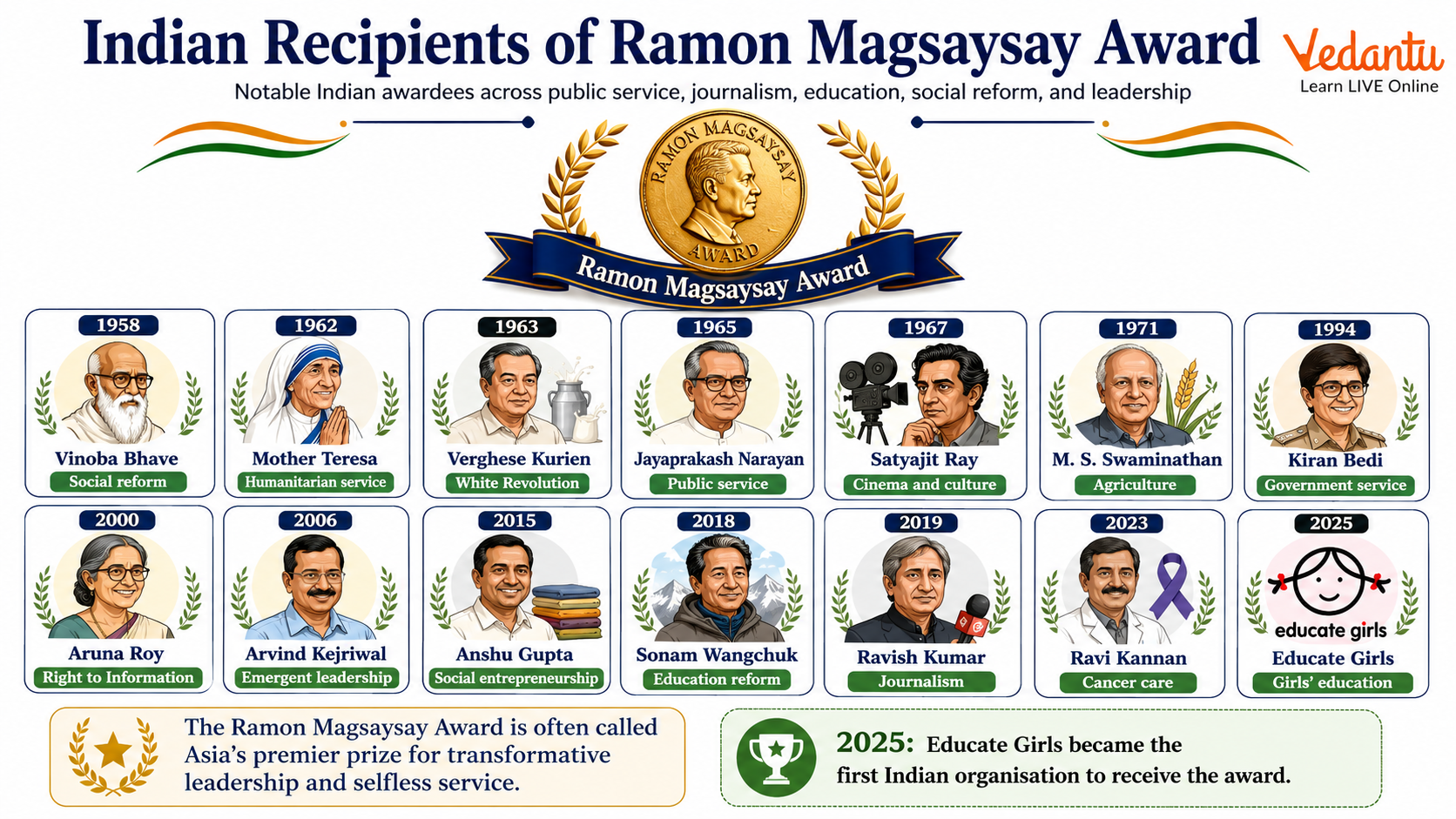
About the Ramon Magsaysay Award
The Ramon Magsaysay Award was instituted in 1957 by the Rockefeller Brothers Fund and is now administered by the Ramon Magsaysay Award Foundation based in Manila, Philippines. It honors individuals and organizations in Asia who have shown transformative leadership and service to the people.
Major Award Categories
- Government Service
- Public Service
- Community Leadership
- Journalism, Literature and Creative Communication Arts
- Peace and International Understanding
- Emergent Leadership
The award includes a certificate, a medallion bearing the likeness of Ramon Magsaysay, and a cash prize. It recognizes practical idealism and moral courage in serving society.
Notable Indian Recipients of Ramon Magsaysay Award
| Name | Year | Field / Contribution |
|---|---|---|
| Vinoba Bhave | 1958 | Community Leadership - Bhoodan Movement |
| Mother Teresa | 1962 | Public Service - Humanitarian Work |
| Jayaprakash Narayan | 1965 | Public Service - Social Reform |
| Verghese Kurien | 1963 | Community Leadership - White Revolution |
| Kiran Bedi | 1994 | Government Service - Police Reforms |
| Aruna Roy | 2000 | Community Leadership - Right to Information |
| Sandeep Pandey | 2002 | Emergent Leadership - Social Activism |
| Arvind Kejriwal | 2006 | Emergent Leadership - RTI Movement |
| Bezwada Wilson | 2016 | Public Service - Campaign Against Manual Scavenging |
The above list highlights some of the most prominent Indian recipients. Many other Indians have also been honored for their exceptional contributions in diverse fields.
Key Contributions of Indian Awardees
1. Social Reform and Community Development
Leaders like Vinoba Bhave and Jayaprakash Narayan worked toward land reforms, social justice, and upliftment of marginalized communities. Their movements inspired peaceful change through public participation.
2. Humanitarian and Health Services
Mother Teresa dedicated her life to serving the poor and sick in India through the Missionaries of Charity. Her work earned global recognition and later the Nobel Peace Prize.
3. Rural and Economic Development
Verghese Kurien played a crucial role in launching the White Revolution in India through Operation Flood. His efforts made India one of the largest milk producers in the world.
4. Governance and Transparency
Aruna Roy and Arvind Kejriwal were instrumental in promoting the Right to Information movement, which strengthened transparency and accountability in governance.
5. Social Justice and Human Rights
Bezwada Wilson led a nationwide campaign against manual scavenging and worked for the dignity and rights of sanitation workers in India.
Why Indian Recipients Are Important for General Knowledge
- Frequently asked in competitive exams such as UPSC, SSC, State PSC, and banking exams
- Important for essays and interviews related to social issues and governance
- Helps understand modern Indian social movements
- Reflects India’s contribution to global humanitarian efforts
Preparation Tips for Competitive Exams
- Memorize important names along with their year and field of contribution
- Focus on recent Indian awardees for current affairs sections
- Understand the major social movements linked to award winners
- Revise through tables for quick recall before exams
Conclusion
Indian recipients of the Ramon Magsaysay Award have made significant contributions in fields such as social reform, public service, governance, rural development, and human rights. Their work highlights the spirit of service and leadership that brings meaningful change to society. For students and competitive exam aspirants, knowing about these awardees is essential as it strengthens general awareness and provides insight into India’s role in shaping progressive social movements across Asia.
FAQs on Indian Recipients of the Ramon Magsaysay Award: Complete Guide for Students
1. What is the Ramon Magsaysay Award?
The Ramon Magsaysay Award is Asia’s highest honor, often called the “Nobel Prize of Asia,” given for outstanding public service and leadership.
• Established in 1957 in memory of Philippine President Ramon Magsaysay
• Honors excellence in government service, public service, community leadership, journalism, literature, and creative communication
• Recognizes individuals and organizations across Asia
This award celebrates integrity, courage, and transformative leadership in society.
2. Who was the first Indian recipient of the Ramon Magsaysay Award?
The first Indian to receive the Ramon Magsaysay Award was Vinoba Bhave in 1958.
• Awarded for his leadership in the Bhoodan (Land Gift) Movement
• Recognized under the category of Community Leadership
• Promoted non-violence and land reforms inspired by Mahatma Gandhi
His contribution marked India’s early presence in this prestigious Asian award.
3. Which famous Indian leaders have won the Ramon Magsaysay Award?
Several prominent Indian leaders and reformers have won the Ramon Magsaysay Award for public service and social change.
• Mother Teresa (1962) – Public Service
• Jayaprakash Narayan (1965) – Public Service
• Verghese Kurien (1963) – Community Leadership (White Revolution)
• Kiran Bedi (1994) – Government Service
• Arvind Kejriwal (2006) – Emergent Leadership
These awardees are known for leadership, governance reforms, and social activism.
4. Why is the Ramon Magsaysay Award important for Indians?
The Ramon Magsaysay Award is significant for Indians as it recognizes excellence in public service and social leadership at an international level.
• Enhances India’s global reputation in social reform
• Highlights grassroots movements and governance reforms
• Important for GK, UPSC, SSC, and competitive exams
• Encourages youth toward ethical leadership and nation-building
It symbolizes Asia-wide recognition of India’s contribution to society.
5. In which categories are Indians awarded the Ramon Magsaysay Award?
Indians have received the Ramon Magsaysay Award in multiple categories recognizing diverse contributions.
• Government Service
• Public Service
• Community Leadership
• Journalism, Literature and Creative Communication Arts
• Emergent Leadership
These categories reflect achievements in administration, journalism, social work, and innovation.
6. Who are some recent Indian recipients of the Ramon Magsaysay Award?
In recent years, several Indians have been honored with the Ramon Magsaysay Award for impactful grassroots work.
• Bezwada Wilson (2016) – Fight against manual scavenging
• Sonam Wangchuk (2018) – Educational reform and innovation
• Ravish Kumar (2019) – Ethical journalism
These awardees are known for social activism, education reform, and independent journalism.
7. How many Indians have received the Ramon Magsaysay Award?
More than 50 Indians have received the Ramon Magsaysay Award since 1958.
• India is among the highest recipient countries
• Awardees include social workers, journalists, administrators, and activists
• Frequently asked in General Knowledge (GK) and competitive exams
The high number reflects India’s strong tradition of public service and reform movements.
8. Is the Ramon Magsaysay Award given only to individuals?
No, the Ramon Magsaysay Award is given to both individuals and organizations.
• NGOs and institutions promoting social change are eligible
• Recognizes collective efforts in governance and community development
• Honors excellence in leadership, transparency, and innovation
This inclusive approach broadens the impact of the award across Asia.
9. What is the connection between Mother Teresa and the Ramon Magsaysay Award?
Mother Teresa received the Ramon Magsaysay Award for Public Service in 1962 for her humanitarian work in India.
• Recognized for serving the poor and destitute in Kolkata
• Founder of the Missionaries of Charity
• Later awarded the Nobel Peace Prize (1979)
Her recognition brought global attention to humanitarian service in India.
10. Why is the Ramon Magsaysay Award important for competitive exams?
The Ramon Magsaysay Award is important for competitive exams because questions frequently appear in UPSC, SSC, Banking, Railways, and State PCS exams.
• Often asked: first Indian winner, recent recipients, categories
• Related to topics like Indian awards and honors
• Important for General Studies and Current Affairs sections
Understanding Indian recipients of this award strengthens GK preparation and interview discussions.
