






List of Major Metals with Their Ores, Uses, and Extraction Methods
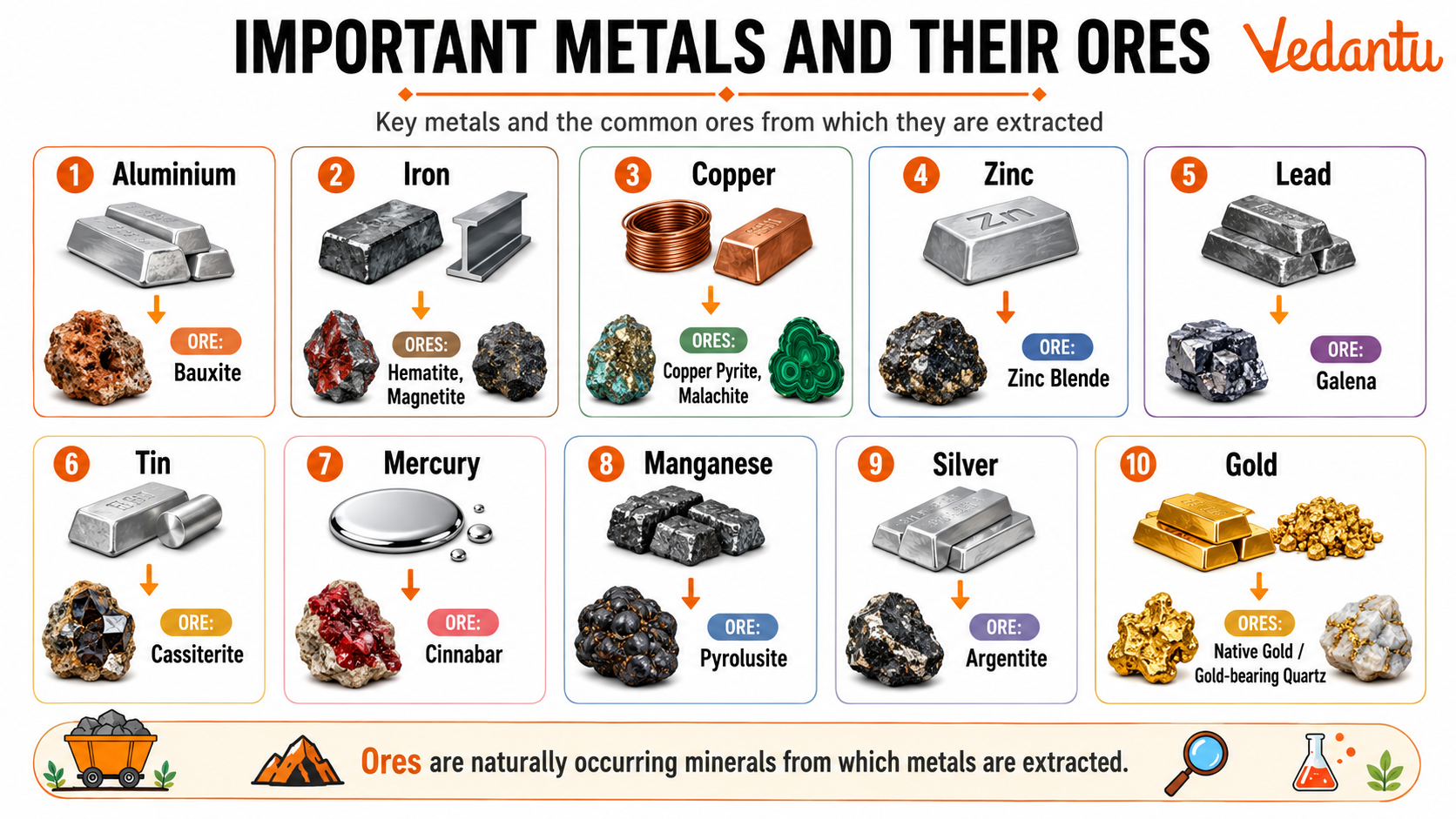
Important metals and their ores are a key topic in General Knowledge and Chemistry. Metals are rarely found in their pure form in nature. Instead, they occur as compounds mixed with impurities in the earth’s crust. These naturally occurring materials from which metals can be extracted profitably are called ores. Understanding important metals and their ores is essential for school exams, competitive exams like NEET, and for general awareness about natural resources and industries.
What Are Ores?
An ore is a naturally occurring rock or mineral from which a metal can be extracted economically. All minerals are not ores, but all ores are minerals. Ores contain a high percentage of a particular metal along with unwanted materials called gangue.
Key Terms Related to Ores
- Mineral - A naturally occurring inorganic substance found in the earth’s crust.
- Ore - A mineral from which metal can be extracted profitably.
- Gangue - Unwanted impurities like sand, clay, and rocks present in an ore.
- Metallurgy - The process of extraction of metals from their ores.
Important Metals and Their Ores
List of Important Metals and Their Ores
| Metal | Important Ore | Chemical Formula |
|---|---|---|
| Iron | Hematite | Fe2O3 |
| Aluminium | Bauxite | Al2O3.2H2O |
| Copper | Chalcopyrite | CuFeS2 |
| Zinc | Zinc Blende | ZnS |
| Lead | Galena | PbS |
| Mercury | Cinnabar | HgS |
| Silver | Argentite | Ag2S |
| Gold | Native Gold | Au |
The above table includes the most commonly asked metals and their principal ores in competitive exams. Students should remember both the name of the ore and its chemical formula for better preparation.
Classification of Ores
Ores can be classified based on the type of compound present in them. This classification helps in understanding the method used for extraction.
1. Oxide Ores
- Hematite - Fe2O3
- Magnetite - Fe3O4
- Bauxite - Al2O3.2H2O
2. Sulphide Ores
- Zinc blende - ZnS
- Galena - PbS
- Cinnabar - HgS
3. Carbonate Ores
- Calamine - ZnCO3
- Siderite - FeCO3
Importance of Studying Metals and Ores
Knowledge of important metals and their ores is essential for understanding industrial processes, economic development, and natural resource management. Metals like iron and aluminium are widely used in construction and transportation, while copper and zinc are essential in electrical and manufacturing industries.
- Frequently asked in school exams and competitive exams like NEET.
- Important for understanding extraction and refining processes.
- Helps in learning about industrial and economic applications of metals.
Preparation Tips for Exams
To score well in questions related to important metals and their ores, students should focus on memorizing the metal, its chief ore, and the corresponding chemical formula. Concept clarity along with regular revision improves retention.
- Prepare a short chart listing metals with their principal ores and formulas.
- Revise classification of ores based on oxides, sulphides, and carbonates.
- Practice multiple choice questions related to metallurgy basics.
- Understand the difference between mineral and ore clearly.
Conclusion
Important metals and their ores form a fundamental part of General Knowledge and basic Chemistry. Since most metals are extracted from ores through metallurgy, knowing their names, types, and chemical formulas is crucial for academic and competitive exam success. A clear understanding of this topic not only helps in exams like NEET but also builds awareness about the natural resources that support modern civilization.
FAQs on Important Metals & Their Ores Explained for Students
1. What are important metals and their ores?
Important metals and their ores refer to commonly used metals in industry and the natural minerals from which they are extracted. Metals occur in the earth’s crust mainly in the form of ores (metal-bearing minerals).
• Iron – Haematite, Magnetite
• Aluminium – Bauxite
• Copper – Copper pyrites
• Zinc – Zinc blende
• Lead – Galena
These metals and ores are important for metallurgy, extraction of metals, competitive exams, and general science knowledge.
2. What is an ore in chemistry?
An ore is a naturally occurring mineral from which a metal can be extracted economically and profitably. Not all minerals are ores.
• Contains a high percentage of metal content
• Suitable for commercial extraction
• Undergoes processes like concentration, roasting, and smelting
In simple terms, all ores are minerals, but not all minerals are ores.
3. What are the main ores of iron?
The main ores of iron are Haematite and Magnetite, which are widely used in the iron and steel industry.
• Haematite (Fe₂O₃) – Most important iron ore
• Magnetite (Fe₃O₄) – Highest iron content
• Limonite – Hydrated iron oxide
• Siderite – Iron carbonate
Iron ores are essential for producing steel, construction materials, and machinery.
4. Which ore is used to extract aluminium?
Bauxite is the principal ore of aluminium and is the main source of aluminium production worldwide.
• Chemical composition: Al₂O₃·2H₂O
• Extracted by the Bayer Process
• Aluminium obtained by electrolysis (Hall-Héroult process)
Aluminium is widely used in transport, packaging, electrical cables, and aircraft manufacturing.
5. What is the chief ore of copper?
Copper pyrites (CuFeS₂) is the chief ore of copper and is widely used for copper extraction.
• Other ores: Malachite, Cuprite
• Extracted through roasting and smelting
• Used in electrical wiring, alloys (bronze, brass), and electronics
Copper is known for its high electrical conductivity and corrosion resistance.
6. What are the important ores of zinc and lead?
Zinc blende and Galena are the most important ores of zinc and lead respectively.
• Zinc blende (ZnS) – Main ore of zinc
• Calamine – Zinc carbonate
• Galena (PbS) – Chief ore of lead
These metals are used in galvanization, batteries, alloys, and construction materials.
7. Why are metals extracted from ores instead of directly from the earth?
Metals are extracted from ores because they are usually found in combined form due to their chemical reactivity.
• Most metals occur as oxides, sulphides, or carbonates
• Free metals are rare (e.g., gold, platinum)
• Extraction requires metallurgical processes
This is because metals react with oxygen, sulfur, and other elements in nature.
8. What are the basic steps involved in extraction of metals from ores?
The extraction of metals from ores involves three main steps in metallurgy.
1. Concentration of ore – Removal of impurities (gangue)
2. Roasting or Calcination – Heating to remove volatile impurities
3. Reduction/Smelting – Obtaining pure metal
These steps are essential in metallurgy, mineral processing, and industrial chemistry.
9. What is the difference between mineral and ore?
A mineral is a naturally occurring substance, while an ore is a mineral that contains enough metal for economic extraction.
• Mineral – Natural chemical compound in the earth’s crust
• Ore – Mineral with profitable metal content
• All ores are minerals, but not all minerals are ores
This distinction is important in general science, geography, and competitive exams.
10. Which metals are found in native (free) state?
Metals found in native or free state are those that occur uncombined in nature due to low reactivity.
• Gold (Au)
• Silver (Ag)
• Platinum (Pt)
• Sometimes Copper (Cu)
These metals are called noble metals because they resist corrosion and oxidation.
