






Rise and Contributions of the Chola, Chera and Pandya Kingdoms in South India
The Chola, Chera, and Pandya dynasties were three powerful ancient Tamil kingdoms that ruled large parts of South India for many centuries. These dynasties played a major role in shaping the political, economic, cultural, and maritime history of India. Known collectively as the "Three Crowned Kings" of Tamilakam, they contributed significantly to temple architecture, trade networks, literature, and administration. Understanding the Chola, Chera, and Pandya dynasties is essential for students preparing for competitive exams and for anyone interested in Indian history and heritage.
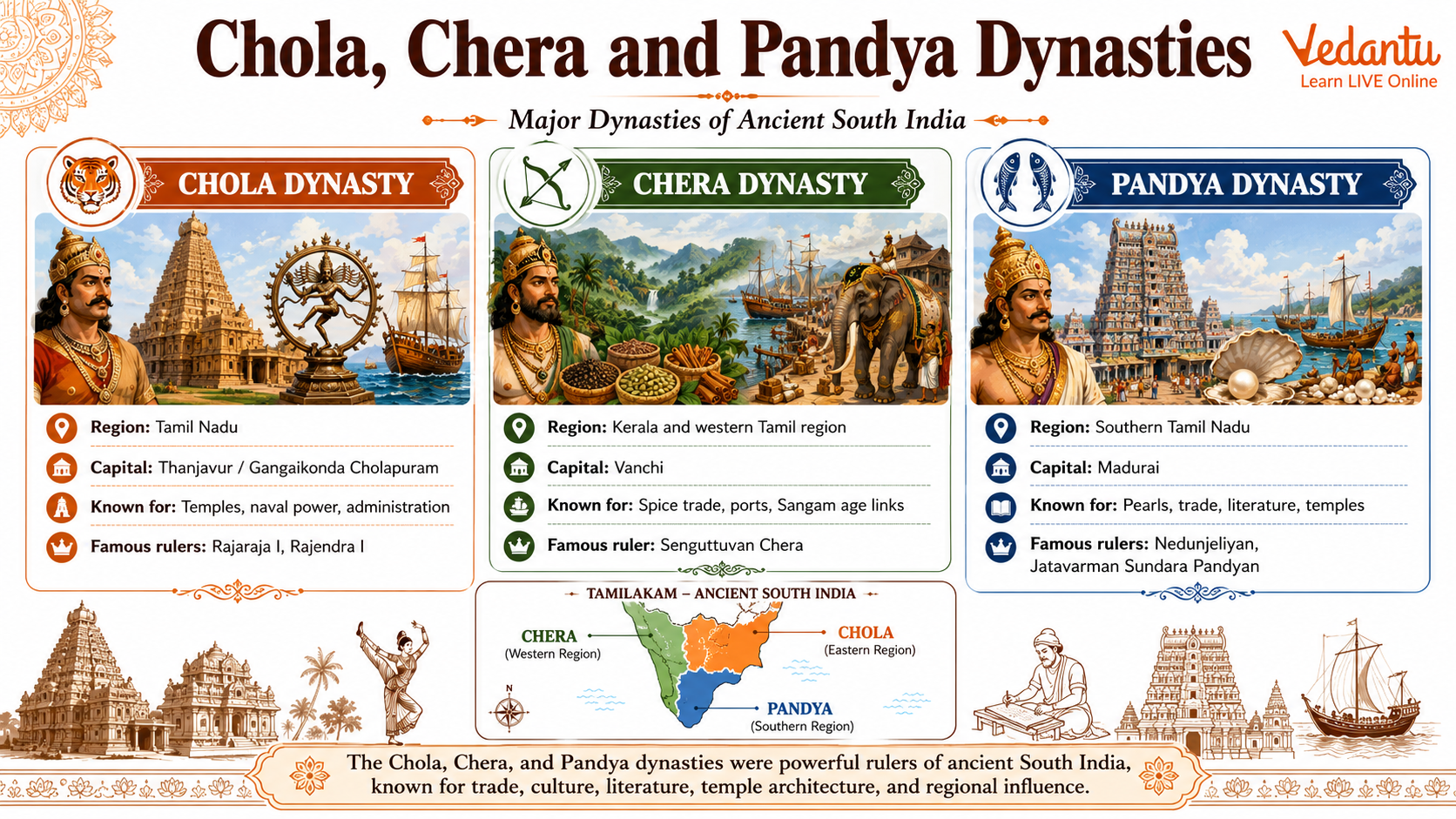
Overview of the Three Dynasties
The Cholas, Cheras, and Pandyas were mentioned in ancient Tamil literature known as Sangam texts. They ruled different regions of South India and often engaged in warfare as well as trade alliances. Their rule extended from the early centuries BCE to the late medieval period, with the Cholas reaching imperial heights between the 9th and 13th centuries CE.
Comparison of Chola, Chera, and Pandya Dynasties
| Dynasty | Region and Capital | Notable Features |
|---|---|---|
| Chola | Tamil Nadu - Capital at Thanjavur and later Gangaikonda Cholapuram | Naval power, Brihadeeswara Temple, efficient administration |
| Chera | Kerala and western Tamil Nadu - Capital at Vanchi | Spice trade, strong trade links with Romans |
| Pandya | Southern Tamil Nadu - Capital at Madurai | Patronage of Sangam literature, pearl trade |
These three dynasties dominated South Indian politics and trade. While they often competed with each other, they also contributed collectively to the growth of Tamil culture and maritime trade.
The Chola Dynasty
Political Achievements
The Cholas became one of the most powerful empires in South India during the medieval period. Important rulers include Rajaraja I and Rajendra I. They expanded their empire to Sri Lanka, the Maldives, and parts of Southeast Asia. The Cholas developed a strong navy, which helped them control sea trade routes.
Administration
The Cholas had a well-organized administrative system. The empire was divided into provinces, districts, and villages. Local self-government was encouraged through village assemblies called Sabha and Ur.
- Efficient revenue collection system
- Detailed land surveys
- Autonomous village administration
Art and Architecture
The Cholas are famous for their temple architecture. The Brihadeeswara Temple at Thanjavur is a UNESCO World Heritage Site and a masterpiece of Dravidian architecture. Chola bronze sculptures, especially the Nataraja statue, are world famous.
The Chera Dynasty
Economic Importance
The Cheras controlled the Malabar Coast, which was rich in spices such as black pepper and cardamom. They maintained strong trade relations with the Roman Empire and West Asia. Roman coins have been found in Kerala, showing active trade.
- Export of spices and ivory
- Active participation in Indian Ocean trade
- Development of port cities
Cultural Contributions
The Cheras supported Tamil literature during the Sangam period. They also contributed to the development of early Malayalam culture and traditions in Kerala.
The Pandya Dynasty
Political and Literary Contributions
The Pandyas ruled from Madurai, which became a major cultural center. They were great patrons of Sangam literature. Many Tamil poets and scholars flourished under their support.
Economic Activities
The Pandyas were known for their pearl fisheries along the Gulf of Mannar. They also engaged in maritime trade with Southeast Asia and the Roman world.
- Pearl trade as a major source of revenue
- Development of Madurai as a cultural hub
- Construction of temples and irrigation works
Social and Cultural Life
Society under the Chola, Chera, and Pandya dynasties was organized but flexible. Agriculture was the main occupation, supported by irrigation systems like tanks and canals. Religion played a significant role, with Hinduism being dominant, along with Jainism and Buddhism in earlier periods.
- Growth of Bhakti movement
- Temple-centered economy
- Rich tradition of Tamil literature
Decline of the Dynasties
The decline of these dynasties occurred due to internal conflicts, succession disputes, and invasions by external powers such as the Delhi Sultanate. By the 14th century, their political dominance had weakened, although their cultural influence continued for centuries.
Key Points for Competitive Exams
- The Cholas were known for their naval strength and temple architecture.
- The Cheras controlled the spice trade on the Malabar Coast.
- The Pandyas were patrons of Sangam literature and pearl trade.
- All three dynasties were mentioned in Sangam texts.
- Brihadeeswara Temple was built by Rajaraja I of the Chola dynasty.
Conclusion
The Chola, Chera, and Pandya dynasties played a foundational role in the development of South Indian civilization. Their achievements in governance, trade, literature, and architecture left a lasting impact on Indian history. From powerful naval expeditions to magnificent temples and vibrant literary traditions, these dynasties represent a golden era of Tamil culture and heritage. A clear understanding of their contributions is essential for building strong General Knowledge and performing well in competitive examinations.
FAQs on Chola, Chera and Pandya Dynasties: Complete History for Students
1. Who were the Chola, Chera, and Pandya dynasties?
The Chola, Chera, and Pandya dynasties were the three major ancient Tamil kingdoms that ruled South India during the Sangam Age and medieval period.
• The Cholas ruled mainly in present-day Tamil Nadu with capitals like Thanjavur and Gangaikonda Cholapuram.
• The Cheras ruled parts of Kerala and western Tamil Nadu, with their capital at Vanji.
• The Pandyas ruled southern Tamil Nadu, with Madurai as their capital.
These dynasties played a key role in South Indian history, trade, culture, and temple architecture.
2. When did the Chola, Chera, and Pandya dynasties rule?
The Chola, Chera, and Pandya kingdoms ruled from the early centuries BCE to the 13th century CE in different phases.
• The Sangam period (around 300 BCE–300 CE) mentions all three dynasties.
• The Medieval Cholas (9th–13th century CE) were especially powerful under Rajaraja Chola I and Rajendra Chola I.
• The Pandyas regained power in the 13th century before the Delhi Sultanate invasions.
This timeline is important for competitive exams and Indian history GK.
3. Who was the greatest ruler of the Chola dynasty?
The greatest ruler of the Chola dynasty was Rajaraja Chola I (985–1014 CE).
• Expanded the Chola Empire across South India and Sri Lanka.
• Built the famous Brihadeeswara Temple at Thanjavur (UNESCO World Heritage Site).
• Strengthened the naval power and overseas trade.
His reign marked the golden age of the Chola Empire in medieval South India.
4. What were the main achievements of the Chola dynasty?
The Chola Empire is known for its military, administrative, and cultural achievements.
• Strong naval dominance in the Indian Ocean and Southeast Asia.
• Construction of grand Dravidian-style temples like Brihadeeswara.
• Efficient local self-government system (village assemblies or Sabha).
• Promotion of Tamil literature and art.
These achievements made the Cholas one of the most powerful South Indian dynasties.
5. What was the importance of the Chera dynasty?
The Chera dynasty was important for trade and early Tamil culture.
• Controlled the Malabar Coast and spice trade, especially pepper.
• Maintained trade relations with the Romans and West Asia.
• Supported Sangam literature and Tamil poets.
The Cheras played a major role in ancient maritime trade in South India.
6. Why was the Pandya dynasty significant in South Indian history?
The Pandya dynasty was significant for promoting Tamil culture and temple architecture.
• Capital city: Madurai, a major cultural center.
• Patronized the Sangam academies of Tamil literature.
• Developed trade with Rome and Southeast Asia.
• Built famous temples like the Meenakshi Temple (later expanded).
The Pandyas were key contributors to Tamil heritage and regional power politics.
7. What was the Sangam Age in relation to the three dynasties?
The Sangam Age refers to the early historic period when the Chola, Chera, and Pandya kingdoms flourished in Tamilakam.
• Period: Approximately 300 BCE to 300 CE.
• Known for Sangam literature, including works like Ettuthokai and Pattupattu.
• Provides details about governance, trade, and society.
This period is crucial for understanding early South Indian civilization.
8. How did the Cholas contribute to trade and naval power?
The Cholas developed one of the strongest naval forces in medieval India.
• Conducted naval expeditions to Sri Lanka and Southeast Asia (Srivijaya Empire).
• Controlled key sea routes in the Bay of Bengal.
• Promoted overseas trade in spices, textiles, and precious stones.
This earned them the title of a major maritime power in Indian Ocean history.
9. What type of administration did the Chola dynasty follow?
The Chola administration was highly organized and decentralized.
• Empire divided into mandalams, valanadus, and nadus.
• Village assemblies called Sabha and Ur managed local governance.
• Efficient revenue system based on land surveys.
This system is often cited in GK and UPSC exams as an example of early local self-government.
10. What led to the decline of the Chola, Chera, and Pandya dynasties?
The decline of the Chola, Chera, and Pandya dynasties was due to internal conflicts and external invasions.
• Continuous wars among the three kingdoms weakened them.
• Rise of new powers like the Delhi Sultanate in the 14th century.
• Invasions by Malik Kafur affected the Pandya kingdom.
These factors gradually ended the dominance of the ancient Tamil dynasties in South India.
