






Who Has Led India in ODI Cricket? Year-Wise Captain List and Records
The One Day International format, commonly known as ODI cricket, has played a vital role in shaping Indian cricket history. Since India played its first ODI in 1974, several legendary players have led the team and contributed significantly to its growth and global success. The captains of the Indian One Day Cricket Team have not only represented leadership on the field but have also guided the team to historic victories, including World Cup triumphs. This General Knowledge page provides a detailed overview of all important ODI captains of India, their tenure, achievements, and impact on Indian cricket.
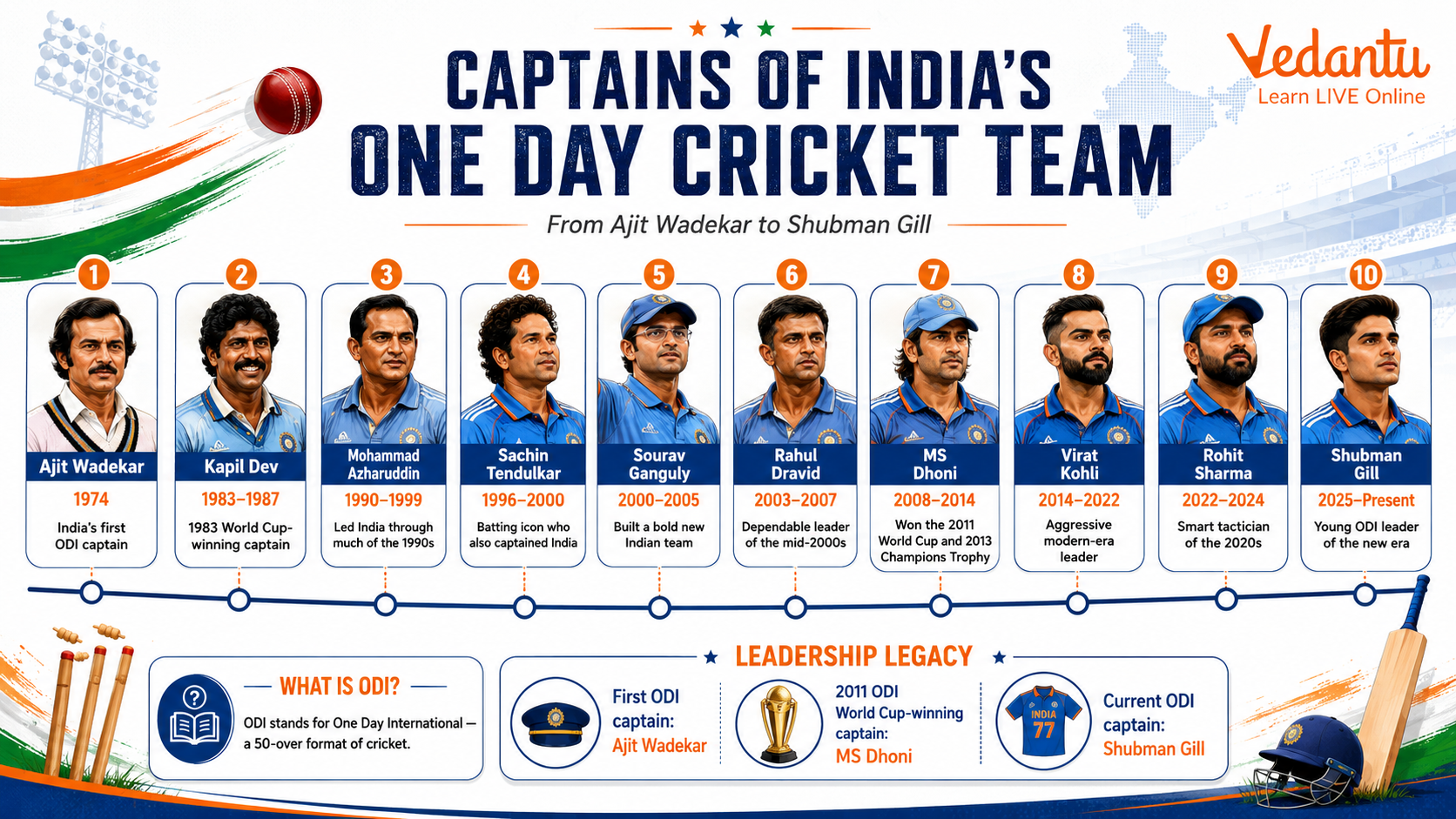
Introduction to ODI Cricket in India
India played its first One Day International match on 13 July 1974 against England at Leeds. Over the decades, ODI cricket has become one of the most popular formats in the country. Leadership in ODI cricket requires strategic planning, quick decision making, and the ability to handle pressure situations. Indian ODI captains have played a crucial role in building a strong and competitive team at the international level.
List of Captains of Indian ODI Cricket Team
| Captain Name | Tenure | Major Achievement |
|---|---|---|
| Ajit Wadekar | 1974 | First ODI Captain of India |
| Srinivas Venkataraghavan | 1974 - 1979 | Led in early World Cups |
| Kapil Dev | 1982 - 1987 | Won 1983 Cricket World Cup |
| Sunil Gavaskar | 1980 - 1985 | World Championship of Cricket 1985 |
| Mohammad Azharuddin | 1990 - 1999 | Most wins in 1990s |
| Sachin Tendulkar | 1996 - 2000 | Led during transition period |
| Sourav Ganguly | 2000- 2005 | Reached 2003 World Cup Final |
| Rahul Dravid | 2003 - 2007 | Champions Trophy 2002 joint winner |
| MS Dhoni | 2008 - 2014 | Won 2011 Cricket World Cup |
| Virat Kohli | 2014 - 2022 | Highest ODI win percentage among Indian captains |
| Rohit Sharma | 2022 - 2024 | Led in ICC Cricket World Cup 2023 |
The above table highlights the most significant ODI captains of India. Some captains served briefly, while others led the team for several years and created a lasting legacy.
Most Successful ODI Captains of India
Kapil Dev
Kapil Dev is remembered as one of the greatest captains in Indian cricket history. Under his leadership, India won its first ICC Cricket World Cup in 1983 by defeating the West Indies. This victory transformed Indian cricket and increased the popularity of the sport across the country.
Sourav Ganguly
Sourav Ganguly built a strong and fearless Indian team in the early 2000s. He backed young players like Yuvraj Singh and Harbhajan Singh and led India to the final of the 2003 ICC Cricket World Cup. His leadership marked the beginning of a new aggressive era in Indian cricket.
MS Dhoni
MS Dhoni is considered the most successful ODI captain of India. He led India to victory in the 2011 ICC Cricket World Cup and the 2013 ICC Champions Trophy. Known for his calm nature and sharp decision making, Dhoni has one of the best winning records among Indian captains.
Virat Kohli
Virat Kohli maintained a high winning percentage as ODI captain. Under his captaincy, India consistently ranked among the top ODI teams in the world. His aggressive leadership style and fitness standards influenced modern Indian cricket.
Key Achievements of Indian ODI Captains
- 1983 - India won its first ICC Cricket World Cup under Kapil Dev.
- 2002 - ICC Champions Trophy shared under Sourav Ganguly.
- 2011 - ICC Cricket World Cup victory under MS Dhoni.
- 2013 - ICC Champions Trophy win under MS Dhoni.
- Multiple Asia Cup victories under various captains.
Important GK Points for Competitive Exams
- First ODI captain of India - Ajit Wadekar.
- First Indian captain to win ODI World Cup - Kapil Dev in 1983.
- Second ODI World Cup winning captain - MS Dhoni in 2011.
- Indian captain with most ODI wins - MS Dhoni.
- Highest ODI win percentage as Indian captain - Virat Kohli.
Conclusion
The captains of the Indian One Day Cricket Team have played a defining role in the country's cricketing journey. From Ajit Wadekar's leadership in the first ODI to Rohit Sharma's modern era captaincy, each leader has contributed uniquely to the team's development. World Cup victories, Champions Trophy wins, and consistent performances at the international level highlight the strength of Indian ODI leadership. Understanding the list of captains and their achievements is important for students preparing for competitive exams and for anyone interested in Indian cricket history.
FAQs on Captains of India's One Day Cricket Team: Complete History for Students
1. Who was the first captain of the Indian ODI cricket team?
Ajit Wadekar was the first captain of the Indian One Day International (ODI) cricket team.
• He led India in their first ODI match in 1974 against England.
• This match was played at Leeds (Headingley).
• India lost the match, but it marked the beginning of India’s journey in limited-overs cricket.
• Wadekar is also remembered for his leadership in Test cricket during the early 1970s.
2. Who is the most successful captain of India in ODI cricket?
MS Dhoni is the most successful captain of India in ODI cricket history.
• Led India to victory in the 2011 ICC Cricket World Cup.
• Won the 2013 ICC Champions Trophy.
• Known for his calm leadership and finishing skills.
• Recorded over 100 ODI wins as captain, making him one of the greatest limited-overs leaders.
3. Who captained India in the 1983 Cricket World Cup?
Kapil Dev captained India in the historic 1983 Cricket World Cup.
• India defeated the West Indies in the final at Lord’s.
• This was India’s first-ever World Cup victory.
• Kapil Dev’s 175* against Zimbabwe is one of the most iconic ODI innings.
• The win transformed Indian cricket and increased the popularity of one-day cricket in India.
4. Who has captained India in the most ODI matches?
MS Dhoni has captained India in the highest number of ODI matches.
• He led India in over 200 ODI games.
• Served as captain from 2007 to 2017.
• Achieved major ICC trophies under his leadership.
• He is regarded as one of the most experienced ODI captains in world cricket.
5. Who was the captain of India during the 2019 ICC Cricket World Cup?
Virat Kohli was the captain of India during the 2019 ICC Cricket World Cup.
• The tournament was held in England and Wales.
• India reached the semi-finals but lost to New Zealand.
• Kohli is known for his aggressive captaincy and consistent batting performance.
• He also led India to the No.1 ranking in ODI cricket.
6. Who is the current captain of the Indian ODI cricket team?
Rohit Sharma is the current captain of the Indian ODI cricket team.
• Appointed full-time ODI captain in 2022.
• Led India in the 2023 ICC Cricket World Cup.
• Known for his record-breaking centuries in ODIs.
• Under his leadership, India has maintained strong performances in bilateral series.
7. Which Indian captain has won the most ICC trophies in ODI cricket?
MS Dhoni has won the most ICC trophies for India in limited-overs cricket.
• 2011 ICC Cricket World Cup winner.
• 2013 ICC Champions Trophy winner.
• Also won the 2007 ICC T20 World Cup.
• He is the only Indian captain to win all three major ICC white-ball tournaments.
8. Who was India’s youngest ODI captain?
Sachin Tendulkar was one of the youngest captains of India in ODI cricket.
• First captained India in 1996 at the age of 23.
• Served two terms as ODI captain.
• Though more famous for his batting records, he also contributed as a leader.
• He is often searched under ‘youngest Indian cricket captain’ in GK exams.
9. How many players have captained India in ODI cricket?
More than 20 players have captained India in One Day Internationals (ODIs) since 1974.
• Notable names include Kapil Dev, Mohammad Azharuddin, Sourav Ganguly, MS Dhoni, Virat Kohli, and Rohit Sharma.
• Some players served as stand-in or interim captains.
• Leadership changes often occurred due to injuries or team transitions.
• This question is common in competitive exams and sports GK sections.
10. Who was the captain of India before MS Dhoni in ODI cricket?
Rahul Dravid was the ODI captain of India before MS Dhoni became full-time captain.
• Dravid led India from 2005 to 2007.
• He captained India during the 2007 ICC Cricket World Cup.
• After the 2007 World Cup, Dhoni took over leadership.
• This transition marked the beginning of a new era in Indian limited-overs cricket.
