






Major turning points in Indian history and key historical events explained
Historical Events in Indian History form a vital part of General Knowledge and play an important role in competitive exams, school education, and overall awareness about the nation’s past. India has witnessed ancient civilizations, powerful empires, social reforms, freedom struggles, and modern nation-building events that have shaped its identity. Understanding these events helps students analyze political, social, economic, and cultural transformations across different periods. This page provides a structured overview of major historical events in Indian history, arranged chronologically for better clarity and exam preparation.
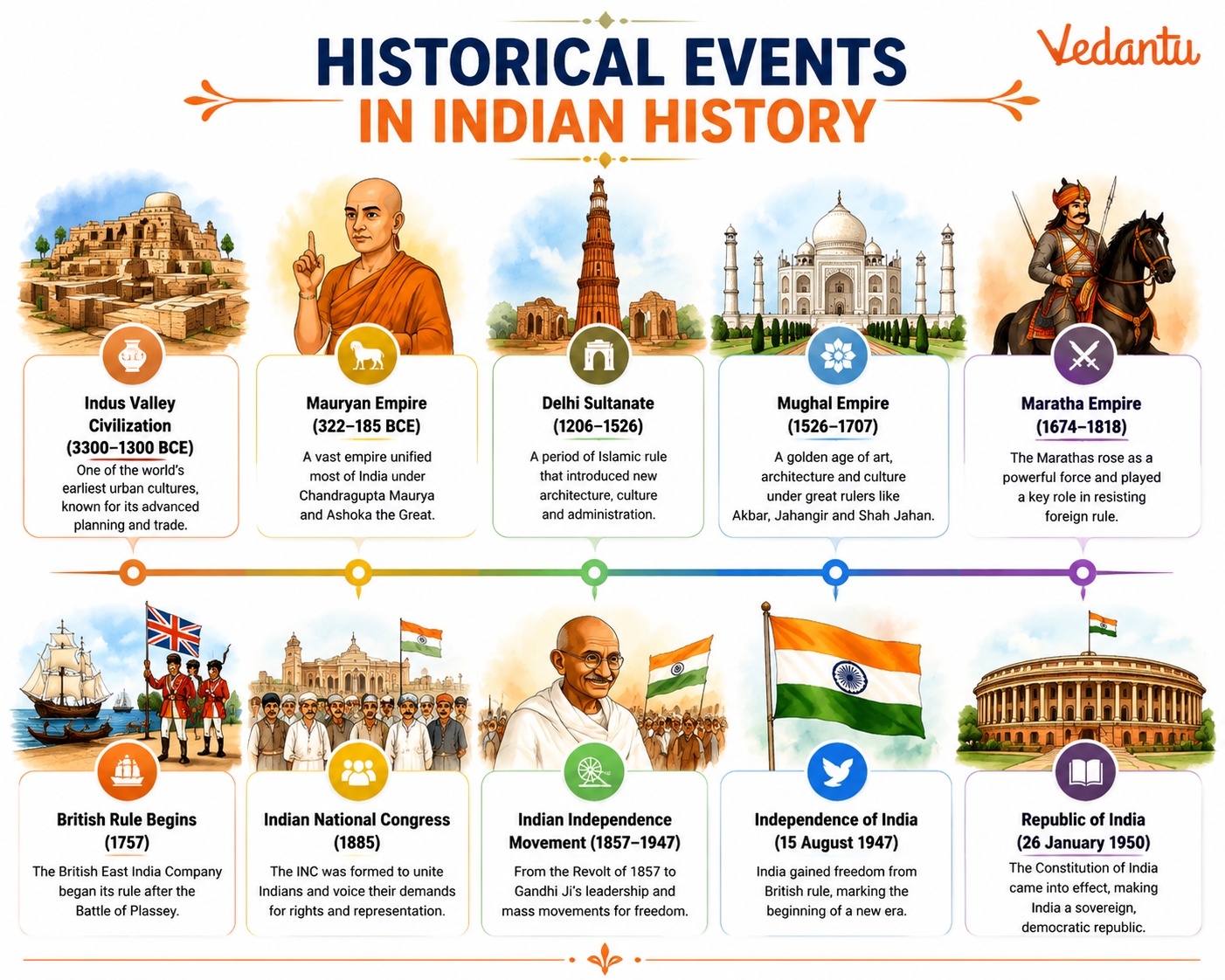
Major Periods in Indian History
1. Ancient India
Ancient Indian history begins with the Indus Valley Civilization and continues until the early medieval period. This era laid the foundation of Indian culture, religion, philosophy, science, and governance systems.
- Indus Valley Civilization - One of the world’s earliest urban civilizations, known for planned cities like Harappa and Mohenjo-Daro.
- Vedic Period - Composition of the Vedas and development of early Hindu society.
- Rise of Mahajanapadas - Sixteen powerful states emerged in northern India.
- Mauryan Empire - Founded by Chandragupta Maurya, expanded under Ashoka who promoted Buddhism.
- Gupta Empire - Known as the Golden Age of India due to advancements in science, mathematics, and art.
2. Medieval India
The medieval period witnessed the establishment of new dynasties, cultural exchanges, and administrative developments. It marked the arrival and consolidation of Islamic rule in India.
- Delhi Sultanate - Established in 1206 by Qutb-ud-din Aibak.
- Mughal Empire - Founded by Babur in 1526 after the First Battle of Panipat.
- Reign of Akbar - Administrative reforms and religious tolerance.
- Bhakti and Sufi Movements - Promoted devotion and social harmony.
- Decline of Mughal Empire - After Aurangzeb, regional powers gained strength.
3. Modern India
Modern Indian history mainly covers the period of British rule and the struggle for independence. This phase significantly influenced India’s political and social structure.
- Arrival of Europeans - Portuguese arrived in 1498, followed by Dutch, French, and British.
- Battle of Plassey 1757 - Marked the beginning of British political control in India.
- Revolt of 1857 - First major uprising against British rule.
- Formation of Indian National Congress 1885 - Organized political movement for independence.
- Non-Cooperation Movement 1920 and Civil Disobedience Movement 1930 - Led by Mahatma Gandhi.
- Quit India Movement 1942 - Final mass movement against British rule.
- Independence and Partition 1947 - India became independent on 15 August 1947.
Timeline of Important Historical Events in Indian History
| Year or Period | Event | Significance |
|---|---|---|
| 3300 to 1300 BCE | Indus Valley Civilization | Early urban planning and trade |
| 322 BCE | Mauryan Empire | First large empire in India |
| 1206 CE | Delhi Sultanate | Beginning of Muslim rule in Delhi |
| 1526 CE | First Battle of Panipat | Foundation of Mughal Empire |
| 1757 CE | Battle of Plassey | Start of British dominance |
| 1857 CE | Revolt of 1857 | First War of Independence |
| 1947 CE | Indian Independence | End of British rule |
The above timeline highlights some of the most important historical events in Indian history. For competitive exams, students should remember dates, key personalities, causes, and consequences of these events. Understanding the chronological order helps in better retention and analysis.
Key Themes in Indian Historical Events
Political Developments
Political changes include the rise and fall of empires, administrative reforms, wars, and formation of modern democratic institutions. From monarchy to colonial rule and finally to a sovereign republic, India has experienced diverse governance systems.
Social and Religious Movements
Movements like Buddhism, Jainism, Bhakti, Sufi traditions, and social reform movements in the 19th century shaped Indian society. Leaders like Raja Ram Mohan Roy and Swami Vivekananda contributed to social awareness and reform.
Economic Changes
Ancient trade networks, medieval land revenue systems, and colonial economic policies significantly impacted Indian society. British economic exploitation led to deindustrialization and poverty, which fueled the freedom struggle.
Importance of Studying Historical Events in Indian History
- Helps in understanding the roots of modern India.
- Essential for competitive exams like UPSC, SSC, Banking, Railways, and State PSC.
- Improves analytical and critical thinking skills.
- Creates awareness about cultural diversity and national heritage.
Preparation Tips for Historical Events in Indian History
- Study history in chronological order to build strong conceptual clarity.
- Focus on causes, events, and consequences of major incidents.
- Prepare short notes for quick revision before exams.
- Practice previous year questions to understand exam patterns.
In conclusion, Historical Events in Indian History provide a comprehensive understanding of India’s journey from ancient civilization to a modern democratic republic. A systematic study of major events, timelines, and their impact enables students to excel in General Knowledge and competitive examinations while developing a deeper appreciation of India’s rich heritage.
FAQs on Historical Events in Indian History: From Ancient to Modern India
1. What are the most important historical events in Indian history?
The most important historical events in Indian history shaped the political, cultural, and social development of the nation. Key events include:
- Indus Valley Civilization (c. 2500 BCE) – One of the world’s earliest urban civilizations.
- Battle of Plassey (1757) – Beginning of British political control in India.
- Revolt of 1857 – First major uprising against British rule.
- Jallianwala Bagh Massacre (1919) – Turning point in the Indian freedom struggle.
- Indian Independence (15 August 1947) – End of British colonial rule.
- Adoption of the Indian Constitution (26 January 1950) – India became a republic.
2. What was the significance of the Revolt of 1857 in Indian history?
The Revolt of 1857 was the first large-scale rebellion against British rule in India. Its significance includes:
- Known as the First War of Independence or Sepoy Mutiny.
- Led by leaders like Rani Lakshmibai, Bahadur Shah Zafar, and Tatya Tope.
- Ended the rule of the East India Company in 1858.
- Brought India directly under the British Crown.
3. Why is the Battle of Plassey important in Indian history?
The Battle of Plassey (1757) marked the beginning of British political dominance in India. Key points include:
- Fought between Siraj-ud-Daulah and Robert Clive.
- Resulted in the victory of the British East India Company.
- Established British control over Bengal.
- Laid the foundation of British colonial rule in India.
4. What led to the Partition of India in 1947?
The Partition of India (1947) resulted from political and communal tensions before independence. Major causes include:
- Demand for a separate Muslim state by the Muslim League led by Muhammad Ali Jinnah.
- Communal riots between Hindus and Muslims.
- Failure of political negotiations like the Cabinet Mission Plan.
- British decision to divide India into India and Pakistan.
5. What is the importance of the Indian National Movement?
The Indian National Movement was a mass struggle to achieve independence from British rule. Its importance lies in:
- Leadership of figures like Mahatma Gandhi, Jawaharlal Nehru, and Subhas Chandra Bose.
- Major movements such as the Non-Cooperation Movement, Civil Disobedience Movement, and Quit India Movement (1942).
- Promotion of unity, nationalism, and self-rule (Swaraj).
6. What was the role of Mahatma Gandhi in Indian history?
Mahatma Gandhi played a central role in India’s struggle for freedom through non-violent resistance. His contributions include:
- Introduction of Satyagraha and Ahimsa (non-violence).
- Leadership in the Salt March (1930) and Quit India Movement.
- Promotion of social reforms and communal harmony.
7. What was the significance of the Jallianwala Bagh Massacre?
The Jallianwala Bagh Massacre (1919) was a brutal incident that intensified the freedom movement. Important facts include:
- Occurred in Amritsar on 13 April 1919.
- Ordered by General Dyer.
- Hundreds of unarmed civilians were killed.
- Led to nationwide protests against British rule.
8. What was the impact of the Mughal Empire on Indian history?
The Mughal Empire (1526–1857) significantly influenced Indian politics, culture, and architecture. Its impact includes:
- Established by Babur after the First Battle of Panipat (1526).
- Expansion under rulers like Akbar, Jahangir, and Shah Jahan.
- Construction of monuments like the Taj Mahal and Red Fort.
- Development of art, administration, and revenue systems.
9. Why is the adoption of the Indian Constitution important?
The adoption of the Indian Constitution on 26 January 1950 marked India’s transformation into a republic. Its importance includes:
- Drafted by the Constituent Assembly under Dr. B.R. Ambedkar.
- Establishes India as a sovereign, socialist, secular, democratic republic.
- Guarantees Fundamental Rights and Directive Principles.
10. What are the major periods of Indian history?
Indian history is broadly divided into three major periods based on political and cultural developments. These include:
- Ancient India – Indus Valley Civilization, Vedic Period, Maurya and Gupta Empires.
- Medieval India – Delhi Sultanate and Mughal Empire.
- Modern India – British Rule, Freedom Movement, and Post-Independence era.
