






History and Significance of Gujarat Formation Day
Gujarat Day is celebrated every year on 1 May to mark the formation of the state of Gujarat in 1960. On this day, the bilingual Bombay State was divided into two separate states - Gujarat and Maharashtra - on the basis of language. Gujarat Day is also known as Gujarat Sthapana Divas. The day is observed with patriotic spirit, cultural programs, and official ceremonies across the state. It holds great historical, cultural, and political importance in Indian General Knowledge and is frequently asked in competitive examinations.
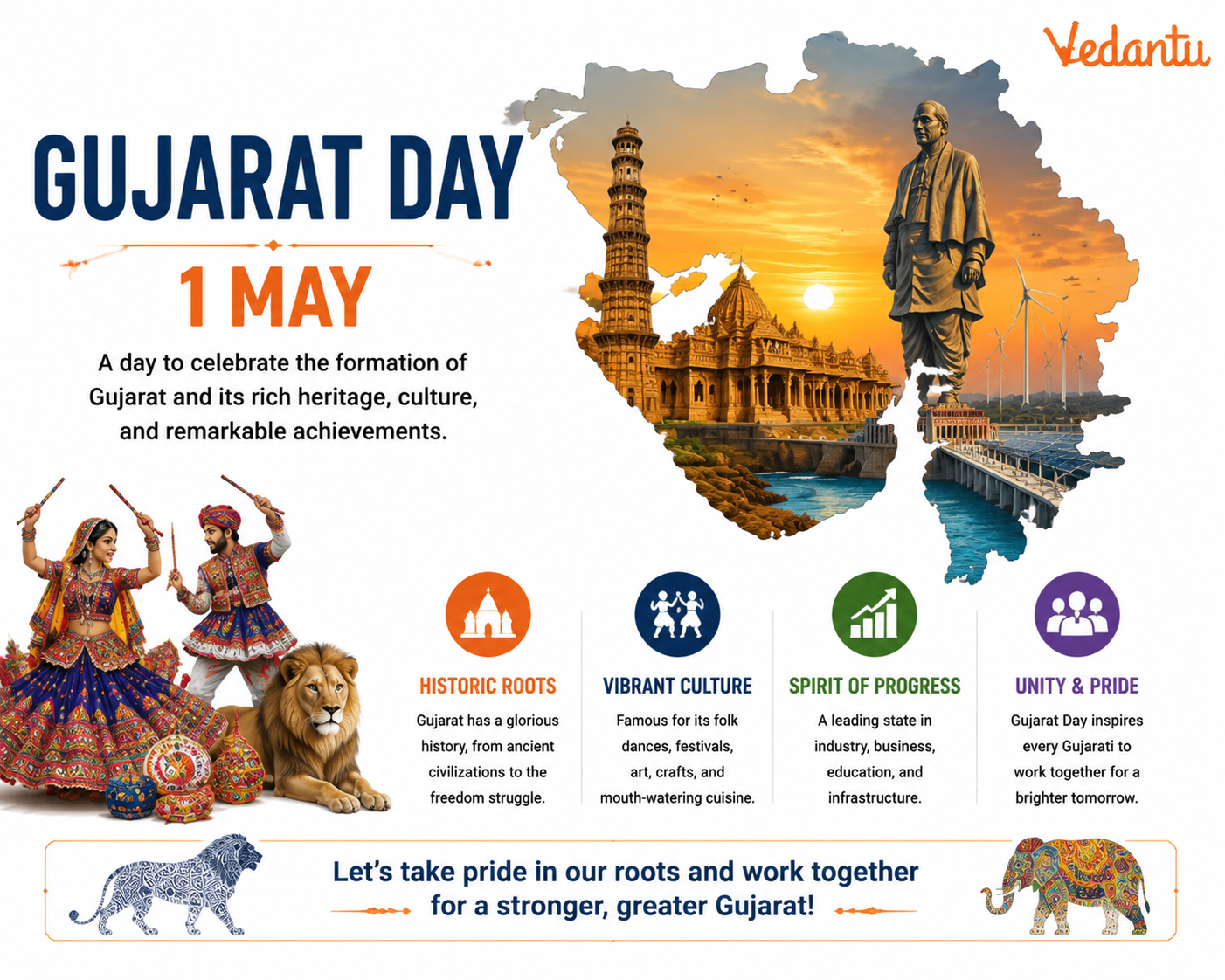
Historical Background of Gujarat Day
After India gained independence in 1947, states were reorganized mainly on linguistic lines. At that time, Gujarati and Marathi speaking people were part of the Bombay State. However, linguistic differences led to a strong demand for separate states. This movement was known as the Mahagujarat Movement.
Due to continuous protests and public support, the Government of India passed the Bombay Reorganisation Act in 1960. As a result, on 1 May 1960, Gujarat was formed as a separate state for Gujarati speaking people, while Maharashtra was created for Marathi speaking people.
Mahagujarat Movement
- Started in the 1950s demanding a separate state for Gujarati speakers.
- Led by prominent leaders like Indulal Yagnik.
- Supported by students, workers, and common citizens.
- Resulted in the creation of Gujarat on 1 May 1960.
Key Facts About Gujarat Day
| Particular | Details | Importance |
|---|---|---|
| Date of Celebration | 1 May every year | Marks formation of Gujarat state |
| Year of Formation | 1960 | Division of Bombay State |
| Movement Name | Mahagujarat Movement | Linguistic reorganization |
These facts are important from a General Knowledge perspective and are frequently asked in state level exams, SSC, banking exams, and other competitive tests.
How Gujarat Day is Celebrated
Gujarat Day is celebrated with great enthusiasm across the state. The government organizes official functions, and cultural events highlight the rich heritage of Gujarat.
- Flag hoisting ceremonies at government offices.
- Cultural programs showcasing Garba and traditional music.
- Award ceremonies honoring distinguished citizens.
- Public speeches highlighting Gujarat’s achievements.
Schools and colleges also conduct essay writing, quizzes, and debates to educate students about the history and significance of the state.
Importance of Gujarat Day
Gujarat Day is not just a celebration of statehood but also a reminder of the democratic struggle and unity of the people. It reflects the importance of linguistic identity in India’s federal structure.
- Honors the sacrifices of leaders and citizens.
- Strengthens state pride and cultural identity.
- Highlights Gujarat’s contribution to India’s economy and culture.
- Promotes awareness about state formation in India.
Gujarat at a Glance
Gujarat is one of the most economically developed states in India. It is known for its industrial growth, rich cultural heritage, and historical significance.
- Capital - Gandhinagar
- Largest City - Ahmedabad
- Official Language - Gujarati
- Famous Festivals - Navratri, Uttarayan
- Important Personalities - Mahatma Gandhi, Sardar Vallabhbhai Patel
Gujarat Day in Competitive Exams
Questions related to Gujarat Day are commonly asked in competitive exams under static GK and Indian Polity sections. Students should remember the date of formation, the reason behind the division, and the movement associated with it.
Important Points for Revision
- Gujarat Day is celebrated on 1 May.
- Gujarat was formed in 1960.
- Formed after the division of Bombay State.
- Mahagujarat Movement led to its creation.
Conclusion
Gujarat Day is an important event in India’s political history that marks the formation of Gujarat as a separate state on 1 May 1960. It symbolizes linguistic pride, democratic struggle, and cultural identity. Understanding its background, key facts, and significance is essential for students preparing for competitive exams as well as for anyone interested in Indian history and governance.
FAQs on Gujarat Day – History, Meaning and Celebration Guide
1. What is Gujarat Day and why is it celebrated?
Gujarat Day is celebrated on 1st May every year to mark the formation of the state of Gujarat in 1960.
• It commemorates the separation of Gujarat from the bilingual Bombay State.
• The state was formed on the basis of the Gujarati language under the States Reorganisation Act.
• The day celebrates Gujarat’s culture, heritage, and development.
This day is also known as Gujarat Sthapana Divas and is important for students and competitive exams.
2. When is Gujarat Day celebrated every year?
Gujarat Day is celebrated annually on 1st May across the state of Gujarat.
• The date marks the official formation of Gujarat in 1960.
• It coincides with Maharashtra Day, as both states were created on the same day.
• Government offices, schools, and institutions organize cultural programs and flag-hoisting ceremonies.
This date is frequently asked in General Knowledge (GK) and competitive exams.
3. Why was Gujarat separated from Bombay State?
Gujarat was separated from Bombay State due to linguistic differences and regional demands.
• The Mahagujarat Movement demanded a separate state for Gujarati-speaking people.
• Bombay State had both Marathi and Gujarati speakers.
• To promote administrative efficiency and linguistic identity, the state was divided into Gujarat and Maharashtra.
This movement played a key role in India’s linguistic reorganization of states.
4. What was the Mahagujarat Movement?
The Mahagujarat Movement was a political movement demanding a separate state for Gujarati-speaking people.
• It began in the 1950s.
• Led by leaders like Indulal Yagnik.
• Aimed to create a distinct state based on Gujarati language and culture.
The movement successfully led to the creation of Gujarat on 1 May 1960.
5. Who was the first Chief Minister of Gujarat?
Dr. Jivraj Narayan Mehta was the first Chief Minister of Gujarat.
• He assumed office on 1 May 1960.
• He played a significant role in the early development of the state.
• He focused on administrative reforms, healthcare, and education.
This is an important fact for state-level exams and GK quizzes.
6. How is Gujarat Day celebrated in the state?
Gujarat Day is celebrated with patriotic and cultural events throughout the state.
• Flag hoisting ceremonies at government offices.
• Cultural programs showcasing Garba, folk music, and dance.
• Speeches highlighting Gujarat’s history and achievements.
• Awards recognizing contributions to society.
The celebrations reflect Gujarat’s rich traditions, unity, and progress.
7. What is the capital of Gujarat?
Gandhinagar is the capital city of Gujarat.
• It was named after Mahatma Gandhi.
• Located near Ahmedabad.
• Known for its planned infrastructure and green spaces.
Gandhinagar plays an important role in Gujarat’s administrative and political activities.
8. What are some important facts about Gujarat?
Gujarat is one of India’s most industrially developed states with rich cultural heritage.
• Birthplace of Mahatma Gandhi and Sardar Vallabhbhai Patel.
• Known for the White Revolution (Amul Dairy).
• Famous for Gir National Park, home of the Asiatic lions.
• Major industries include textiles, petrochemicals, and diamond polishing.
These facts are commonly asked in GK and competitive exams.
9. Why is Gujarat important in Indian history?
Gujarat holds a significant place in Indian history due to its freedom fighters and economic growth.
• Birthplace of Mahatma Gandhi, leader of India’s freedom movement.
• Home to the historic Dandi March (1930).
• Major center of trade and commerce since ancient times.
• Important role in India’s industrial and agricultural development.
Gujarat’s historical and cultural legacy makes it vital in Indian studies.
10. What is the significance of 1st May in India?
1st May is significant in India as it marks Gujarat Day and Maharashtra Day.
• Both states were formed in 1960 after the division of Bombay State.
• The day also coincides with International Labour Day.
• Celebrated with official ceremonies and public events.
This date is important in Indian polity, history, and General Knowledge.
