






Key Features of the Government of India Act 1935 and Its Federal Structure
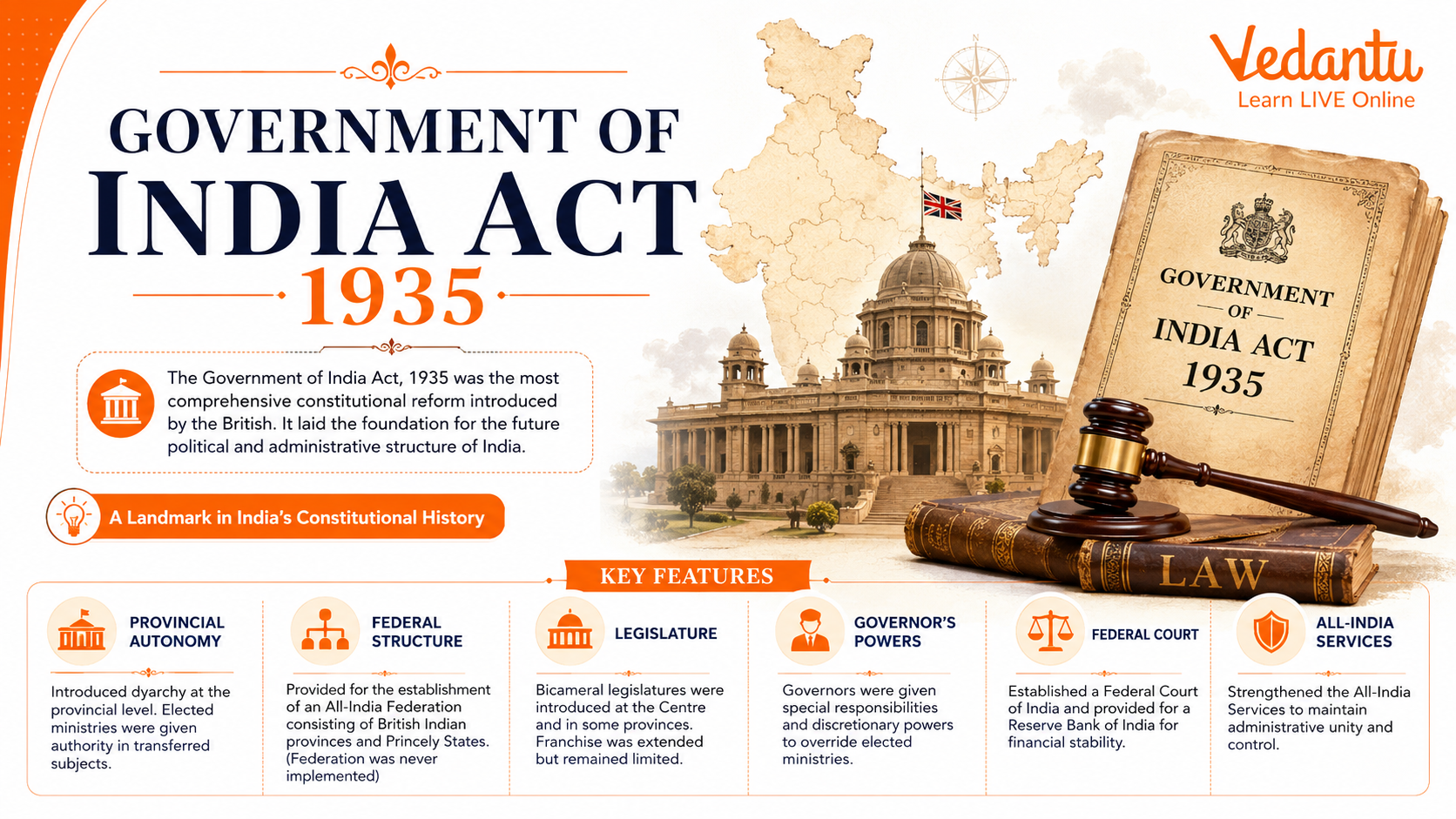
The Government of India Act 1935 was one of the most significant constitutional reforms introduced by the British Parliament in India before independence. It was the longest Act passed by the British Parliament at that time and laid the foundation for many administrative features that later became part of the Indian Constitution. The Act aimed to provide provincial autonomy and establish a federal structure in India, although the federal part was never fully implemented. For students and competitive exam aspirants, understanding this Act is essential as it marks a crucial stage in India’s constitutional development.
Background of the Government of India Act 1935
The Government of India Act 1935 was enacted based on the recommendations of the Simon Commission, the Round Table Conferences, and the White Paper of 1933. The Simon Commission was appointed in 1927 to review the working of the Government of India Act 1919. Its recommendations, along with discussions in the Round Table Conferences held in London, led to the drafting of this comprehensive Act.
- Simon Commission Report 1930
- Three Round Table Conferences 1930 - 1932
- White Paper issued in 1933
- Joint Select Committee Report
After detailed discussions and revisions, the British Parliament passed the Government of India Act in 1935.
Main Features of the Government of India Act 1935
1. All India Federation
The Act proposed the establishment of an All India Federation consisting of British Indian provinces and princely states. However, the federation could not come into existence because the required number of princely states did not join it.
2. Provincial Autonomy
One of the most important features was the introduction of provincial autonomy. Provinces were allowed to function independently in their allotted subjects. The system of dyarchy introduced by the Act of 1919 at the provincial level was abolished.
3. Dyarchy at the Centre
While dyarchy was removed from provinces, it was introduced at the central level. The federal subjects were divided into reserved and transferred subjects. However, since the federation never came into being, this provision was not implemented.
4. Bicameral Legislature
The Act provided for a bicameral federal legislature consisting of:
- Council of State - Upper House
- Federal Assembly - Lower House
5. Division of Powers
The Act divided powers between the Centre and Provinces into three lists:
- Federal List
- Provincial List
- Concurrent List
Residuary powers were given to the Governor General.
6. Establishment of Federal Court
The Act provided for the establishment of a Federal Court in 1937 to interpret the Act and adjudicate disputes between provinces and the Centre.
7. Separate Electorates
The Act extended the system of separate electorates to minorities such as Muslims, Sikhs, Europeans, and others, which further divided Indian society.
Comparison: Government of India Act 1919 and 1935
| Feature | Act of 1919 | Act of 1935 |
|---|---|---|
| Dyarchy | Introduced in Provinces | Abolished in Provinces, Proposed at Centre |
| Provincial Autonomy | Limited | Full Provincial Autonomy |
| Federal Structure | Not Provided | Proposed All India Federation |
The Government of India Act 1935 was more comprehensive and advanced than the Act of 1919. It introduced major structural changes that influenced the later Constitution of independent India.
Significance of the Government of India Act 1935
- It served as the basis for the administrative structure of independent India.
- It introduced provincial autonomy which allowed Indian leaders to gain governance experience.
- It laid the foundation for a federal system.
- Many provisions were later incorporated into the Constitution of India.
Criticism of the Government of India Act 1935
Despite its comprehensive nature, the Act was criticized by Indian leaders for several reasons.
- It did not grant complete responsible government at the Centre.
- The Governor General retained significant powers.
- Separate electorates promoted communal divisions.
- The proposed federation was complicated and never implemented.
Important Facts for Competitive Exams
- Passed by British Parliament in 1935.
- Came into effect in 1937.
- Established the Federal Court in 1937.
- Provided three legislative lists - Federal, Provincial, and Concurrent.
- Provincial autonomy was successfully implemented.
Conclusion
The Government of India Act 1935 was a landmark constitutional reform in British India. Although it did not satisfy Indian demands for complete self rule, it played a crucial role in shaping India’s administrative and constitutional framework. Many of its features, such as federalism, provincial autonomy, and the division of powers, were later adopted in the Constitution of India. For students and aspirants, this Act remains an essential topic in understanding India’s journey toward independence and constitutional democracy.
FAQs on Government of India Act 1935: Complete Explanation for Students
1. What was the Government of India Act 1935?
The Government of India Act 1935 was the most comprehensive constitutional reform introduced by the British Parliament to govern India before independence.
Key features of the Government of India Act, 1935 include:
- Establishment of an All-India Federation
- Introduction of Provincial Autonomy
- Abolition of Dyarchy in Provinces
- Creation of a Federal Court (1937)
- Extension of franchise to more Indians
It served as the foundation for the Indian Constitution and is frequently asked in competitive exams like UPSC, SSC, and State PSC.
2. What were the main features of the Government of India Act 1935?
The main features of the Government of India Act 1935 aimed to decentralize power and expand self-governance in British India.
Major provisions included:
- All-India Federation of British Provinces and Princely States
- Provincial Autonomy with responsible governments
- Division of powers into Federal, Provincial, and Concurrent Lists
- Introduction of Bicameral Legislature in some provinces
- Establishment of the Reserve Bank of India (RBI)
These reforms shaped modern Indian governance and are important for understanding constitutional development.
3. What is meant by Provincial Autonomy under the Government of India Act 1935?
Provincial Autonomy under the Government of India Act 1935 meant that provinces were given independent authority to govern without interference in transferred subjects.
It included:
- Abolition of Dyarchy at the provincial level
- Elected ministers responsible to the Provincial Legislature
- Governors acting mainly on ministerial advice (with special powers)
This system allowed Indian leaders to form ministries in 1937, marking a major step toward self-government.
4. What was the concept of Federation in the Government of India Act 1935?
The Federation under the Government of India Act 1935 proposed uniting British Indian provinces and princely states under a central government.
Key aspects:
- Division of powers between Centre and Provinces
- Three legislative lists: Federal, Provincial, Concurrent
- Princely states had the option to join
However, the federation never came into force due to lack of participation by princely states.
5. Why is the Government of India Act 1935 considered important?
The Government of India Act 1935 is important because it laid the groundwork for India’s future Constitution and administrative system.
Its significance includes:
- Basis for the Constitution of India (1950)
- Introduction of Federal structure
- Creation of the Federal Court
- Expansion of electoral participation
Many structural features of modern Indian governance originated from this Act.
6. What were the defects of the Government of India Act 1935?
The Government of India Act 1935 had several limitations that prevented it from satisfying Indian political demands.
Major defects were:
- Excessive powers to the Governor-General and Governors
- No full responsible government at the Centre
- Separate electorates continued
- Federation was not fully implemented
Due to these flaws, Indian leaders criticized it as inadequate for complete self-rule or Swaraj.
7. When was the Government of India Act 1935 implemented?
The Government of India Act 1935 was enacted in August 1935, but its provisions were implemented in stages.
Implementation details:
- Provincial Autonomy came into force in 1937
- Federal provisions were never implemented
- Federal Court established in 1937
The Act remained operational until India gained independence in 1947.
8. What was Dyarchy and how did the Act of 1935 change it?
Dyarchy was a system introduced by the Government of India Act 1919 where provincial subjects were divided between elected ministers and British officials.
Changes under the Government of India Act 1935:
- Dyarchy was abolished in provinces
- Introduced at the Centre (though never implemented)
- Full provincial responsibility granted
This reform strengthened provincial self-governance and reduced dual control at the local level.
9. How did the Government of India Act 1935 influence the Indian Constitution?
The Government of India Act 1935 significantly influenced the Indian Constitution by providing structural and administrative models.
Influences include:
- Federal system with division of powers
- Office of Governor
- Public Service Commissions
- Emergency provisions
Many constitutional provisions adopted in 1950 were adapted from this Act with democratic modifications.
10. Who opposed the Government of India Act 1935 and why?
Indian political leaders and parties opposed the Government of India Act 1935 because it did not grant complete independence.
Opposition reasons:
- Indian National Congress demanded full responsible government
- Muslim League had reservations about representation
- Excessive discretionary powers to British authorities
Despite criticism, elections were held in 1937 under this Act, shaping pre-independence politics.
