






Currencies of the World: List of Countries Where the Rupee Is the Official Currency
The Rupee is a widely used currency name across several countries in Asia and the Indian Ocean region. The term "Rupee" is derived from the Sanskrit word "Rupya", which means a silver coin. Many countries that were historically influenced by trade, culture, or colonial administration in the Indian subcontinent adopted the Rupee as their official currency. Understanding the countries that use the Rupee is important for students preparing for competitive exams and general knowledge tests. This topic is frequently asked in GK, banking awareness, and geography sections of various examinations.
What is a Rupee?
A Rupee is a unit of currency used as the official monetary system in several countries. Although the name is common, each country's Rupee has a different value, symbol, and international currency code. These currencies are managed by their respective central banks and operate independently.
Key Features of Rupee Currencies
- The name originates from ancient India.
- Used mainly in South Asia and nearby island nations.
- Each Rupee has a unique ISO currency code.
- Subdivision is generally into 100 smaller units such as paise or cents.
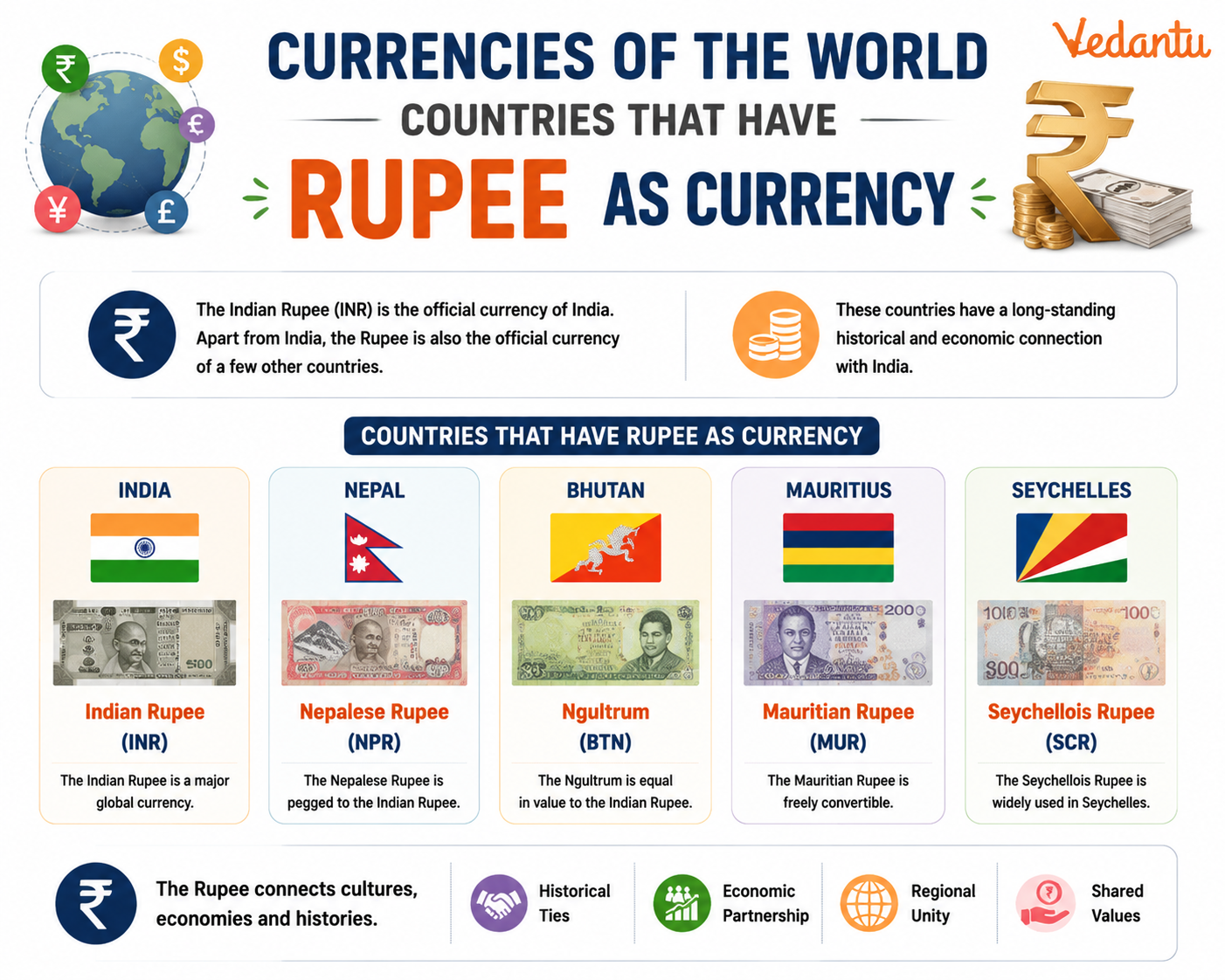
Countries That Have Rupee As Currency
| Country | Currency Name | ISO Code |
|---|---|---|
| India | Indian Rupee | INR |
| Pakistan | Pakistani Rupee | PKR |
| Nepal | Nepalese Rupee | NPR |
| Sri Lanka | Sri Lankan Rupee | LKR |
| Maldives | Maldivian Rufiyaa | MVR |
| Mauritius | Mauritian Rupee | MUR |
| Seychelles | Seychellois Rupee | SCR |
| Indonesia | Indonesian Rupiah | IDR |
The table above lists the major countries that use a form of the Rupee as their official currency. Although Maldives uses the name Rufiyaa and Indonesia uses Rupiah, both are derived from the same Sanskrit origin as Rupee. Each currency functions independently under its respective country's central bank.
Brief Overview of Each Country's Rupee
1. Indian Rupee - INR
The Indian Rupee is the official currency of India and is issued by the Reserve Bank of India. It is one of the most traded currencies in South Asia and is symbolized by ₹. One Rupee is divided into 100 paise.
2. Pakistani Rupee - PKR
The Pakistani Rupee is issued by the State Bank of Pakistan. It became the official currency after the partition of India in 1947. It is subdivided into 100 paise.
3. Nepalese Rupee - NPR
The Nepalese Rupee is issued by Nepal Rastra Bank. It is pegged to the Indian Rupee at a fixed exchange rate, which makes it closely linked to the Indian economy.
4. Sri Lankan Rupee - LKR
The Sri Lankan Rupee is managed by the Central Bank of Sri Lanka. It is widely used for domestic and international trade in Sri Lanka.
5. Mauritian Rupee - MUR
The Mauritian Rupee is the official currency of Mauritius and is issued by the Bank of Mauritius. It plays a key role in the island nation's tourism-based economy.
6. Seychellois Rupee - SCR
The Seychellois Rupee is issued by the Central Bank of Seychelles. It is used in this island nation located in the Indian Ocean.
7. Maldivian Rufiyaa - MVR
The Maldivian Rufiyaa is the official currency of Maldives. Although its name differs slightly, it shares the same origin as the Rupee.
8. Indonesian Rupiah - IDR
The Indonesian Rupiah is the official currency of Indonesia. The term Rupiah is linguistically related to the word Rupee.
Why Do Many Countries Use the Name Rupee?
The widespread use of the name Rupee is mainly due to historical trade links, cultural influence, and colonial administration during the British era. The Indian Rupee was once used as a common currency across many regions under British rule. After independence, several countries retained the name for their national currencies.
Important Points for Competitive Exams
- India, Pakistan, Nepal, Sri Lanka, Mauritius, Seychelles, Maldives, and Indonesia use a form of the Rupee.
- Nepalese Rupee is pegged to the Indian Rupee.
- The word Rupee comes from the Sanskrit word Rupya.
- Each country has its own central bank controlling its Rupee.
Conclusion
Countries that use the Rupee as currency are mainly located in South Asia and the Indian Ocean region. Although the name is common, each Rupee is unique in value and management. This topic is highly important for general knowledge, geography, and competitive examinations. Understanding these countries and their currencies helps in building a strong foundation in world economics and international awareness.
FAQs on Currencies of the World: Countries That Use the Rupee
1. Which countries have the rupee as their official currency?
The rupee is the official currency of several countries in South Asia and the Indian Ocean region.
- India – Indian Rupee (INR)
- Pakistan – Pakistani Rupee (PKR)
- Sri Lanka – Sri Lankan Rupee (LKR)
- Nepal – Nepalese Rupee (NPR)
- Bhutan – Bhutanese Ngultrum (pegged to Indian Rupee)
- Maldives – Maldivian Rufiyaa (historically linked to rupee)
- Mauritius – Mauritian Rupee (MUR)
These nations use the term rupee currency due to historical, colonial, and trade influences in South Asia.
2. What is the origin and meaning of the word ‘rupee’?
The word rupee originates from the Sanskrit word ‘Rupya’, meaning "wrought silver" or "silver coin."
- Introduced by Sher Shah Suri in the 16th century in India
- Originally a silver coin used during the Mughal Empire
- Later adopted by British India and other colonies
The term is closely linked to Indian currency history, ancient coinage, and South Asian trade systems.
3. Which country introduced the rupee for the first time?
The rupee was first introduced in India during the rule of Sher Shah Suri around 1540–1545.
- It was made of pure silver
- Weighed about 11.5 grams
- Became the standard currency of the Mughal administration
This early form laid the foundation for the modern Indian Rupee (INR) and other rupee-based currencies.
4. Are all rupee currencies equal in value?
No, all rupee currencies have different values depending on each country’s economy and exchange rate.
- Indian Rupee (INR) value differs from Pakistani Rupee (PKR)
- Sri Lankan Rupee (LKR) has a separate exchange rate
- Mauritian Rupee (MUR) is independently valued
Each rupee’s value depends on foreign exchange rates, inflation, and economic stability.
5. What is the symbol of the Indian Rupee?
The official symbol of the Indian Rupee is ₹.
- Adopted in 2010
- Designed by D. Udaya Kumar
- Combines the Devanagari letter ‘र’ and Roman letter ‘R’
The symbol represents India’s growing presence in the global economy and international currency market.
6. Why do many South Asian countries use the rupee?
Many South Asian countries use the rupee due to shared historical and colonial connections.
- Influence of British India currency system
- Strong regional trade ties
- Cultural and economic similarities
The widespread use of rupee reflects South Asian monetary history and regional economic cooperation.
7. Which rupee is pegged to the Indian Rupee?
The Bhutanese Ngultrum and the Nepalese Rupee are pegged to the Indian Rupee (INR).
- Bhutan maintains a fixed exchange rate with INR
- Nepalese Rupee is officially linked to INR
- Indian currency is widely accepted in Bhutan and Nepal
This peg supports economic stability and cross-border trade.
8. What are the subdivisions of the rupee?
The rupee is generally divided into 100 smaller units.
- In India: 1 Rupee = 100 Paise
- In Pakistan: 1 Rupee = 100 Paisa
- In Sri Lanka and Mauritius: 1 Rupee = 100 Cents
These subdivisions are important in understanding currency denominations and coin systems.
9. Which rupee has the highest value among rupee currencies?
The Mauritian Rupee (MUR) is often stronger compared to some other rupee currencies in exchange value.
- Value depends on global forex market
- Influenced by tourism and trade economy
- Exchange rates fluctuate regularly
Currency strength depends on GDP, foreign reserves, and economic growth, not just the name "rupee."
10. Is the rupee used outside South Asia?
Yes, the Mauritian Rupee is used in Mauritius, an island nation in the Indian Ocean outside mainland South Asia.
- Mauritius adopted rupee during British colonial rule
- It remains the official national currency
- Used in trade, banking, and tourism sectors
This shows the historical spread of the rupee currency system beyond South Asia.
