






Types and Importance of Small-Scale Cottage Industries in India
Cottage Industries in India refer to small-scale industries that are typically operated from homes or small workshops using traditional skills and minimal capital investment. These industries are labor-intensive and often involve family members in production. Cottage industries play a significant role in India’s rural economy by generating employment, preserving traditional crafts, and contributing to exports. They form an essential part of the unorganized sector and are closely linked to India's cultural heritage and economic development.
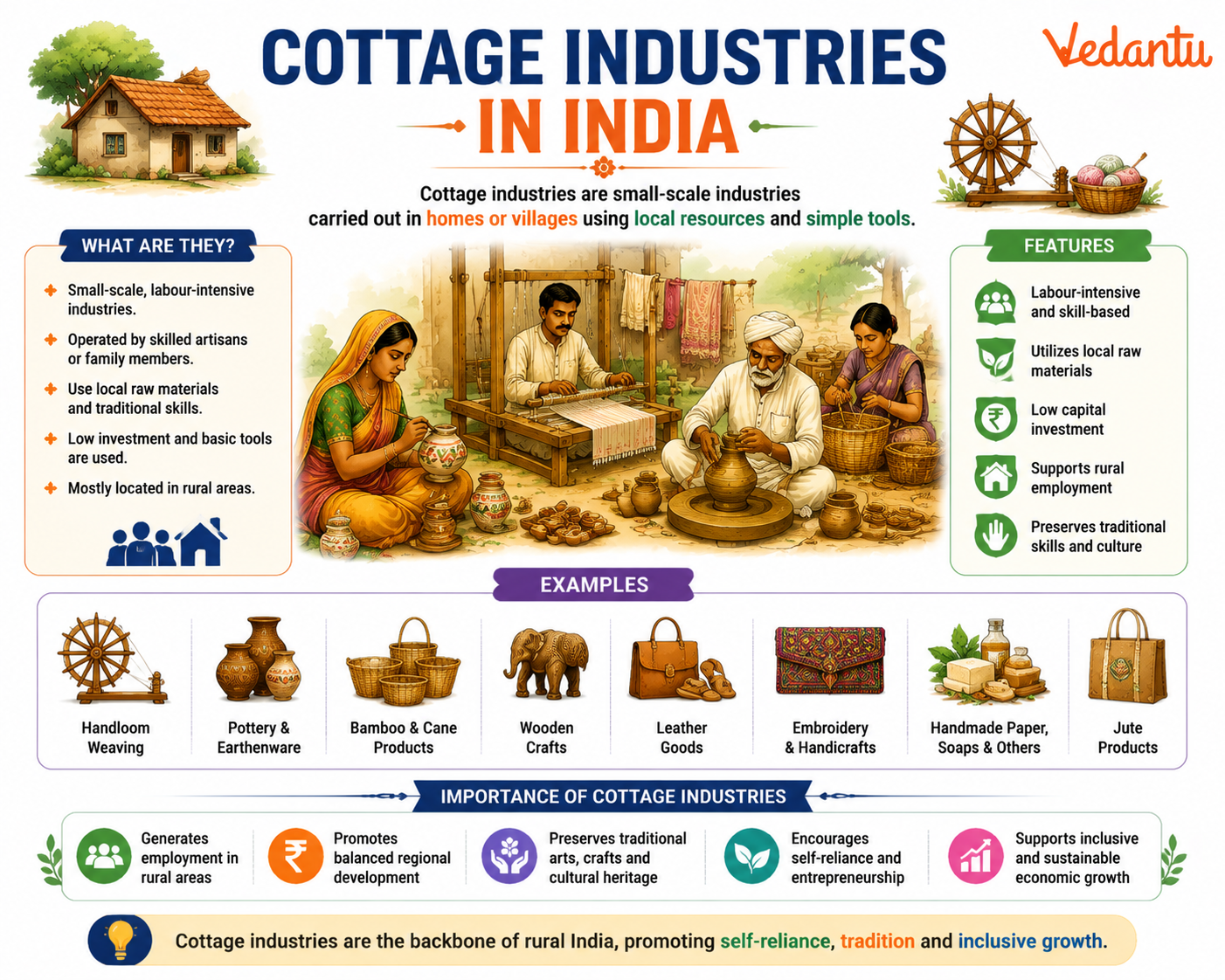
Meaning and Definition of Cottage Industries
Cottage industries are small manufacturing units where production is carried out by individuals or families using simple tools and traditional techniques. These industries generally operate on a small scale, require low capital investment, and rely more on manual labor than on machinery.
- Operated mainly in rural and semi-urban areas
- Family-based or home-based production units
- Use of traditional skills and local resources
- Low capital requirement and simple technology
Historical Background of Cottage Industries in India
Cottage industries in India have a rich history dating back to ancient times. India was known worldwide for its handicrafts, textiles, and handmade goods. During the colonial period, many cottage industries declined due to competition from machine-made goods imported from Britain. After independence, the Government of India promoted cottage industries to revive traditional crafts and generate employment.
Types of Cottage Industries in India
1. Textile and Handloom Industry
This is one of the oldest cottage industries in India. It includes hand-spun and hand-woven fabrics such as khadi, silk, and cotton textiles.
2. Handicrafts Industry
Handicrafts include products made by skilled artisans using traditional methods.
- Wood carving
- Metal crafts
- Pottery
- Carpet weaving
3. Coir Industry
The coir industry produces products like ropes, mats, and carpets from coconut husk. It is mainly concentrated in coastal states such as Kerala and Tamil Nadu.
4. Sericulture
Sericulture involves the rearing of silkworms for silk production. India is one of the largest producers of silk in the world.
5. Food Processing Units
Small-scale food processing units produce pickles, papad, jams, spices, and other food items using traditional methods.
Features of Cottage Industries
- Small-scale production
- Low investment requirement
- Labor-intensive techniques
- Use of local raw materials
- Limited production capacity
- Traditional and indigenous methods
Importance of Cottage Industries in India
Cottage industries contribute significantly to the Indian economy and rural development. They help in reducing unemployment and preventing migration from rural to urban areas.
- Generate rural employment
- Promote balanced regional development
- Preserve traditional arts and crafts
- Encourage women empowerment
- Contribute to export earnings
Major Cottage Industries in India
| Industry | Main Products | Major States |
|---|---|---|
| Handloom | Khadi, Silk Sarees | Uttar Pradesh, West Bengal, Tamil Nadu |
| Coir | Ropes, Mats | Kerala, Tamil Nadu |
| Carpet Weaving | Handmade Carpets | Rajasthan, Jammu and Kashmir |
The table above highlights some of the major cottage industries in India along with their key products and leading states. These industries reflect India's regional diversity and traditional craftsmanship.
Government Initiatives for Promotion
The Government of India has launched several schemes and programs to support cottage industries and small-scale producers.
- Khadi and Village Industries Commission - KVIC
- Prime Minister Employment Generation Programme - PMEGP
- Cluster Development Programme
- Financial assistance and skill development programs
Challenges Faced by Cottage Industries
Despite their importance, cottage industries face several problems that limit their growth and competitiveness.
- Lack of modern technology
- Limited access to finance
- Competition from large-scale industries
- Poor marketing and branding
- Irregular supply of raw materials
Difference Between Cottage Industries and Small-Scale Industries
- Cottage Industries: Home-based, family-run, low capital, manual labor oriented
- Small-Scale Industries: Larger than cottage industries, may employ hired labor, use machinery and higher investment
Conclusion
Cottage Industries in India are a vital part of the rural economy and cultural heritage. They provide employment opportunities, especially in rural and backward regions, and help in preserving traditional skills. With proper government support, modernization, and improved marketing strategies, cottage industries can continue to contribute significantly to India’s economic growth and sustainable development.
FAQs on Cottage Industries of India: Meaning, Types and Role in Economy
1. What are Cottage Industries in India?
Cottage Industries in India are small-scale, home-based manufacturing units run mainly by families using traditional skills and local resources. • Operate with low capital investment • Use handmade techniques and simple tools • Provide rural employment • Produce goods like handloom textiles, pottery, handicrafts, coir, and khadi • Also known as home industries or traditional village industries (People also ask: What is cottage industry? Meaning of cottage industries in India).
2. What are the main features of Cottage Industries?
The main features of Cottage Industries include small-scale production, family labor, and traditional methods. • Operate from homes or small workshops • Use manual labor instead of heavy machinery • Require limited capital and local raw materials • Focus on craftsmanship and skill-based production • Common in rural and semi-urban areas (PAS: characteristics of cottage industries, small-scale industries features).
3. Why are Cottage Industries important for the Indian economy?
Cottage Industries play a vital role in India’s economy by generating employment and promoting rural development. • Provide self-employment opportunities • Reduce rural unemployment and poverty • Promote Make in India and local products • Preserve traditional art and culture • Contribute to exports and GDP growth (People also search: role of cottage industries in economic development).
4. What are some examples of Cottage Industries in India?
Examples of Cottage Industries in India include traditional and handmade production units across different states. • Khadi and handloom weaving • Pottery and terracotta work • Carpet weaving • Coir production in Kerala • Silk weaving in Karnataka and West Bengal • Bamboo and cane crafts (PAS: list of cottage industries, examples of village industries).
5. How are Cottage Industries different from Small-Scale Industries?
Cottage Industries differ from Small-Scale Industries mainly in size, investment, and technology used. • Cottage Industries use family labor and manual tools • Operate from homes with very low capital • Small-Scale Industries (SSI) use machines and hired workers • SSI require higher investment and formal setup • Cottage industries are more traditional and rural-based (People also ask: difference between cottage and small-scale industries).
6. What challenges do Cottage Industries face in India?
Cottage Industries face several challenges that limit their growth and competitiveness. • Lack of modern technology • Limited access to finance and credit • Poor marketing and branding • Competition from large-scale industries and imported goods • Inadequate infrastructure and government support (PAS: problems of cottage industries in India).
7. What role did Mahatma Gandhi play in promoting Cottage Industries?
Mahatma Gandhi strongly promoted Cottage Industries as a means of self-reliance and rural empowerment. • Encouraged the use of Khadi and spinning wheel (Charkha) • Supported the Swadeshi Movement • Aimed to achieve economic independence from British goods • Promoted village self-sufficiency (People also ask: Gandhi and khadi movement, role of charkha in freedom struggle).
8. How do Cottage Industries promote rural development?
Cottage Industries promote rural development by creating jobs and utilizing local resources effectively. • Generate employment in villages • Prevent migration to cities • Encourage women’s participation in economic activities • Use locally available raw materials • Strengthen rural economy and self-reliance (PAS: importance of cottage industries in rural areas).
9. What government schemes support Cottage Industries in India?
The Indian government supports Cottage Industries through various schemes and organizations. • Khadi and Village Industries Commission (KVIC) • Prime Minister’s Employment Generation Programme (PMEGP) • Make in India initiative • MSME development schemes • Financial support through MUDRA loans (People also search: government schemes for village industries).
10. How do Cottage Industries help in preserving Indian culture?
Cottage Industries help preserve Indian culture by keeping traditional crafts and skills alive. • Protect regional art forms and handicrafts • Pass down skills from one generation to another • Promote handmade and eco-friendly products • Represent India’s heritage in global markets • Support cultural identity and diversity (PAS: traditional industries in India, importance of handicrafts).
