






Key Features, Objectives and Types of Cooperative Societies in India
The Cooperative Movement and Cooperative Societies in India play a vital role in promoting economic democracy, social equality, and inclusive growth. The cooperative model is based on the principle of mutual help, where individuals voluntarily come together to achieve common economic, social, or cultural objectives. In India, the cooperative movement has significantly contributed to rural development, agricultural credit, dairy production, housing, and small-scale industries. It is an important topic in General Knowledge, especially for competitive examinations and academic understanding of India’s socio-economic framework.
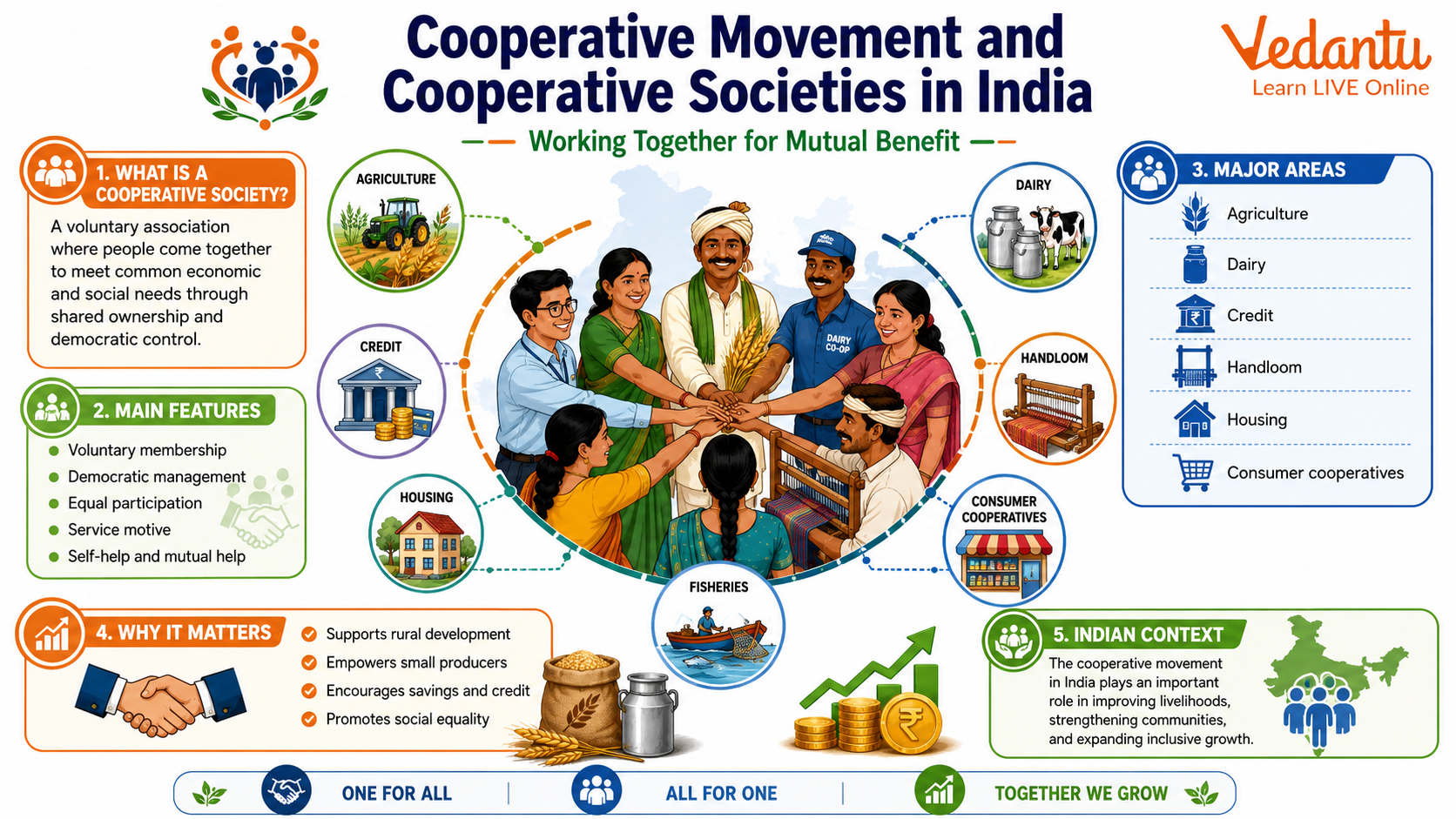
Meaning of Cooperative Movement
The Cooperative Movement refers to an organized effort of people with common needs joining together to form an association for their mutual benefit. These associations operate on democratic principles and aim to eliminate exploitation by middlemen and promote self-reliance.
- Based on the principle of self-help and mutual help.
- Members voluntarily join and leave the society.
- Democratic management with one member one vote.
- Service motive rather than profit maximization.
History of Cooperative Movement in India
The cooperative movement in India began during the British period to address the problem of rural indebtedness and exploitation by moneylenders. The Cooperative Credit Societies Act of 1904 marked the beginning of formal cooperative institutions in India.
Important Milestones
- 1904 - Cooperative Credit Societies Act passed.
- 1912 - Cooperative Societies Act expanded the scope beyond credit societies.
- 1950 onwards - Cooperatives became integral to Five Year Plans.
- 1991 onwards - Economic reforms encouraged autonomy and modernization.
- 97th Constitutional Amendment Act, 2011 - Gave constitutional status to cooperative societies.
Features of Cooperative Societies
A cooperative society is a voluntary association of individuals who unite to meet their common economic needs. It is registered under the Cooperative Societies Act of the respective state or the Multi State Cooperative Societies Act.
- Voluntary Membership - Open to all without discrimination.
- Democratic Control - One member one vote principle.
- Limited Liability - Liability of members is limited to their share capital.
- Separate Legal Entity - Registered societies have a separate legal identity.
- Service Motive - Focus on member welfare rather than profit.
Types of Cooperative Societies in India
| Type | Main Objective | Example |
|---|---|---|
| Credit Cooperative Society | Provide loans and financial assistance to members | Primary Agricultural Credit Societies |
| Consumer Cooperative Society | Supply goods at reasonable prices | Super Bazaars |
| Producer Cooperative Society | Assist small producers in production and marketing | Handloom societies |
| Dairy Cooperative Society | Procurement and marketing of milk | Amul |
| Housing Cooperative Society | Provide housing facilities to members | Group Housing Societies |
These cooperative societies operate at village, district, state, and national levels and contribute significantly to employment generation and poverty reduction.
Role of Cooperative Movement in India
The cooperative movement has played a transformative role in India's rural and urban economy. It strengthens grassroots democracy and supports inclusive development.
- Provides affordable credit to farmers and small entrepreneurs.
- Promotes agricultural and dairy development.
- Encourages savings and investment habits.
- Generates employment opportunities.
- Reduces exploitation by intermediaries.
97th Constitutional Amendment Act, 2011
The 97th Constitutional Amendment Act gave constitutional status and protection to cooperative societies in India. It introduced Part IXB in the Constitution and recognized the right to form cooperative societies as a fundamental right under Article 19.
- Ensured democratic functioning of cooperatives.
- Fixed maximum term of office bearers to five years.
- Mandated regular elections and audits.
Challenges Faced by Cooperative Societies
Despite their importance, cooperative societies face several operational and structural challenges that limit their efficiency.
- Political interference in management.
- Lack of professional management.
- Limited financial resources.
- Poor member participation.
- Delayed audits and transparency issues.
Difference Between Cooperative Society and Company
| Basis | Cooperative Society | Company |
|---|---|---|
| Objective | Service to members | Profit maximization |
| Voting Rights | One member one vote | Based on shareholding |
| Distribution of Profit | Limited dividend | Dividend based on shares |
This comparison highlights the democratic and welfare-oriented nature of cooperative societies compared to profit-driven companies.
Importance for Competitive Exams
The cooperative movement is frequently asked in UPSC, SSC, Banking, State PSC, and other government examinations. Questions are usually related to constitutional amendments, features, types, and the role of cooperatives in rural development.
- Remember key acts and years such as 1904 and 1912.
- Focus on the 97th Constitutional Amendment Act.
- Understand types and examples like Amul.
- Revise differences between cooperative society and company.
Conclusion
The Cooperative Movement and Cooperative Societies in India represent a powerful model of participatory development and economic democracy. From agricultural credit to dairy success stories like Amul, cooperatives have transformed rural India and empowered millions. Understanding their history, structure, features, and challenges is essential for academic learning and competitive exam preparation. The cooperative sector continues to be a cornerstone of inclusive growth and grassroots empowerment in India.
FAQs on Cooperative Movement and Cooperative Societies in India: Meaning, Structure and Importance
1. What is the Cooperative Movement in India?
The Cooperative Movement in India is a voluntary movement where individuals unite to achieve common economic, social, and cultural goals through jointly owned and democratically controlled enterprises.
- Based on the principle of self-help and mutual aid
- Promotes economic development and financial inclusion
- Works on the motto: "Each for all and all for each"
- Important for rural development, agricultural credit, and poverty alleviation
It plays a crucial role in strengthening cooperative societies in India and empowering farmers, workers, and small producers.
2. When did the Cooperative Movement start in India?
The Cooperative Movement in India began in 1904 with the passing of the Cooperative Credit Societies Act, 1904 during British rule.
- 1904: Introduction of Cooperative Credit Societies Act
- 1912: Expansion through the Cooperative Societies Act, 1912
- Aimed to provide affordable credit to farmers
This marked the foundation of the organized cooperative banking and credit system in India.
3. What are Cooperative Societies?
Cooperative Societies are voluntary associations of individuals who come together to meet common economic needs through a jointly owned and democratically managed organization.
- Formed under the Cooperative Societies Act
- Follow the principle of one member, one vote
- Provide services like credit, marketing, housing, and consumer goods
They promote democratic management, equality, and collective benefit in sectors such as agriculture, banking, and housing.
4. What are the main types of Cooperative Societies in India?
There are several types of Cooperative Societies in India based on their objectives and activities.
- Credit Cooperative Societies – Provide loans and financial services
- Consumer Cooperative Societies – Supply goods at reasonable prices
- Marketing Cooperative Societies – Help farmers sell products
- Housing Cooperative Societies – Provide residential facilities
- Producer Cooperative Societies – Support small producers and artisans
These societies support economic growth, rural development, and cooperative banking across India.
5. What are the principles of Cooperative Societies?
Cooperative Societies operate on internationally accepted cooperative principles that ensure democratic and fair functioning.
- Voluntary and open membership
- Democratic member control
- Member economic participation
- Autonomy and independence
- Education and training
- Cooperation among cooperatives
These principles promote transparency, equality, and sustainable development within the cooperative movement.
6. What is the role of Cooperative Societies in rural development?
Cooperative Societies play a vital role in rural development in India by supporting farmers, artisans, and small entrepreneurs.
- Provide agricultural credit and loans
- Ensure fair prices through marketing cooperatives
- Promote dairy, sugar, and farming cooperatives
- Encourage employment generation and self-reliance
They strengthen the rural economy and contribute to inclusive growth and poverty reduction.
7. What is the significance of the 97th Constitutional Amendment related to Cooperatives?
The 97th Constitutional Amendment Act, 2011 gave constitutional status to Cooperative Societies in India.
- Inserted Article 43B in the Directive Principles
- Added Part IX-B related to cooperatives
- Made the right to form cooperative societies a fundamental right (Article 19)
This amendment strengthened democratic functioning, transparency, and accountability of cooperative societies.
8. How do Cooperative Societies differ from companies?
Cooperative Societies differ from companies in purpose, management, and profit distribution.
- Objective: Service motive vs. profit motive
- Voting: One member, one vote vs. voting by shares
- Ownership: Jointly owned by members
- Profit distribution: Shared among members
Unlike companies, cooperatives focus on mutual benefit, community welfare, and democratic control.
9. What are the advantages of Cooperative Societies?
Cooperative Societies offer several economic and social advantages to their members.
- Easy formation and democratic management
- Limited liability of members
- Elimination of middlemen
- Lower cost of goods and services
- Encouragement of savings and mutual help
They promote financial inclusion, social equality, and community development.
10. What are some famous examples of Cooperative Societies in India?
India has several successful cooperative models that have transformed sectors like dairy and banking.
- Amul – Dairy cooperative (White Revolution)
- IFFCO – Indian Farmers Fertiliser Cooperative
- Sugar Cooperatives of Maharashtra
- State Cooperative Banks
These examples highlight the success of the Cooperative Movement in India in promoting rural prosperity and economic empowerment.
