






Why the Communal Award Led to the Poona Pact and Its Impact on Depressed Classes
The Communal Award and Poona Pact are two important events in modern Indian history that shaped the political future of India during British rule. Announced in 1932, the Communal Award introduced separate electorates for different communities, including the Depressed Classes. This decision led to strong opposition from Mahatma Gandhi and eventually resulted in the Poona Pact between Gandhi and Dr. B. R. Ambedkar. These developments had a lasting impact on the representation of marginalized communities and the structure of India’s democratic system.
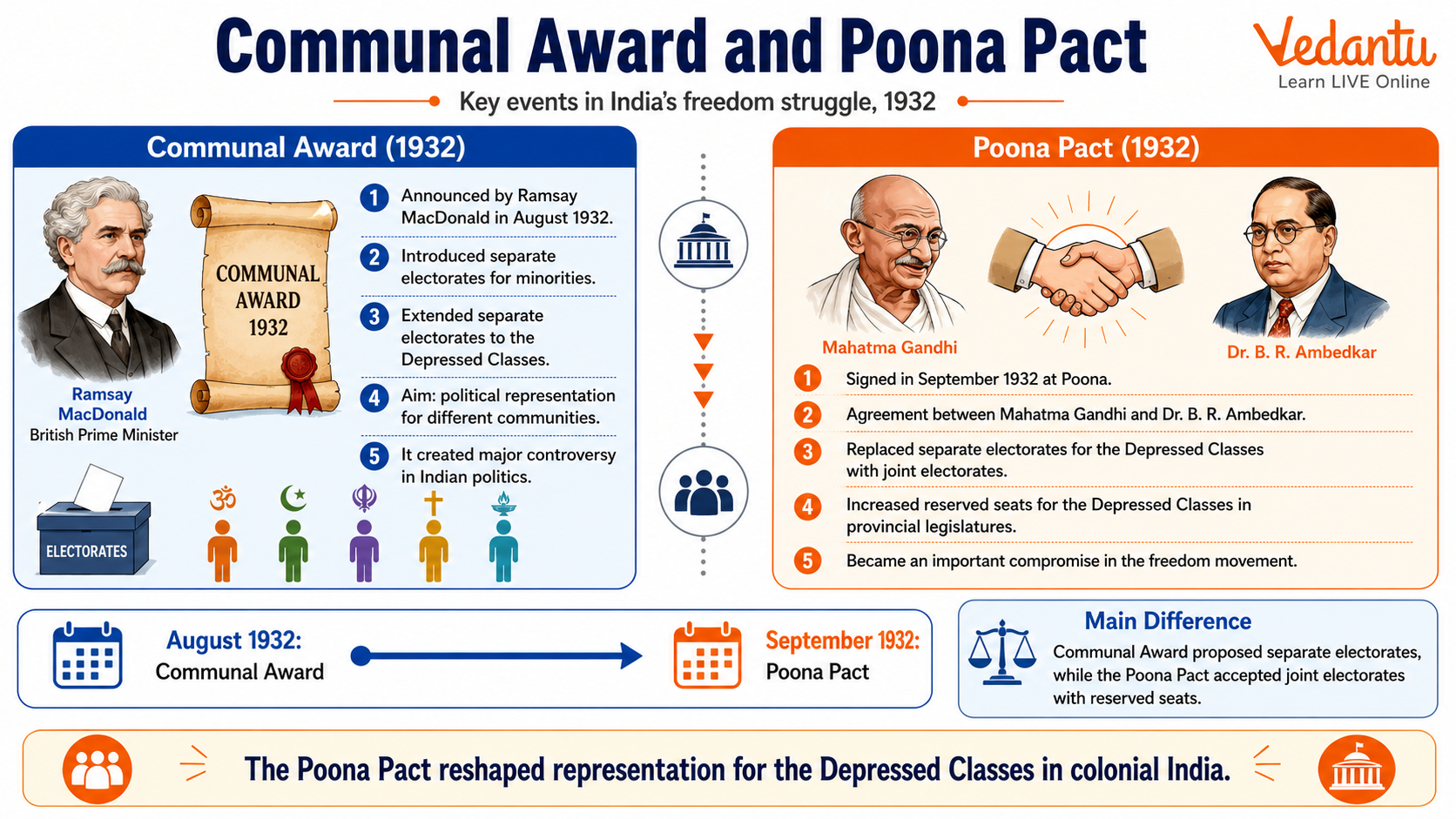
Background of the Communal Award
During the British rule in India, communal representation was introduced through various constitutional reforms. The British government aimed to provide political representation to different religious and social communities. The issue became more prominent during the Round Table Conferences held between 1930 and 1932 in London to discuss constitutional reforms in India.
Dr. B. R. Ambedkar strongly demanded separate electorates for the Depressed Classes to ensure their political independence and protection from social discrimination. On 16 August 1932, British Prime Minister Ramsay MacDonald announced the Communal Award.
What was the Communal Award?
The Communal Award was a decision by the British government to extend separate electorates to various minority communities in India. Separate electorates meant that members of a particular community would vote only for candidates belonging to their own community.
Communities Included
- Muslims
- Sikhs
- Indian Christians
- Anglo-Indians
- Europeans
- Depressed Classes (Scheduled Castes)
The most controversial part of the Communal Award was the provision of separate electorates for the Depressed Classes. Mahatma Gandhi believed that this would divide Hindu society permanently.
Gandhi’s Opposition and Fast unto Death
Mahatma Gandhi opposed the inclusion of the Depressed Classes as a separate electorate. He believed that they were an integral part of Hindu society and that separate electorates would weaken national unity. In protest, Gandhi began a fast unto death on 20 September 1932 while imprisoned in Yerwada Jail.
His fast created nationwide pressure and led to urgent negotiations between leaders of the Depressed Classes and caste Hindus.
The Poona Pact of 1932
The Poona Pact was an agreement reached on 24 September 1932 between Mahatma Gandhi and Dr. B. R. Ambedkar. It resolved the deadlock created by the Communal Award regarding separate electorates for the Depressed Classes.
Key Features of the Poona Pact
- Separate electorates for the Depressed Classes were abolished.
- Reserved seats were provided for the Depressed Classes in provincial legislatures.
- The number of reserved seats was increased from 71 to 148.
- Depressed Classes were to be elected through joint electorates.
- Adequate representation in public services was promised.
The Pact ensured political representation while maintaining Hindu unity, according to Gandhi’s viewpoint.
Difference Between Communal Award and Poona Pact
| Basis | Communal Award (1932) | Poona Pact (1932) |
|---|---|---|
| Announced By | Ramsay MacDonald | Agreement between Gandhi and Ambedkar |
| Electorate System | Separate electorates for Depressed Classes | Joint electorates with reserved seats |
| Number of Seats | 71 seats | 148 seats |
The Poona Pact modified the Communal Award by removing separate electorates but increasing reserved seats for the Depressed Classes, thereby balancing representation and social unity.
Significance of the Communal Award and Poona Pact
- Marked a major development in the political representation of marginalized communities.
- Highlighted differences between Gandhi and Ambedkar on social reform and political safeguards.
- Laid the foundation for the reservation system in independent India.
- Strengthened the national movement by preventing further division within Hindu society.
Criticism and Historical Debate
Some historians argue that the Poona Pact limited the political independence of the Depressed Classes by replacing separate electorates with joint electorates. Others believe it was a practical compromise that ensured increased representation and prevented social fragmentation. The debate between Gandhi and Ambedkar remains an important chapter in India’s social and political history.
Conclusion
The Communal Award and Poona Pact were turning points in India’s struggle for independence and social justice. While the Communal Award aimed to provide political safeguards through separate electorates, the Poona Pact modified this approach by introducing reserved seats within a joint electorate system. These events not only shaped colonial constitutional reforms but also influenced the reservation policy adopted in independent India. Understanding these developments is essential for grasping the complexities of India’s freedom movement and the evolution of its democratic framework.
FAQs on Communal Award and Poona Pact: Background, Impact, and Significance
1. What was the Communal Award of 1932?
The Communal Award of 1932 was a constitutional proposal announced by British Prime Minister Ramsay MacDonald granting separate electorates to various communities in India. It aimed to ensure political representation for minorities during British rule.
• Announced on 16 August 1932
• Provided separate electorates for Muslims, Sikhs, Christians, Anglo-Indians, Europeans, and Depressed Classes
• Based on the idea of minority safeguards and communal representation
• Became a major issue in the Indian freedom struggle and constitutional reforms
This topic is frequently asked in GK, UPSC, SSC, and other competitive exams under British constitutional reforms.
2. Why did Mahatma Gandhi oppose the Communal Award?
Mahatma Gandhi opposed the Communal Award because it granted separate electorates to the Depressed Classes (Scheduled Castes), which he believed would divide Hindu society permanently.
• Feared fragmentation of Hindu unity
• Considered it a “divide and rule” policy of the British
• Started a fast unto death in Yerwada Jail in September 1932
• Wanted joint electorates with reserved seats instead
This issue connects with themes like Poona Pact, Dalit representation, and Gandhi-Ambedkar differences.
3. What was the Poona Pact of 1932?
The Poona Pact (1932) was an agreement between Mahatma Gandhi and Dr. B.R. Ambedkar that replaced separate electorates with reserved seats for the Depressed Classes in joint electorates.
• Signed on 24 September 1932
• Increased reserved seats for Depressed Classes from 71 to 148
• Allowed joint electorates instead of separate ones
• Marked a compromise between nationalist unity and minority rights
It is an important milestone in Indian constitutional history and social justice reforms.
4. Who were the main leaders involved in the Poona Pact?
The main leaders of the Poona Pact were Mahatma Gandhi and Dr. B.R. Ambedkar, representing different perspectives on Dalit political rights.
• Mahatma Gandhi – Represented the Indian National Congress
• Dr. B.R. Ambedkar – Leader of the Depressed Classes
• Negotiations took place in Yerwada Jail, Poona (Pune)
• Mediated by other Hindu leaders
This event highlights the Gandhi vs Ambedkar debate on representation and social equality.
5. What were the key features of the Poona Pact?
The key features of the Poona Pact focused on political reservation and representation of Scheduled Castes within a unified electorate system.
• Joint electorates with reserved seats for Depressed Classes
• Increased number of reserved seats in provincial legislatures
• Provision for fair representation in public services
• Commitment to improve education and social conditions
These features later influenced provisions related to reservation in the Indian Constitution.
6. How did the Communal Award affect Indian politics?
The Communal Award significantly impacted Indian politics by intensifying debates over minority rights and communal representation.
• Strengthened communal divisions
• Led to Gandhi’s fast and the Poona Pact
• Highlighted tensions between nationalism and minority safeguards
• Influenced later constitutional developments
It is closely related to themes like separate electorates, minority politics, and British colonial strategy.
7. What is the difference between the Communal Award and the Poona Pact?
The main difference between the Communal Award and the Poona Pact lies in the method of political representation for the Depressed Classes.
• Communal Award (1932): Separate electorates for Depressed Classes
• Poona Pact (1932): Joint electorates with reserved seats
• Award announced by British government; Pact was a mutual agreement
• Pact increased number of reserved seats compared to the Award
This comparison is important for understanding Indian constitutional reforms and Dalit political history.
8. Why is the Poona Pact important in Indian history?
The Poona Pact is important because it shaped the future policy of reservation and representation for Scheduled Castes in India.
• Prevented division within Hindu society
• Recognized political rights of Depressed Classes
• Influenced reservation provisions in the Constitution of India
• Marked a key moment in Gandhi-Ambedkar relations
It remains a frequently asked topic in GK, history exams, and competitive tests.
9. What were separate electorates in British India?
Separate electorates were a system in which members of a particular community voted only for candidates from their own community.
• Introduced under the Morley-Minto Reforms (1909)
• Applied to Muslims, Sikhs, and later other minorities
• Extended to Depressed Classes under the Communal Award
• Criticized for promoting communalism
This concept is linked to minority representation, communal politics, and British constitutional reforms.
10. How did the Poona Pact influence the Indian Constitution?
The Poona Pact influenced the Indian Constitution by laying the foundation for the system of reservation for Scheduled Castes.
• Inspired provisions for reserved seats in legislatures
• Supported affirmative action policies
• Reflected in Articles related to social justice and equality
• Shaped debates in the Constituent Assembly led by Dr. B.R. Ambedkar
Thus, the Pact remains a cornerstone in the history of social justice and constitutional development in India.
