






How the CBI Investigates Major Corruption and Crime Cases in India
The Central Bureau of Investigation (CBI) is India’s premier investigating agency responsible for handling high-profile cases related to corruption, economic crimes, special crimes, and other serious offenses. Established to ensure transparency and accountability in public life, the CBI plays a vital role in maintaining law and order at the national level. It operates under the jurisdiction of the Government of India and is often referred to as the top investigative authority in the country.
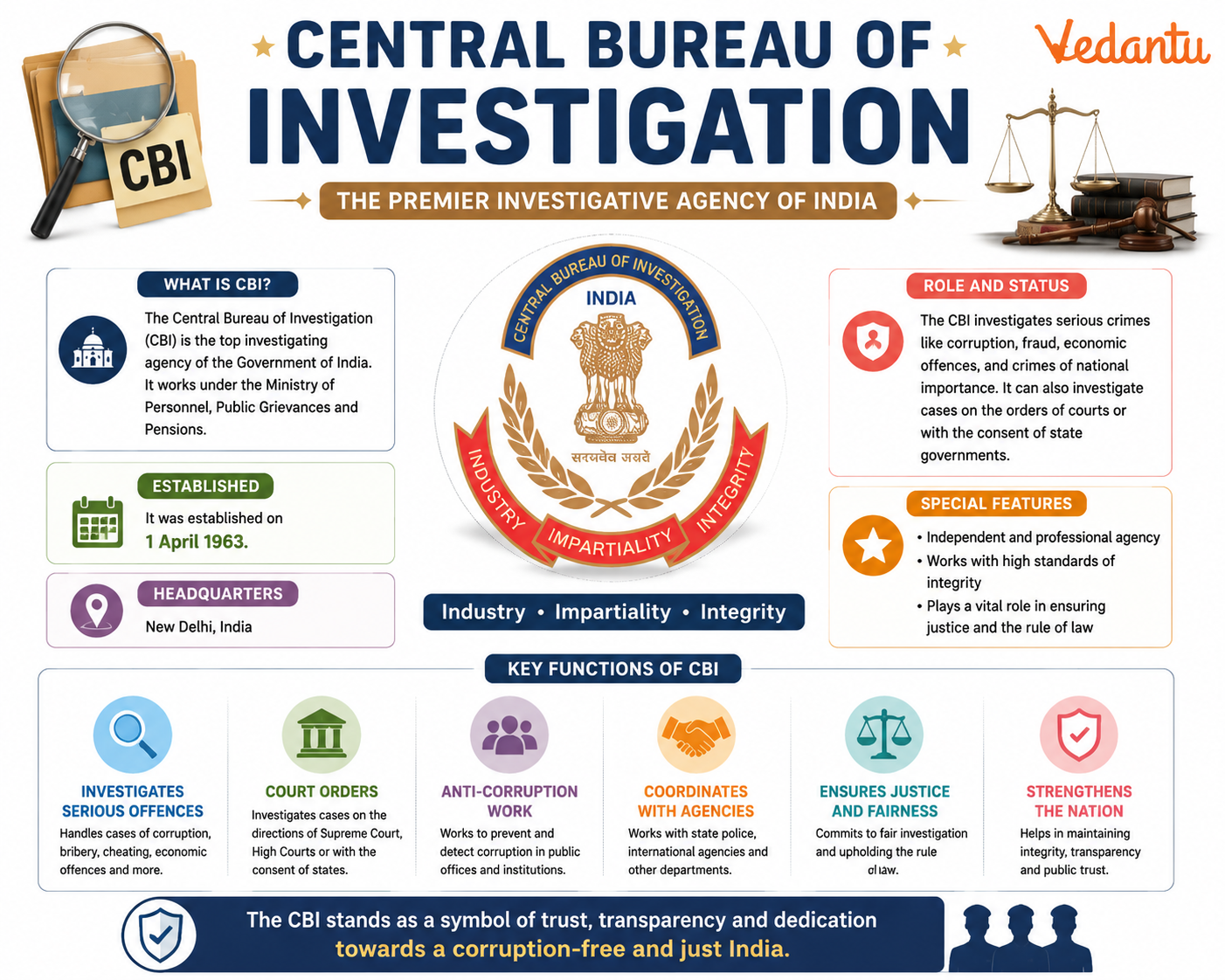
Introduction to Central Bureau of Investigation
The Central Bureau of Investigation investigates cases that require specialized expertise, inter-state coordination, or international cooperation. It derives its powers from the Delhi Special Police Establishment Act, 1946. The agency handles sensitive and complex cases that are beyond the scope of state police forces. The CBI also acts as the nodal police agency in India for coordinating investigations with Interpol.
Key Facts About Central Bureau of Investigation
| Particular | Details | Year |
|---|---|---|
| Established | Central Bureau of Investigation | 1963 |
| Governing Act | Delhi Special Police Establishment Act | 1946 |
| Headquarters | New Delhi | - |
The CBI was formally established in 1963 by a resolution of the Ministry of Home Affairs. It was initially set up to investigate cases of bribery and corruption in government departments but later expanded its jurisdiction to include major criminal offenses and economic crimes.
Objectives of the CBI
The primary aim of the Central Bureau of Investigation is to uphold the rule of law and ensure fair investigation in significant cases. Its objectives include:
- Investigating corruption cases involving central government employees and public officials.
- Handling economic offenses such as bank frauds and financial scams.
- Investigating serious crimes like murder, kidnapping, and organized crime when assigned.
- Coordinating with international agencies in cross-border crime investigations.
Organizational Structure of CBI
The CBI is headed by a Director, who is selected by a committee consisting of the Prime Minister, the Leader of Opposition in the Lok Sabha, and the Chief Justice of India or a nominated judge. The Director has a fixed tenure to ensure independence in functioning.
Major Divisions of CBI
- Anti Corruption Division - Investigates corruption cases against public servants.
- Economic Offences Division - Deals with financial frauds, banking scams, and corporate crimes.
- Special Crimes Division - Handles serious and sensational crimes.
- Policy and International Police Cooperation Division - Coordinates with Interpol and foreign agencies.
Jurisdiction and Powers
The CBI can investigate cases in states only with the consent of the state government. However, the Supreme Court and High Courts can direct the CBI to investigate cases without state consent. Its officers have powers similar to those of police officers under the Criminal Procedure Code.
Functions of the Central Bureau of Investigation
- Registering and investigating criminal cases.
- Collecting evidence and filing charge sheets in courts.
- Assisting state police forces in complex investigations.
- Providing forensic and technical support.
Importance of CBI in India
The Central Bureau of Investigation is considered essential for ensuring transparency and accountability in governance. It handles cases that have national and international implications. Due to its professionalism and expertise, courts often entrust the CBI with sensitive cases where impartial investigation is required.
Challenges Faced by CBI
Despite its significance, the CBI faces several challenges in functioning effectively:
- Allegations of political interference.
- Dependence on state government consent for investigations.
- Heavy workload and limited manpower.
- Delays in prosecution and trial processes.
Conclusion
The Central Bureau of Investigation plays a crucial role in safeguarding the integrity of India’s administrative and legal systems. By investigating corruption, economic crimes, and serious offenses, the CBI helps maintain public trust in governance. Understanding the structure, powers, and functions of the CBI is important for students preparing for competitive examinations and for anyone interested in India’s law enforcement system.
FAQs on Central Bureau of Investigation: Meaning, History and Functions
1. What is the Central Bureau of Investigation (CBI)?
The Central Bureau of Investigation (CBI) is India’s premier investigating agency responsible for handling high-profile corruption and criminal cases.
- Established in 1963 under the Delhi Special Police Establishment (DSPE) Act, 1946
- Functions under the Ministry of Personnel, Public Grievances and Pensions
- Investigates corruption, economic offenses, special crimes, and major fraud cases
- Often called India’s top investigative or anti-corruption agency (People also ask: What does CBI do?)
2. When and why was the CBI established?
The CBI was established in 1963 to investigate corruption in central government departments and public sector undertakings.
- Originated from the Special Police Establishment (SPE) during World War II
- Formally set up by a resolution of the Government of India
- Aimed to curb bribery, corruption, and financial irregularities
- Later expanded to handle economic crimes, bank frauds, and serious criminal cases
3. What are the main functions of the CBI?
The main function of the Central Bureau of Investigation is to investigate serious crimes affecting national interest.
- Investigates corruption cases involving central government employees
- Handles economic offenses like bank frauds and financial scams
- Probes special crimes such as murder, terrorism, and organized crime (when assigned)
- Coordinates with INTERPOL as India’s nodal agency
- Assists state police forces on request (People also search: powers of CBI, role of CBI in India)
4. Under which Act does the CBI operate?
The CBI operates under the Delhi Special Police Establishment (DSPE) Act, 1946.
- Provides legal powers to investigate offenses
- Requires state government consent to investigate cases in a state
- Empowers CBI officers with powers similar to police officers
- Forms the statutory basis of CBI’s jurisdiction across India
5. Who appoints the Director of CBI?
The Director of the CBI is appointed by a high-level selection committee to ensure transparency.
- Committee includes the Prime Minister (Chairperson)
- The Chief Justice of India or a Supreme Court judge nominated by him
- The Leader of Opposition in the Lok Sabha
- Director has a fixed tenure of two years
6. What types of cases are investigated by the CBI?
The CBI investigates high-profile and sensitive cases that have national or inter-state importance.
- Corruption and bribery cases
- Bank frauds and economic scams
- Cybercrime and financial fraud
- Special crimes like murder or kidnapping when directed by courts
- Cases transferred by the Supreme Court or High Courts
7. What is the difference between CBI and State Police?
The key difference is that the CBI handles national-level cases, while state police handle local law and order.
- CBI works under the Central Government
- State Police function under respective State Governments
- CBI needs state consent to investigate within a state
- CBI deals with inter-state, corruption, and high-profile cases
8. Where is the headquarters of the CBI located?
The headquarters of the CBI is located in New Delhi, India.
- Situated in the CGO Complex, Lodhi Road
- Headed by the Director of CBI
- Has regional offices across major Indian cities
- Coordinates investigations nationwide
9. Can the CBI investigate cases without state permission?
Generally, the CBI requires state government consent to investigate cases within a state’s jurisdiction.
- Based on provisions of the DSPE Act, 1946
- Some states grant general consent, others require case-specific approval
- Supreme Court or High Court can order CBI investigation without state consent
- This issue is often debated in federal governance discussions
10. Why is the CBI called India’s premier investigating agency?
The CBI is called India’s premier investigating agency because it handles the most sensitive and high-profile cases in the country.
- Deals with major corruption scandals and financial crimes
- Investigates cases with national and international implications
- Acts as India’s official representative to INTERPOL
- Known for specialized expertise in forensic investigation and economic offenses
