






Why the Anti-Rowlatt Satyagraha Protest Began and Its Effects on Indian Nationalism
The Anti Rowlatt Satyagraha was one of the first large scale mass movements led by Mahatma Gandhi against British rule in India. Launched in 1919, it was a nationwide protest against the repressive Rowlatt Act, which allowed the British government to arrest and detain people without trial. This movement marked the beginning of Gandhi’s strategy of non violent resistance at the national level and played a crucial role in uniting Indians against colonial injustice. The Anti Rowlatt Satyagraha also laid the foundation for future freedom movements in India.
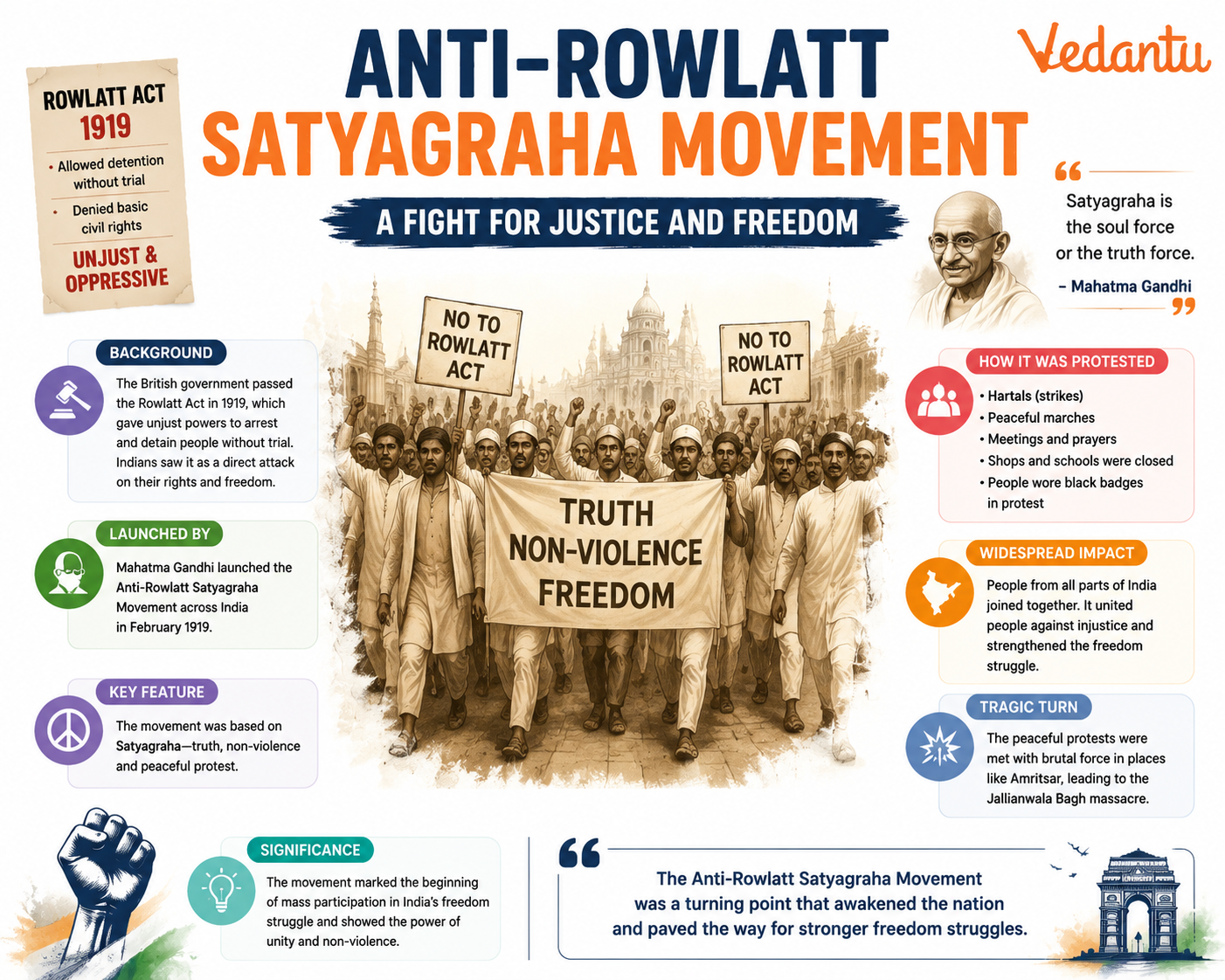
Background of the Rowlatt Act
After World War I, the British government passed the Rowlatt Act in March 1919 based on the recommendations of the Sedition Committee headed by Sir Sidney Rowlatt. The Act aimed to curb revolutionary activities in India. However, it severely restricted civil liberties and gave extraordinary powers to the government.
- Allowed detention without trial for up to two years.
- Permitted arrest without warrant.
- Restricted freedom of press and public gatherings.
- Denied the right to legal appeal in certain cases.
These harsh provisions angered Indian leaders and the general public, who viewed the Act as a betrayal after India’s support to Britain during World War I.
Launch of the Anti Rowlatt Satyagraha
Mahatma Gandhi decided to oppose the Rowlatt Act through a nationwide Satyagraha based on truth and non violence. He formed the Satyagraha Sabha in 1919 and called for peaceful protests, strikes, and civil disobedience.
Key Features of the Movement
- Nationwide hartal on 6 April 1919.
- Closure of shops and businesses.
- Peaceful processions and fasting.
- Public meetings to protest against the Act.
The movement received widespread support from different sections of society including students, workers, and traders. It was one of the first attempts to mobilize people across regions on a single issue.
Jallianwala Bagh Massacre and Its Impact
The protest against the Rowlatt Act led to unrest in several cities, especially in Punjab. On 13 April 1919, General Dyer ordered troops to fire on a peaceful gathering at Jallianwala Bagh in Amritsar. Hundreds of people were killed and many more were injured.
The massacre shocked the entire nation and exposed the brutality of British rule. It intensified anti British sentiments and strengthened the resolve for independence.
Key Facts about Anti Rowlatt Satyagraha
| Aspect | Details | Year |
|---|---|---|
| Rowlatt Act Passed | Based on Sedition Committee Report | 1919 |
| Nationwide Hartal | Peaceful protest led by Gandhi | 6 April 1919 |
| Jallianwala Bagh Massacre | Firing ordered by General Dyer | 13 April 1919 |
These events marked a turning point in the Indian freedom struggle. The Anti Rowlatt Satyagraha demonstrated the power of collective action and non violent resistance.
Significance of the Anti Rowlatt Satyagraha
- First nationwide mass movement under Gandhi’s leadership.
- Introduced Satyagraha as a powerful political tool.
- Exposed the repressive nature of British rule.
- Prepared the ground for the Non Cooperation Movement.
Although the movement was eventually called off due to incidents of violence, it marked a major shift in India’s freedom struggle. It brought Gandhi to the forefront of national politics and united people from different regions and communities.
Conclusion
The Anti Rowlatt Satyagraha was a landmark event in modern Indian history. It represented the awakening of mass political consciousness and the beginning of organized non violent resistance against colonial rule. The movement highlighted the importance of unity, civil liberties, and peaceful protest. Understanding the Anti Rowlatt Satyagraha is essential for grasping the evolution of India’s struggle for independence and the rise of Mahatma Gandhi as a national leader.
FAQs on Anti-Rowlatt Satyagraha Movement: History, Causes and Significance
1. What was the Anti Rowlatt Satyagraha?
The Anti Rowlatt Satyagraha (1919) was a nationwide peaceful protest led by Mahatma Gandhi against the oppressive Rowlatt Act passed by the British government.
- Launched in March 1919
- Opposed the Rowlatt Act (Anarchical and Revolutionary Crimes Act)
- Marked Gandhi’s first all-India mass movement
- Based on the principles of Satyagraha (non-violent resistance)
It became a major turning point in the Indian National Movement and strengthened the demand for Swaraj (self-rule).
2. What was the Rowlatt Act of 1919?
The Rowlatt Act (1919) was a repressive law that allowed the British government to arrest and detain individuals without trial.
- Passed based on recommendations of the Rowlatt Committee
- Allowed detention without warrant
- Permitted trials without a jury
- Restricted freedom of press and expression
This act was widely called the “Black Act” and triggered widespread protests across India.
3. Why did Mahatma Gandhi oppose the Rowlatt Act?
Mahatma Gandhi opposed the Rowlatt Act because it violated civil liberties and basic human rights.
- Denied the right to a fair trial
- Increased colonial repression after World War I
- Suppressed political activities
- Betrayed Indian expectations of reforms
Gandhi believed the act was unjust and launched the Rowlatt Satyagraha Movement to resist it through non-violent protest.
4. When and how did the Anti Rowlatt Satyagraha begin?
The Anti Rowlatt Satyagraha began in March 1919 with a call for a nationwide hartal (strike).
- Gandhi formed the Satyagraha Sabha
- Observed 6 April 1919 as a day of fasting and prayer
- Organized peaceful protests and strikes
- Encouraged civil disobedience
The movement quickly spread to major cities like Delhi, Bombay, Lahore, and Amritsar.
5. What was the impact of the Anti Rowlatt Satyagraha?
The Anti Rowlatt Satyagraha had a significant impact on India’s freedom struggle.
- United people across regions and religions
- Led to mass political awakening
- Resulted in violent incidents in some areas
- Set the stage for future movements like the Non-Cooperation Movement (1920)
It marked Gandhi’s emergence as a national leader in the Indian independence movement.
6. What was the connection between the Rowlatt Satyagraha and the Jallianwala Bagh Massacre?
The Jallianwala Bagh Massacre (13 April 1919) occurred during protests against the Rowlatt Act.
- Peaceful gathering in Amritsar
- Ordered firing by General Dyer
- Hundreds of innocent civilians killed
- Result of heightened tensions during the Anti Rowlatt protests
This tragic event intensified anti-British sentiments and strengthened the freedom movement.
7. What were the main features of the Rowlatt Satyagraha Movement?
The Rowlatt Satyagraha was based on non-violent resistance and civil disobedience.
- Nationwide hartals (strikes)
- Fasting and prayer meetings
- Peaceful demonstrations
- Boycott of British institutions
- Promotion of Hindu-Muslim unity
It was inspired by the principles of truth (Satya) and non-violence (Ahimsa).
8. Why is the Anti Rowlatt Satyagraha considered a turning point in Indian history?
The Anti Rowlatt Satyagraha is considered a turning point because it transformed the freedom struggle into a mass movement.
- First nationwide Gandhian movement
- Large-scale public participation
- Shift from moderate politics to mass agitation
- Strengthened demand for Swaraj
It laid the foundation for future campaigns like the Civil Disobedience Movement and Quit India Movement.
9. Who were the key leaders involved in the Rowlatt Satyagraha?
The Rowlatt Satyagraha was led by several prominent nationalist leaders.
- Mahatma Gandhi
- Dr. Saifuddin Kitchlew
- Dr. Satyapal
- Support from leaders of the Indian National Congress
These leaders mobilized people against colonial repression and promoted non-violent resistance.
10. What were the reasons for the failure of the Rowlatt Satyagraha?
The Rowlatt Satyagraha faced challenges and was eventually withdrawn by Gandhi due to rising violence.
- Violent outbreaks in some cities
- Lack of disciplined mass control
- Arrest of key leaders
- British suppression and martial law
Although it did not immediately repeal the Rowlatt Act, it played a crucial role in shaping the future of the Indian National Movement.
