






How India and China Compare in Economy, Population, Military and Development Indicators
India and China are two of the largest and most influential countries in Asia and the world. Both nations have ancient civilizations, massive populations, fast-growing economies, and significant global influence. Comparing India and China across multiple parameters helps students understand global politics, economics, geography, and international relations. This topic is especially important for competitive exams, school studies, and general awareness. Below are 13 important parameters to compare India and China in a structured and easy-to-understand format.
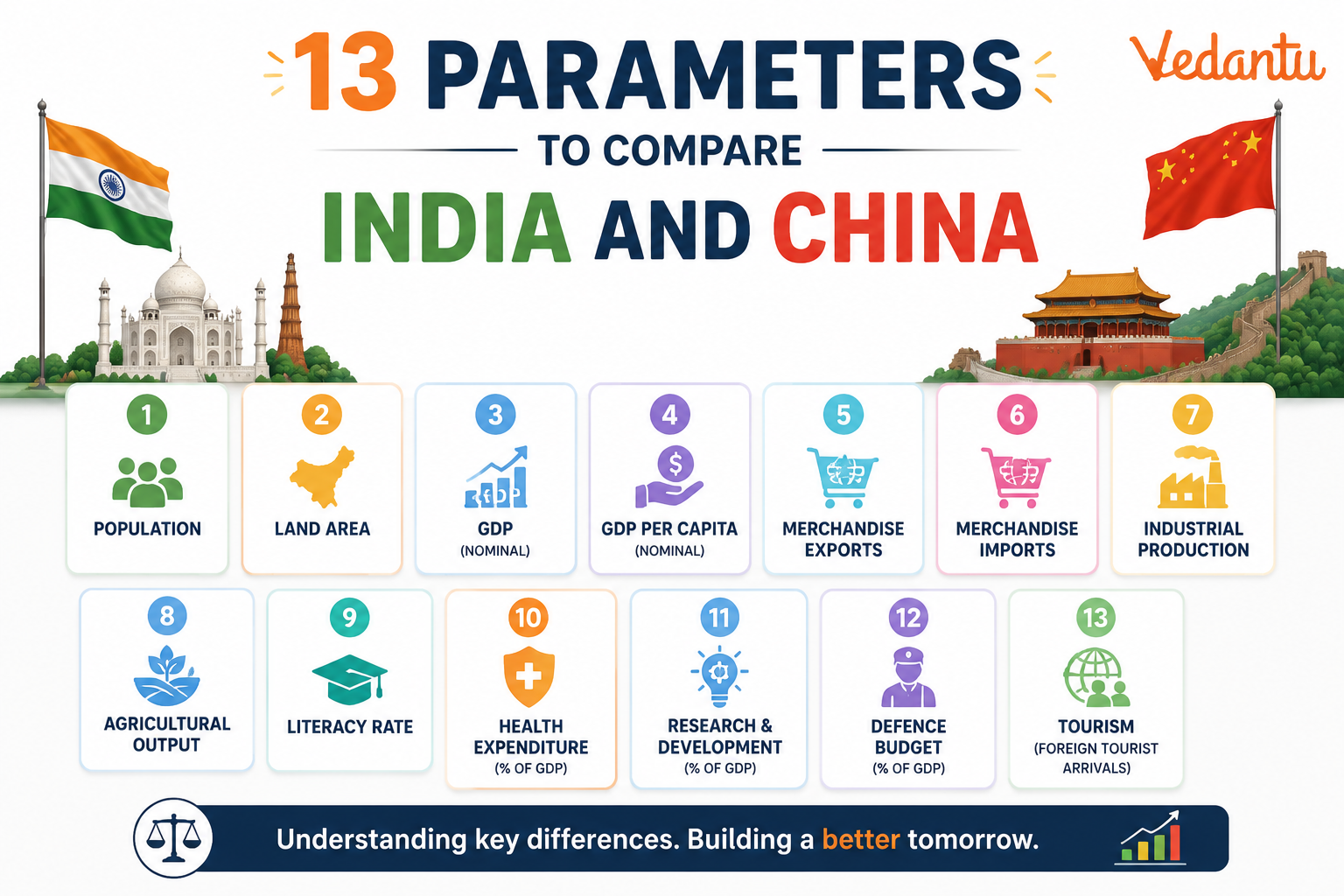
Comparison Table - India and China
| Parameter | India | China |
|---|---|---|
| Capital | New Delhi | Beijing |
| Population 2025 approx | 1.43 Billion | 1.41 Billion |
| Area | 3.28 Million sq km | 9.6 Million sq km |
| Government Type | Federal Democratic Republic | Single Party Socialist Republic |
| GDP Nominal 2025 approx | 3.7 Trillion USD | 18 Trillion USD |
| Currency | Indian Rupee | Renminbi Yuan |
The table above gives a quick snapshot comparison. Below is a detailed explanation of 13 major parameters used to compare India and China.
1. Geographical Area
China is the fourth largest country in the world by area, covering about 9.6 million square kilometers. India ranks seventh globally with about 3.28 million square kilometers. China has diverse landscapes including plateaus, deserts, mountains, and plains, while India has mountains, plains, deserts, coastal regions, and plateaus.
2. Population
India recently became the most populous country in the world, slightly surpassing China. Both countries have populations exceeding 1.4 billion people. However, China is experiencing population decline due to its earlier one child policy, while India has a younger and growing population.
3. Political System
- India - Federal parliamentary democratic republic with multiple political parties.
- China - Single party socialist state governed by the Communist Party of China.
4. Economic Size GDP
China has the second largest economy in the world by nominal GDP, while India ranks among the top five fastest growing major economies. China became a manufacturing hub, while India has strong growth in services, IT, and digital sectors.
5. Per Capita Income
China's per capita income is significantly higher than India's. This indicates that average income levels and living standards are generally higher in China compared to India, although both countries face rural and urban disparities.
6. Military Strength
Both India and China have powerful armed forces and are nuclear weapon states.
- China has one of the largest military budgets in the world.
- India has one of the largest standing armies and is strengthening defense technology.
7. Industrial Development
China is known as the manufacturing hub of the world, producing electronics, machinery, steel, and consumer goods. India is growing in manufacturing through initiatives like Make in India but remains more service oriented compared to China.
8. Technology and Innovation
China has advanced rapidly in technology sectors such as artificial intelligence, 5G, electronics, and electric vehicles. India is globally recognized for its IT services, software exports, and startup ecosystem. Both countries are investing heavily in digital transformation.
9. Education System
China has high literacy rates and strong performance in science and mathematics education. India has made significant progress in education but continues to work on improving literacy and higher education access. India has globally recognized institutions like IITs and IIMs.
10. Infrastructure
China has highly developed infrastructure including high speed rail networks, modern highways, and large scale urban development. India is rapidly improving infrastructure through smart cities, highways, airports, and railway modernization projects.
11. International Influence
China plays a major role in global trade and initiatives like the Belt and Road Initiative. India is an active member of global organizations such as the United Nations, G20, BRICS, and QUAD. Both countries are important regional powers in Asia.
12. Demographic Structure
India has a young population with a large working age group, which can provide a demographic dividend. China is facing an aging population problem, which may impact its future workforce and economic growth.
13. Cultural Heritage and Civilization
Both India and China have ancient civilizations that are thousands of years old. India is known for its diverse religions, languages, and traditions. China is known for Confucian philosophy, traditional medicine, and a rich cultural legacy. Both countries have strong cultural influence worldwide.
Key Differences at a Glance
- China has a larger land area and stronger manufacturing base.
- India has a younger population and a strong service sector.
- China's per capita income is higher than India's.
- India follows a democratic political system, while China follows a single party system.
Conclusion
Comparing India and China across 13 parameters highlights their strengths, challenges, and global importance. While China currently leads in economic size, infrastructure, and manufacturing, India has strong demographic advantages and growing global influence. Understanding these comparisons helps students develop awareness about global trends, geopolitics, and economic development. This topic is highly relevant for school exams, competitive exams, and general knowledge preparation.
FAQs on 13 Key Parameters to Compare India and China for Students
1. What are the 13 parameters used to compare India and China?
The 13 parameters to compare India and China include major economic, social, political, and military indicators used in General Knowledge and competitive exams.
- Population and demographic structure
- GDP (Gross Domestic Product) and economic growth rate
- Per capita income
- Area and geographical features
- Political system (Democracy vs Communist system)
- Military strength and defense budget
- Human Development Index (HDI)
- Literacy rate and education system
- Industrial and manufacturing output
- Agriculture production
- Export and trade balance
- Technology and innovation
- Global influence and international relations
These parameters help students understand the comparative development of India vs China in global rankings.
2. How does the population of India compare with China?
India has recently surpassed China to become the most populous country in the world.
- India: Over 1.4 billion people (young population)
- China: Slightly lower population with an aging demographic
- India has a demographic dividend
- China faces challenges due to its former One-Child Policy
Population comparison is a key topic in India vs China GK questions and global demographic studies.
3. Which country has a stronger economy: India or China?
China currently has a larger GDP and stronger manufacturing economy than India.
- China’s GDP: Second largest in the world
- India’s GDP: Among the top 5 global economies
- China leads in exports and industrial production
- India shows rapid growth in the services and IT sector
This comparison is important in topics related to economic development, global trade, and emerging economies.
4. What is the difference between the political systems of India and China?
India follows a democratic system, while China follows a one-party communist system.
- India: Parliamentary democracy, multi-party elections
- China: Governed by the Communist Party of China (CPC)
- India ensures fundamental rights and freedom of speech
- China has centralized political control
Political comparison is frequently asked in civics, polity, and international relations exams.
5. How do India and China compare in military strength?
Both India and China are among the strongest military powers in the world.
- China has a larger defense budget
- India has one of the largest armed forces
- Both are nuclear-armed nations
- China ranks higher in the Global Firepower Index
Military comparison is significant in discussions on border disputes, regional security, and Asian geopolitics.
6. Which country has better human development indicators: India or China?
China ranks higher than India in the Human Development Index (HDI).
- Higher literacy rate in China
- Better life expectancy
- Higher per capita income
- India improving through schemes like Digital India and Skill India
HDI comparison reflects differences in education, healthcare, and living standards.
7. How does the education system of India compare with China?
China has a higher overall literacy rate, while India has globally recognized institutions.
- China: Strong focus on STEM education
- India: Home to IITs, IIMs, and AIIMS
- China performs strongly in PISA rankings
- India has a large English-speaking population
Education comparison is relevant in global competitiveness and skill development discussions.
8. What is the difference in industrial development between India and China?
China is known as the "Factory of the World" due to its massive manufacturing sector.
- China leads in electronics, steel, and machinery production
- India focuses more on IT services and pharmaceuticals
- China has stronger export-oriented industries
- India promotes Make in India initiative
Industrial comparison highlights differences in manufacturing growth and economic models.
9. How do India and China compare in global influence?
China currently has wider global economic influence, while India is expanding its diplomatic reach.
- China’s Belt and Road Initiative (BRI)
- India’s active role in G20, QUAD, and BRICS
- China holds permanent membership in the UN Security Council
- India is a key voice for developing nations
This parameter is crucial in studying international relations and global power balance.
10. Why is comparing India and China important for competitive exams?
Comparison of India and China is important because both are emerging Asian superpowers frequently asked in GK and UPSC exams.
- Helps understand economic growth trends
- Important for current affairs and geopolitics
- Covers topics in polity, economy, geography, and defense
- Useful for exams like UPSC, SSC, Banking, and State PSC
Studying these 13 parameters improves conceptual clarity about India vs China comparison and global development patterns.
