






Who Are the Anglo-Indian Community in India? Origin and Legal Status
Anglo Indians in India form a unique community with a distinct cultural identity shaped by a blend of Indian and European heritage. The term generally refers to people of mixed Indian and British ancestry who developed as a separate social group during British rule in India. Recognized as a minority community under the Constitution of India, Anglo Indians have played a significant role in education, railways, armed forces, literature, music, and public administration. Understanding the history, culture, constitutional status, and contributions of Anglo Indians is important for General Knowledge, competitive exams, and academic awareness.
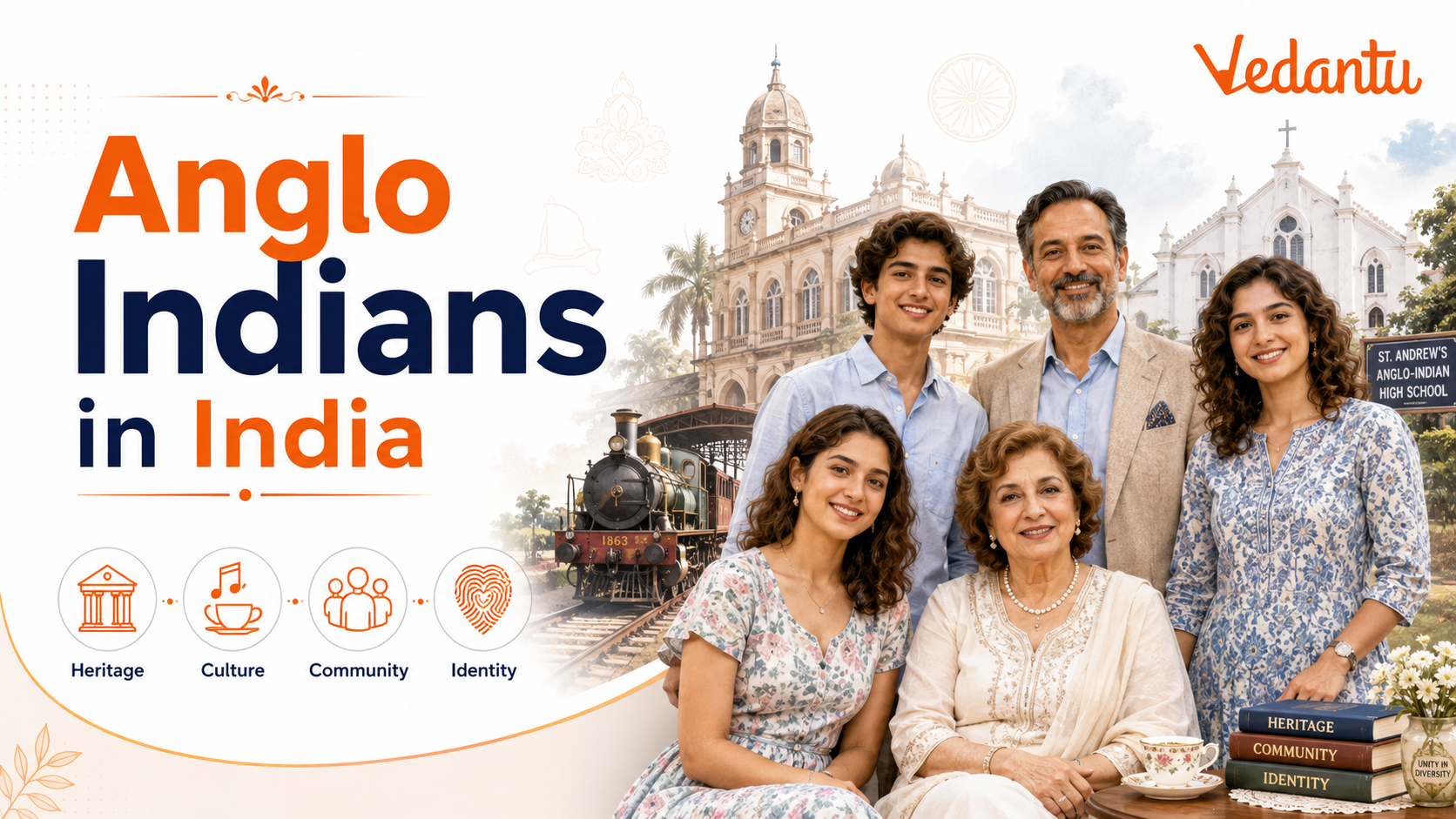
Who Are Anglo Indians?
Anglo Indians are defined under Article 366(2) of the Indian Constitution as persons whose father or male ancestor in the male line is of European descent but who are domiciled in India and born of parents habitually resident in India. Historically, the term was used for people of mixed British and Indian ancestry who adopted English as their first language and followed a distinct lifestyle influenced by Western culture.
Key Characteristics of Anglo Indians
- Mixed Indian and European ancestry, mainly British.
- English as the primary language.
- Christian faith followed by a majority of the community.
- Distinct cultural traditions in food, dress, and social customs.
Historical Background of Anglo Indians
The Anglo Indian community emerged during the British East India Company rule in the 17th and 18th centuries. Interactions between British officials and Indian women led to the formation of a mixed community. Over time, Anglo Indians developed a distinct identity separate from both British rulers and Indian natives.
During British rule, Anglo Indians were often employed in railways, postal services, telegraph departments, customs, and educational institutions. After India gained independence in 1947, many Anglo Indians migrated to countries such as the United Kingdom, Australia, and Canada, while a significant number continued to live in India.
Constitutional Provisions Related to Anglo Indians
Constitutional Safeguards for Anglo Indians
| Article | Provision | Current Status |
|---|---|---|
| Article 366(2) | Definition of Anglo Indian | Still valid |
| Article 331 and 333 | Nomination in Lok Sabha and State Assemblies | Provision ended in 2020 |
Originally, the President of India could nominate two Anglo Indian members to the Lok Sabha if the community was not adequately represented. Similarly, Governors could nominate one member to State Legislative Assemblies. However, the 104th Constitutional Amendment Act, 2019, which came into effect in 2020, abolished this provision.
Population and Distribution
The Anglo Indian population in India is relatively small. Major concentrations are found in states such as West Bengal, Tamil Nadu, Karnataka, Kerala, and Maharashtra. Kolkata and Chennai have historically been important cultural centers for the community.
Culture and Lifestyle of Anglo Indians
Language
English is the mother tongue of Anglo Indians. Their accent and vocabulary often reflect British influence, though regional Indian elements are also present.
Food
Anglo Indian cuisine is a fusion of Indian spices and British cooking styles. Popular dishes include railway mutton curry, ball curry, country captain chicken, and yellow rice.
Music and Dance
Western music, including jazz and rock and roll, has traditionally been popular among Anglo Indians. Social gatherings often include ballroom dancing and community celebrations.
Contributions of Anglo Indians to India
- Significant role in the development of Indian Railways and telecommunication services.
- Contribution to English medium education in India.
- Influence in sports such as hockey and athletics.
- Notable personalities in literature, cinema, and public service.
Notable Anglo Indians
- Frank Anthony - Educationist and parliamentarian who represented the Anglo Indian community.
- Ruskin Bond - Renowned author known for his literary works.
- Neil O Brien - Educationist and quizmaster.
Challenges Faced by the Anglo Indian Community
After independence, the community faced identity and migration challenges. The loss of reserved legislative representation in 2020 also raised concerns about political voice. However, Anglo Indians continue to preserve their heritage through community associations, schools, and cultural events.
- Declining population due to migration.
- Cultural assimilation and loss of distinct identity.
- Reduced political representation after constitutional amendment.
Importance of Anglo Indians in General Knowledge
Questions related to Anglo Indians are frequently asked in competitive exams such as UPSC, State PSC, SSC, and other government recruitment tests. Topics generally include constitutional provisions, historical background, cultural identity, and recent amendments. Understanding their role enhances knowledge of India's social diversity and constitutional framework.
Summary
Anglo Indians in India represent a small but culturally rich community formed during the colonial period. With a unique blend of Indian and European heritage, they have contributed significantly to education, railways, literature, and public service. Although constitutional nomination provisions ended in 2020, their historical importance and cultural legacy remain vital parts of India's diverse social fabric. Studying Anglo Indians helps students understand minority rights, constitutional safeguards, and India's multicultural society.
FAQs on Anglo-Indians in India: History, Culture and Contribution
1. Who are Anglo-Indians in India?
Anglo-Indians are people of mixed Indian and European (mainly British) ancestry recognized as a distinct community in India.
- The term was officially defined in Article 366(2) of the Indian Constitution.
- They mostly emerged during the British colonial period.
- English is their primary language.
- They have contributed significantly to education, railways, armed forces, and administration.
2. What is the origin of the Anglo-Indian community?
The Anglo-Indian community originated during British rule in India through marriages and relationships between British officials and Indian women.
- Developed mainly in the 18th and 19th centuries.
- Strong presence in cities like Kolkata, Chennai, Mumbai, and Bangalore.
- Initially connected with the East India Company.
3. How are Anglo-Indians defined in the Indian Constitution?
Article 366(2) of the Indian Constitution defines Anglo-Indians as persons of European descent domiciled in India.
- Father or male ancestor must be of European origin.
- Born and residing permanently in India.
- Not temporary residents.
4. Did Anglo-Indians have reserved seats in Parliament?
Yes, Anglo-Indians had nominated seats in Parliament and State Assemblies until 2020.
- Under Article 331, the President could nominate 2 members to the Lok Sabha.
- Similar provisions existed in some State Legislative Assemblies.
- The provision was removed by the 104th Constitutional Amendment Act, 2020.
5. What language do Anglo-Indians speak?
English is the primary language of the Anglo-Indian community in India.
- They follow British-style English traditions.
- Many contributed to the growth of English-medium education.
- Some also speak regional Indian languages.
6. What role did Anglo-Indians play in Indian Railways?
Anglo-Indians played a major role in the development of Indian Railways during British rule.
- Worked as station masters, drivers, guards, and technical staff.
- Helped manage railway colonies and workshops.
- Contributed to railway administration and discipline.
7. What is the culture of the Anglo-Indian community?
Anglo-Indian culture is a blend of Indian and British traditions.
- Celebrate festivals like Christmas and Easter.
- Known for unique Anglo-Indian cuisine such as railway mutton curry.
- Follow Western-style dress, music, and dance.
8. Why did many Anglo-Indians migrate after Independence?
Many Anglo-Indians migrated after 1947 due to uncertainty about their future in independent India.
- Concerns over job security and identity.
- Opportunities in countries like UK, Australia, and Canada.
- Decline in colonial-era privileges.
9. Who are some famous Anglo-Indians in India?
Several Anglo-Indians have made notable contributions in politics, literature, and arts.
- Frank Anthony – Prominent Anglo-Indian leader and educationist.
- Ruskin Bond – Famous author (of British descent, often linked culturally).
- Contributors in sports, armed forces, and cinema.
10. What is the current status of Anglo-Indians in India?
The Anglo-Indian community is recognized as a minority group in India today, though their political nomination has ended.
- Protected under minority rights.
- Active in education, social services, and cultural preservation.
- Population has declined due to migration.
