






Amazing Facts About the Prime Minister’s Official Home: History, Design, and Security Features
The Prime Minister's Residence is one of the most important and secure buildings in any country. It is not just a home but also a center of political activity, decision-making, and national administration. Over the years, these residences have witnessed historic meetings, important policy decisions, and visits from global leaders. In this article, we explore amazing facts about the Prime Minister's Residence, focusing mainly on India while also mentioning interesting global comparisons. This topic is highly relevant for General Knowledge preparation, competitive exams, and interviews.
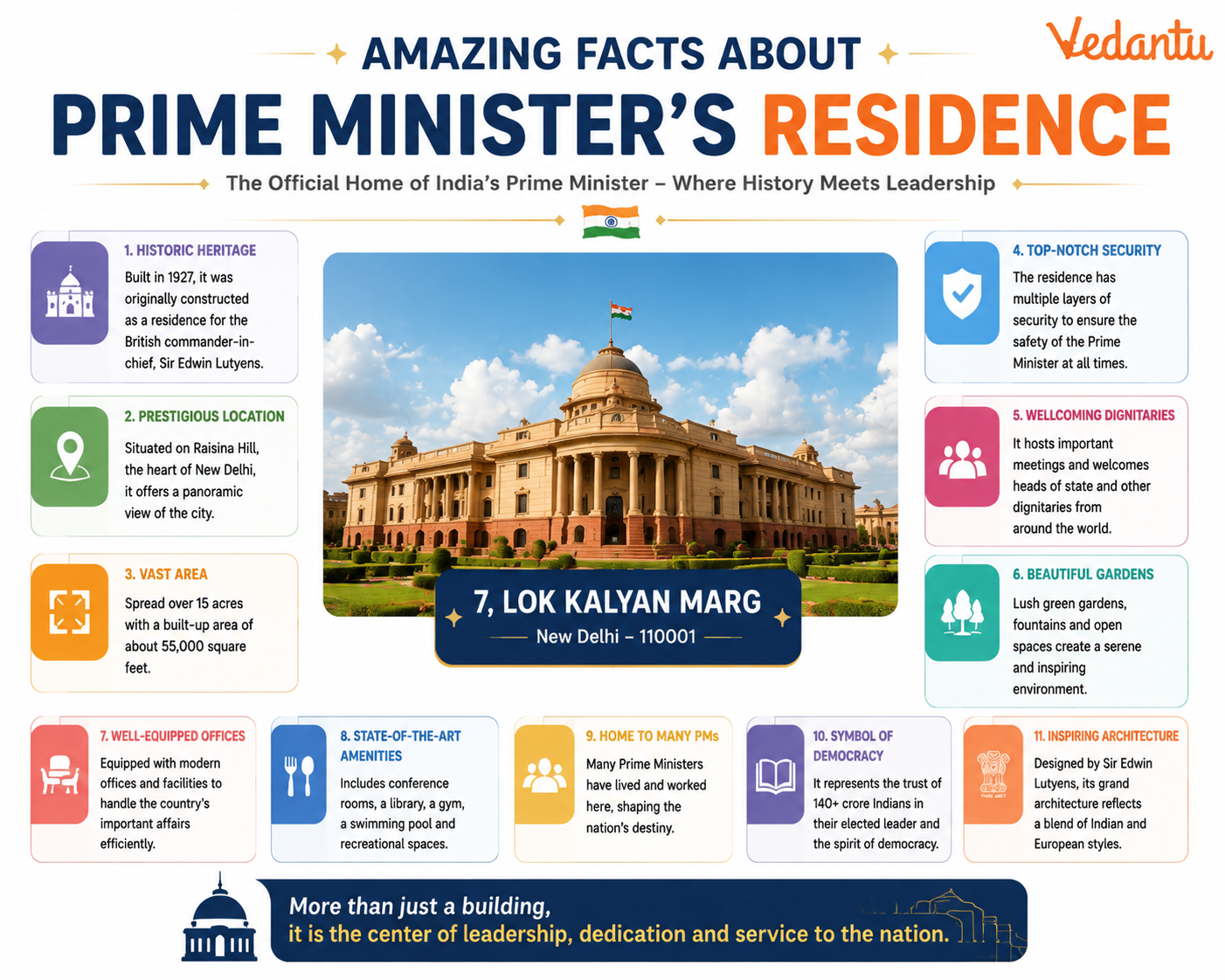
What is the Prime Minister's Residence?
The Prime Minister's Residence is the official home where the Prime Minister of a country lives during their term in office. It often includes office spaces, meeting rooms, security zones, and facilities for hosting foreign dignitaries. In India, the official residence of the Prime Minister is located at 7, Lok Kalyan Marg in New Delhi.
Amazing Facts About India's Prime Minister's Residence
- The official residence is located at 7, Lok Kalyan Marg, New Delhi.
- It was earlier known as 7, Race Course Road before being renamed in 2016.
- The complex consists of multiple bungalows connected by corridors and lawns.
- It includes residential quarters, office space, meeting halls, and a helipad nearby.
- The area is heavily guarded by the Special Protection Group or SPG.
- Several historic decisions affecting India were taken within its premises.
Historical Background
The buildings that form the Prime Minister's Residence were originally constructed during the British era. After independence in 1947, the residence of the Prime Minister changed several times. For many years, 7, Race Course Road became the permanent official residence. In 2016, the road was renamed Lok Kalyan Marg, meaning Path of Public Welfare.
Structure and Facilities
Residential Area
The residential section provides living quarters for the Prime Minister and their family. It is designed to maintain privacy while ensuring maximum security.
Office Complex
The residence also includes offices where the Prime Minister meets ministers, officials, and foreign dignitaries. Important administrative work and confidential discussions take place here.
Security Arrangements
Security is extremely tight. The Special Protection Group monitors the entire complex using advanced surveillance systems, controlled entry points, and trained personnel.
Key Details About India's Prime Minister's Residence
| Feature | Details | Location |
|---|---|---|
| Official Name | 7, Lok Kalyan Marg | New Delhi |
| Previous Name | 7, Race Course Road | Renamed in 2016 |
| Security | Special Protection Group | High Security Zone |
The table above summarizes the essential information related to the Prime Minister's official residence in India. Such factual data is frequently asked in competitive examinations and quizzes.
Interesting Global Comparisons
Different countries have unique Prime Minister residences that reflect their culture and history. Here are some interesting examples:
- United Kingdom - 10 Downing Street in London is one of the most famous political addresses in the world.
- Canada - The Prime Minister resides at 24 Sussex Drive in Ottawa.
- Australia - The official residence is known as The Lodge in Canberra.
- Japan - The Prime Minister's residence is called Kantei in Tokyo.
Why is the Prime Minister's Residence Important?
The Prime Minister's Residence is more than just a house. It is a symbol of executive authority and national governance. Important domestic and international decisions are often finalized here. It also serves as a venue for diplomatic meetings, press briefings, and official ceremonies.
GK Preparation Tips
For competitive exams and general awareness preparation, focus on these key points related to the Prime Minister's Residence:
- Memorize the official address and its previous name.
- Remember the year when Race Course Road was renamed Lok Kalyan Marg.
- Know the security agency responsible for protection.
- Be aware of famous Prime Minister residences in other countries.
Conclusion
The Prime Minister's Residence represents power, responsibility, and national leadership. From historic decisions to international diplomacy, it plays a central role in governance. Understanding amazing facts about the Prime Minister's Residence enhances your general knowledge and prepares you for competitive exams, interviews, and quizzes. Staying updated with such important facts helps build a strong foundation in political and civic awareness.
FAQs on Amazing Facts About the Prime Minister’s Residence and Its History
1. What is the official residence of the Prime Minister of India?
The official residence of the Prime Minister of India is located at 7, Lok Kalyan Marg, New Delhi.
• Earlier known as 7, Race Course Road (7 RCR)
• Renamed in 2016
• Serves as the official home and workplace of the Prime Minister
• Highly secured and managed by the Special Protection Group (SPG)
This residence is one of the most searched facts about the Prime Minister’s residence in India.
2. Why was Race Course Road renamed Lok Kalyan Marg?
The name was changed to reflect Indian values and remove colonial influence.
• Renamed from Race Course Road to Lok Kalyan Marg in September 2016
• "Lok Kalyan" means public welfare
• Aimed at promoting Indian identity over British-era names
This change is considered an important administrative reform linked to the Prime Minister’s official residence.
3. Who was the first Prime Minister to live at 7 Lok Kalyan Marg?
The first Prime Minister to reside at this complex was Rajiv Gandhi.
• Shifted to 7, Race Course Road in 1984
• Before that, Prime Ministers stayed at Teen Murti Bhavan and other locations
• Since then, it has remained the official PM residence
This makes Rajiv Gandhi significant in the history of the Prime Minister’s residence of India.
4. How many buildings are there in the Prime Minister’s residence complex?
The Prime Minister’s residence is a group of multiple interconnected bungalows.
• Consists of five bungalows
• Includes residential quarters, office space, and meeting rooms
• Connected through secure corridors
• Equipped with advanced security systems
This secure complex layout makes it unique among official residences of world leaders.
5. What are some amazing facts about the Prime Minister’s residence?
The Prime Minister’s residence has several unique and lesser-known features.
• Protected by the SPG and advanced surveillance systems
• Contains a conference hall for high-level meetings
• Has a helipad facility nearby
• Landscaped gardens used for official events
These amazing facts make 7 Lok Kalyan Marg one of the most secure and important addresses in India.
6. Where did the Prime Ministers of India live before 7 Lok Kalyan Marg?
Before shifting to the current residence, Prime Ministers lived in different official buildings.
• Jawaharlal Nehru lived at Teen Murti Bhavan
• Lal Bahadur Shastri stayed at 10, Janpath
• Residences varied until 1984
The establishment of 7 RCR created a permanent official residence for the Indian Prime Minister.
7. Is the Prime Minister’s residence open to the public?
No, the Prime Minister’s residence is not open to the general public due to security reasons.
• Guarded by the Special Protection Group (SPG)
• Entry allowed only to authorized officials and guests
• Strict surveillance and restricted access zones
This high security ensures the safety of the Prime Minister of India.
8. What security measures are taken at the Prime Minister’s residence?
The residence is one of the most secure locations in India.
• Protected by the SPG commandos
• Equipped with CCTV surveillance and advanced sensors
• Anti-drone and perimeter security systems
• Multi-layered security checkpoints
These measures make the PM residence in New Delhi extremely secure.
9. How is the Prime Minister’s residence different from Rashtrapati Bhavan?
The Prime Minister’s residence and Rashtrapati Bhavan serve different constitutional roles.
• 7 Lok Kalyan Marg is the home of the Prime Minister
• Rashtrapati Bhavan is the residence of the President of India
• Rashtrapati Bhavan is open to public tours; PM residence is not
This distinction is important in understanding India’s Parliamentary system.
10. Why is the Prime Minister’s residence important in Indian governance?
The Prime Minister’s residence is a key center of decision-making in India.
• Venue for Cabinet meetings and high-level discussions
• Hosts foreign dignitaries and global leaders
• Symbol of executive authority in India
• Linked closely with the functioning of the Prime Minister’s Office (PMO)
Thus, 7 Lok Kalyan Marg plays a crucial role in the administration and governance of India.
